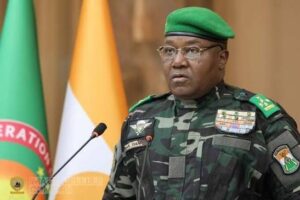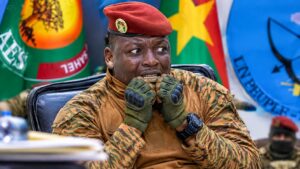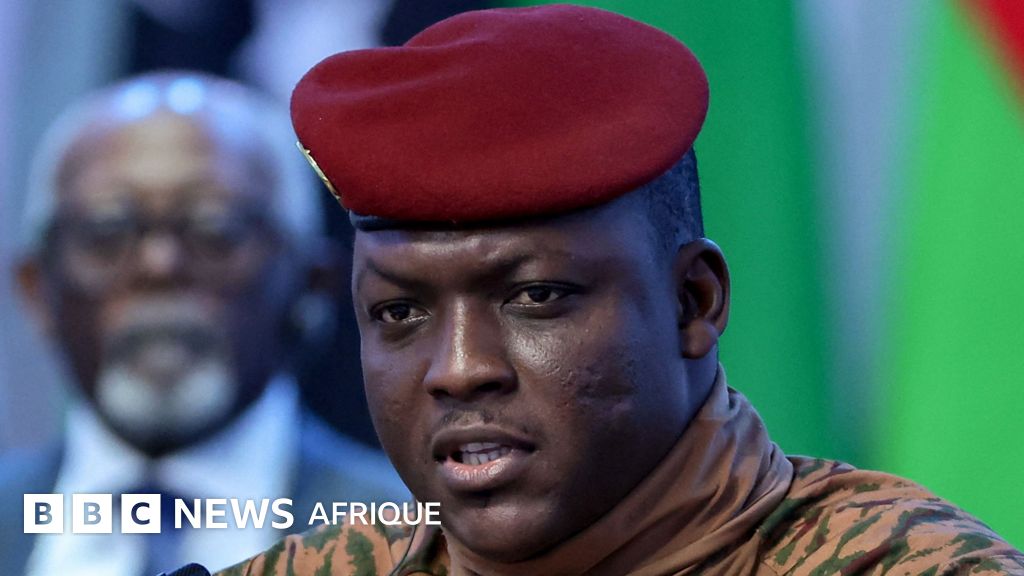
The head of Burkina Faso’s military government has declared that the nation must abandon democratic principles, calling the system ‘deadly’ for its people. Speaking during a prime-time interview on state television, Captain Ibrahim Traoré, who seized power in a 2022 coup, asserted that democracy is incompatible with the country’s needs.
Democracy ‘not for us,’ says Burkinabe leader
During the televised address, Traoré made sweeping statements about the failures of democracy in Africa, declaring that citizens should ‘forget about democracy entirely.’ He argued that Western-imposed democratic systems have repeatedly led to chaos and suffering across the continent, citing the example of Libya as a cautionary tale of foreign intervention gone wrong.
Libya’s prolonged civil conflict following the 2011 NATO intervention serves as a stark reminder of the instability that can follow regime change efforts, according to Traoré. The country remains divided between rival governments and armed factions, unable to hold elections despite years of international assistance.
Political parties banned in state restructuring plan
In a move that has drawn international criticism, the military government dissolved all political parties in January as part of a broader state reconstruction initiative. Traoré justified the decision by describing political parties as fundamentally divisive and incompatible with his revolutionary vision for Burkina Faso.
He went further to condemn traditional politicians as corrupt and self-serving, stating: ‘In Africa – at least in Burkina Faso’s experience – a real politician embodies every vice: liars, flatterers, and empty talkers.’
A new path forward for Burkina Faso
The military leader outlined his alternative vision, emphasizing sovereignty, patriotism, and revolutionary mobilization as the foundation for a new system. He stressed the need for economic and military self-reliance, arguing that shorter workdays would hinder national progress. ‘Six or eight-hour workdays won’t help us catch up to wealthier nations,’ he stated.
His administration has systematically suppressed dissent, targeting opposition figures, media outlets, and civil society organizations. Reports indicate critics have faced severe consequences, including deployment to frontline combat positions against Islamist militants.
Regional shifts in counter-terrorism cooperation
Since taking power, Traoré has aligned Burkina Faso with neighboring military governments in Mali and Niger, all of which have distanced themselves from Western partners in their fight against Islamist insurgencies. These countries have pivoted toward Russia for security assistance, though violence in the Sahel continues unabated.
Human rights organizations have documented over 1,800 civilian deaths in Burkina Faso since Traoré’s 2022 coup, with two-thirds attributed to state forces and allied militias. The remaining third are blamed on Islamist militants. The ongoing conflict shows no signs of abating despite the military government’s consolidation of power.