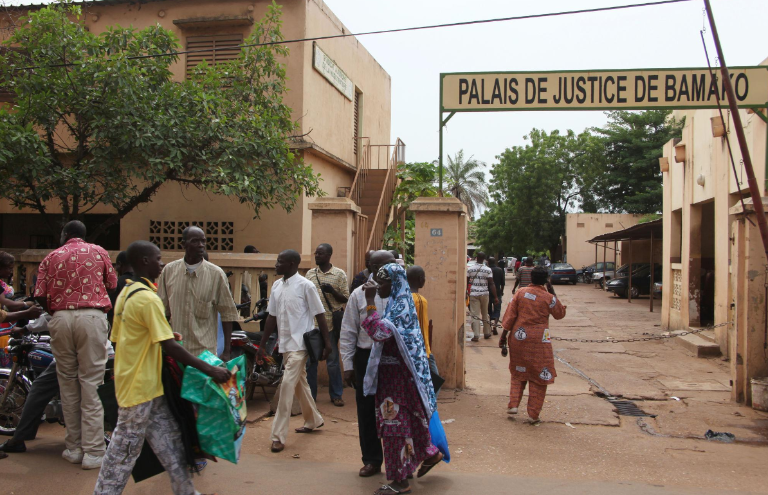
The real estate market in Bamako is in turmoil following the 10-year prison sentence handed down to former Bamako District Mayor Adama Sangaré. The ruling, delivered by Mali’s National Economic and Financial Crimes Court, has sparked widespread debate over land management practices in the capital and raised concerns about the broader economic consequences of the case.
Controversial land allocations spark legal battle
At the heart of the controversy are allegations that Adama Sangaré oversaw the irregular subdivision and distribution of plots in the Bamako-Sénou airport zone, which prosecutors claim belongs to the Malian state’s public domain. The prosecution accused him of forgery, embezzlement, misuse of public funds, and complicity in these acts. However, Sangaré’s legal team has vigorously contested these charges, framing the case as a dispute over administrative decisions rather than a criminal matter.
Defense argues case falls under administrative law
The former mayor’s lawyers have challenged the court’s jurisdiction, asserting that the land allocations and regularizations in question were made within the scope of his official duties. They contend that administrative irregularities do not automatically constitute criminal offenses. The defense also highlighted a prior ruling by the Supreme Court, which they claim supports the inadmissibility of the current prosecution.
The court ultimately rejected these arguments, allowing the trial to proceed and culminating in Sangaré’s conviction.
Former president’s alleged instructions complicate the case
Sangaré’s defense took an unexpected turn when he claimed to have acted on verbal instructions from former President Ibrahim Boubacar Keïta, who passed away in 2022. According to Sangaré, these operations were intended to facilitate the resettlement of internally displaced persons from northern Mali, a region deeply affected by conflict. He further argued that the disputed plots fell outside the airport’s official boundaries.
Prosecutors dismissed these claims, maintaining that the allocation and subdivision processes violated established legal procedures. The court sided with the prosecution, imposing severe financial penalties alongside the prison sentence.
Financial discrepancies fuel corruption allegations
The prosecution presented evidence of 49.39 million FCFA in disputed development fees and a 483.964 million FCFA financial loss attributed to the irregular land transactions. Sangaré denied allegations of embezzlement, asserting his authority to grant exemptions for certain beneficiaries. He also distanced himself from the management of demolition funds, attributing oversight to state agencies instead.
The court, however, ordered Sangaré to pay 483.964 million FCFA in demolition costs and 50 million FCFA in damages to the state. These financial obligations further strain the already fragile economic landscape of Bamako’s real estate sector.
Wider fallout: multiple convictions and unanswered questions
Adama Sangaré was not the only figure convicted in this case. Former deputy mayors Daha Keïta and Ibrahim Koïta received identical 10-year sentences. Former Bamako Commune VI mayor Souleymane Dagnon, tried in absentia, was handed a 20-year prison term, while Fatouma Samassékou and Bourama Komagara received 10-year sentences, five of which were suspended. Sékou Keïta was acquitted.
The prosecution had sought even harsher penalties, including 15 years for Sangaré, Keïta, and Koïta, and 20 years for Dagnon. The disparity in sentences underscores the complexity of the case and the challenges of distinguishing between administrative negligence and criminal intent.
Appeal looms as the legal saga continues
Sangaré’s legal team has vowed to appeal the verdict, ensuring that Bamako’s land scandal will remain a contentious issue in the coming months. The case has exposed deep-seated vulnerabilities in Mali’s land governance system, raising critical questions about transparency, accountability, and the rule of law in one of Africa’s fastest-growing urban centers.
The appeal process will provide another opportunity to examine the legal and procedural flaws that have marred this high-profile case. For now, the conviction serves as a stark reminder of the real-world impact of land mismanagement on Mali’s economy and its citizens.