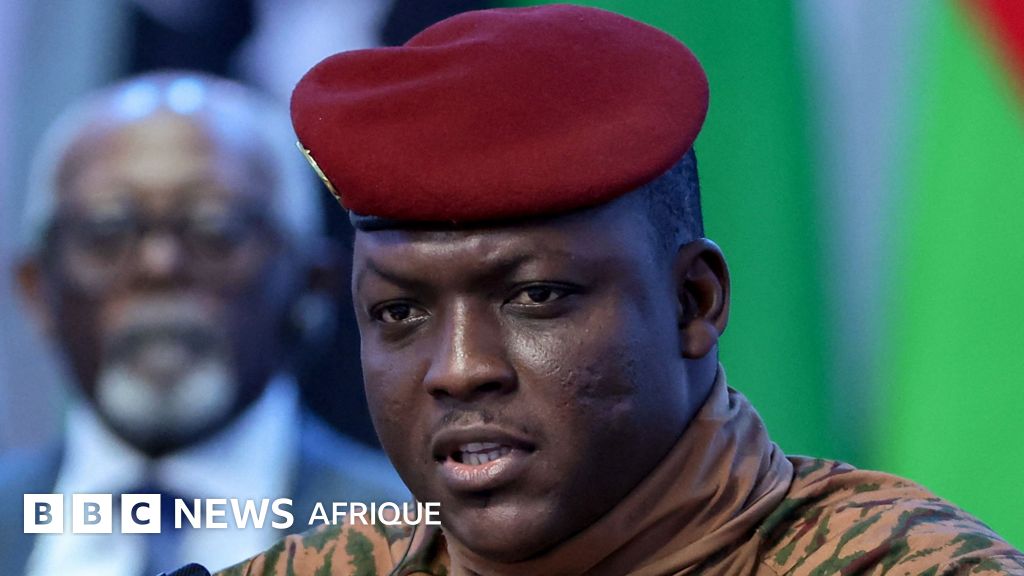
Burkina Faso’s military leader declares democracy ‘irrelevant’ for national progress
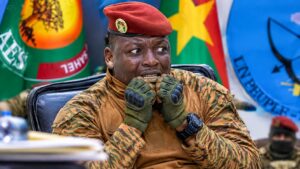
Photo: TASS via Reuters
- Temps de lecture: 5 min
In a televised interview broadcast on national television, Burkina Faso’s military leader Captain Ibrahim Traoré declared that the nation must ‘forget about democracy,’ asserting that the system ‘doesn’t suit us.’ The 38-year-old leader, who seized power in a 2022 coup, argued that Western-imposed democracy brings only chaos and bloodshed to Africa.
Traoré, who positions himself as a revolutionary fighting against Western imperialism, cited Libya as a cautionary example. He noted that despite decades of autocratic rule under Colonel Muammar Gaddafi—which provided free education and healthcare—the country descended into chaos after Western intervention toppled the regime. Today, Libya remains divided between rival administrations and armed factions, unable to hold elections.
Three years after taking control, Traoré has abandoned his initial promise to restore democratic governance by July 2024. Instead, his junta recently extended his rule by five years, citing the need to ‘rebuild the state.’ Earlier this year, authorities banned all political parties, transferring their assets to the government as part of this restructuring effort.
During the interview, Traoré stated, ‘People must forget about democracy. It’s not for us.’ He condemned what he called the destructive nature of political parties, labeling them as divisive and corrupt. ‘In Africa—and especially in Burkina Faso—a true politician is a liar, a flatterer, a smooth talker who embodies all vices,’ he said.
The military leader did not outline a specific alternative system but insisted Burkina Faso would forge its own path. ‘We have our own approach. We’re not copying anyone. We’re here to completely transform how things are done,’ he declared. His vision emphasizes sovereignty, patriotism, and revolutionary mobilization, with traditional leaders and grassroots structures playing key roles.
Traoré also stressed the need for economic and military self-reliance, arguing that Burkina Faso cannot develop with Western-style work hours. ‘Six or eight-hour workdays won’t help us catch up with wealthier nations,’ he stated. His government has cracked down on dissent, targeting opposition figures, media outlets, and civil society groups. Critics have accused his administration of sending opponents to dangerous frontline positions in the fight against Islamist militants.
Despite these controversies, Traoré has cultivated significant support across Africa for his anti-Western rhetoric and panafricanist stance. Like neighboring military-led governments in Mali and Niger, Burkina Faso has severed cooperation with Western nations—particularly France—in its battle against Islamist insurgencies that have plagued the region for a decade. Instead, the country has turned to Russia for military assistance, though violence continues unabated.
On Thursday, a report by Human Rights Watch revealed that over 1,800 civilians have been killed in Burkina Faso since Traoré’s 2023 takeover. The report attributes two-thirds of these deaths to the military and allied militias, with the remainder linked to Islamist militants. The ongoing violence underscores the challenges facing Traoré’s revolutionary vision as the nation grapples with security crises and political upheaval.