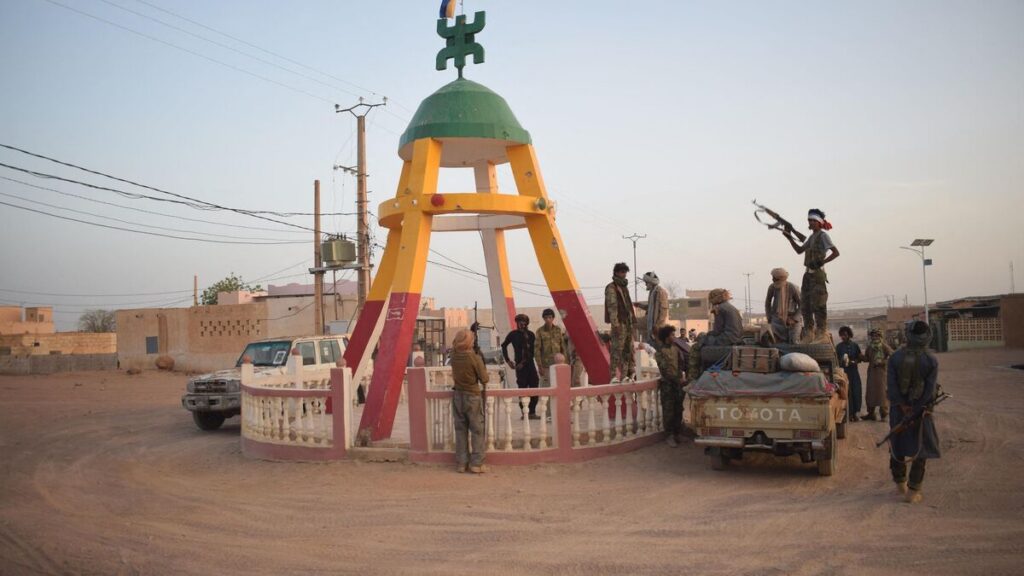
Tuareg rebels of the Azawad Liberation Front (FLA) coalition gather at the Kidal roundabout in Kidal, on April 26, 2026. April 25, 2026's shock attacks, synchronised by Tuareg rebels of the Azawad Liberation Front (FLA) coalition and the jihadist Group for the Support of Islam and Muslims (JNIM), targeted several areas in the vast arid country. Fighting resumed on April 26 in several areas, including Kita near Bamako, Kidal, Gao and Severe. Tuareg rebels meanwhile announced an agreement allowing Russian forces backing Mali's army to withdraw from the northern city of Kidal, which they claimed was "totally" under their control. (Photo by abdollah Ag Mohamed / AFP)
Russia’s Africa corps steps into Wagner’s shadow in Mali
A shadowy Russian paramilitary force, Africa Corps, has recently retreated from a key stronghold in Mali’s embattled north, but its influence across the Sahel remains unshaken.
A deadly weekend unfolded in Mali as jihadist factions and Tuareg rebels launched coordinated assaults on multiple junta-held positions, including Bamako—where Defense Minister Sadio Camara was killed.
In eastern Mali, rebels reclaimed Kidal, a pivotal junta stronghold long controlled by Africa Corps. After fierce clashes and prolonged negotiations, the Russian-backed paramilitary force withdrew—but its footprint across North Africa endures.
Mali withdrawal: all Africa Corps personnel gathered at the former camp’s entrance under FLA escort. With this convoy, Russian mercenaries leave the city and the base. pic.twitter.com/fGS1yA4E24
— Wassim Nasr (@SimNasr) April 26, 2026
Africa Corps, one of Russia’s most clandestine overseas military arms, was officially unveiled in late 2023. On November 20, military blogger *Deux Majors* announced its formation on Telegram, citing remarks by Igor Korotchenko, a Kremlin-aligned analyst and former colonel. The group reportedly falls under the leadership of Russian Deputy Defense Minister Yunus-bek Yevkurov.
Its emergence coincides with the decline of Wagner Group, the once-dominant Russian private military company founded in 2014 to advance Moscow’s strategic interests—particularly in Africa.
Wagner’s co-founders, oligarch Yevgeny Prigozhin and ex-intelligence officer Dmitri Utkin, died in a suspicious plane crash in August 2023, weeks after Prigozhin’s brief mutiny against the Kremlin.
stated goals and strategic shift
Africa Corps positions itself as a more disciplined, state-controlled successor to Wagner, absorbing personnel and operations across the continent. “Africa Corps is a rival to Wagner, designed to absorb its African assets and manpower,” noted a U.S. government source in 2023. Unlike its predecessor—often accused of war crimes—Africa Corps focuses on forging alliances with pro-Russian governments by supplying troops and military hardware.
The group’s name echoes the Nazi-era *Afrikakorps*, a deliberate nod to historical symbolism. Africa Corps operates in Burkina Faso, Libya, Sudan, Central African Republic, and Niger, expanding its influence beyond Mali.
military presence and regional stakes in Mali
Since 2024, Africa Corps has replaced Wagner in Mali, deploying hundreds—possibly thousands—of fighters. Several Wagner commanders and their units have reportedly defected to Africa Corps in the region.
The group’s primary mission: prop up Bamako’s junta against Tuareg rebels while advancing Moscow’s geopolitical goals—including securing mineral resources and migration routes after Western powers, including France, scaled back their involvement.