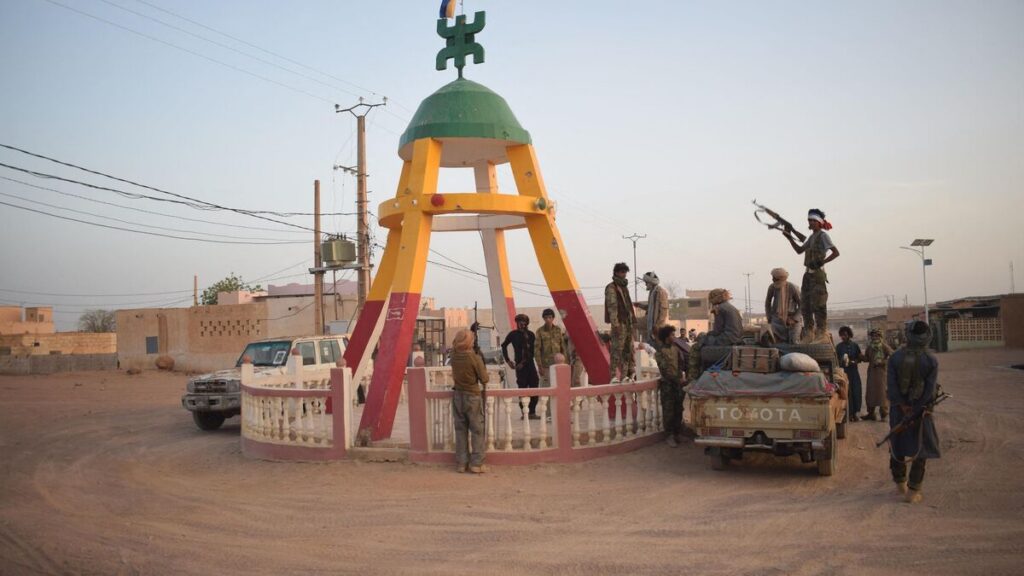
Tuareg rebels of the Azawad Liberation Front (FLA) coalition gather at the Kidal roundabout in Kidal, on April 26, 2026. April 25, 2026's shock attacks, synchronised by Tuareg rebels of the Azawad Liberation Front (FLA) coalition and the jihadist Group for the Support of Islam and Muslims (JNIM), targeted several areas in the vast arid country. Fighting resumed on April 26 in several areas, including Kita near Bamako, Kidal, Gao and Severe. Tuareg rebels meanwhile announced an agreement allowing Russian forces backing Mali's army to withdraw from the northern city of Kidal, which they claimed was "totally" under their control. (Photo by abdollah Ag Mohamed / AFP)
The strategic landscape in Bamako has shifted dramatically this weekend as rebel forces, allied with Touareg factions, launched a coordinated assault on multiple strongholds held by the Malian junta. Among the targets was the residence of Defense Minister Sadio Camara, who was killed in the attack, marking a pivotal moment in the country’s ongoing instability.
In the eastern region, the rebels reclaimed control of Kidal, a critical stronghold for the junta that had been under the firm grip of the Africa Corps for years. After intense clashes and prolonged negotiations, the Russian-backed paramilitary group withdrew its forces from the city, though its influence across the Sahel remains unshaken.
Africa Corps, often shrouded in secrecy, emerged in 2023 as a direct replacement for the disbanded Wagner Group. Its formation was first disclosed by military blogger Deux Majors on Telegram, citing statements from Igor Korotchenko, a former colonel and Kremlin-affiliated journalist. The group is reportedly overseen by Yunus-bek Yevkurov, Russia’s Deputy Defense Minister, signaling Moscow’s tighter control over its African operations.
Unlike Wagner, which operated with significant autonomy under the leadership of Evgueni Prigojine and Dmitri Outkine—both of whom perished in a mysterious plane crash in August 2023—Africa Corps is designed to be more centralized and disciplined. Its stated mission is to conduct large-scale military operations in Africa, helping regimes break free from neocolonial dependence, expel Western influence, and secure full sovereignty.
The naming of the group is no coincidence. It draws inspiration from Nazi Germany’s Afrikakorps, the elite unit that fought in North Africa during World War II, evoking a deliberate historical parallel. While Africa Corps presents itself as a more disciplined force, it has not escaped international scrutiny. In 2024, the United Kingdom sanctioned the group, accusing it of widespread human rights abuses and the exploitation of natural resources across the continent for profit.
Since its deployment in Mali in 2024, Africa Corps has become a cornerstone of Moscow’s strategy to maintain influence in the region. The group has deployed hundreds—possibly thousands—of fighters to support the Bamako junta against Touareg rebels. This effort aligns with Russia’s broader goals: countering Western withdrawal, securing migration routes, and gaining access to valuable mineral resources.
The shift from Wagner to Africa Corps reflects Moscow’s evolving approach to Africa. While Wagner was known for its brutal tactics and high-profile human rights violations, Africa Corps aims to project a more controlled, state-backed image. It has expanded its footprint beyond Mali, establishing a presence in Burkina Faso, Libya, Sudan, the Central African Republic, and Niger. However, its operations remain controversial, with reports of forced conscription and resource extraction raising concerns among local populations and international observers.
As Bamako grapples with escalating violence and political turmoil, the role of Africa Corps will be pivotal in shaping the future of the Sahel. Whether it succeeds in stabilizing the region—or exacerbates existing conflicts—remains one of the most pressing questions for Mali and its neighbors.