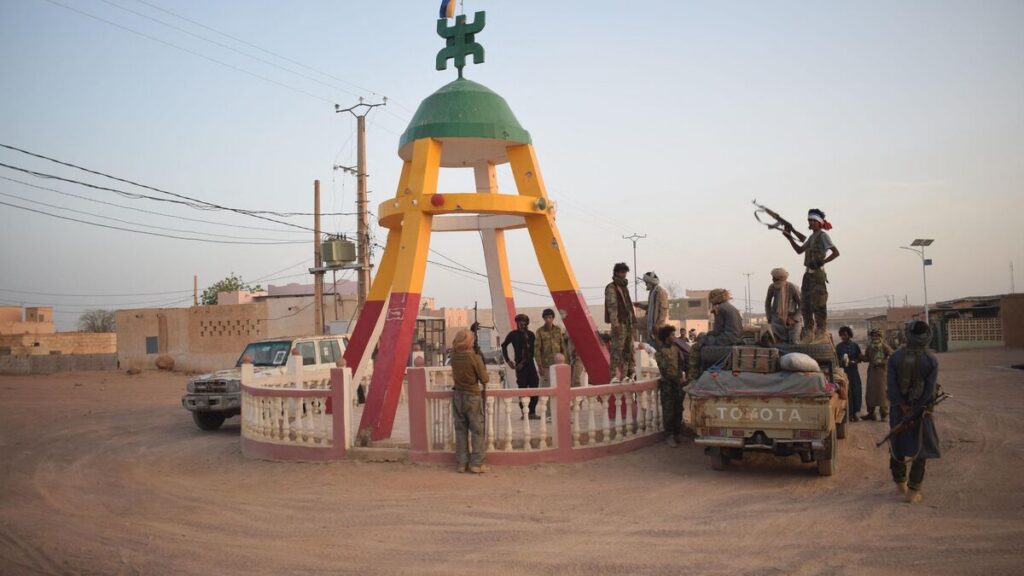
Tuareg rebels of the Azawad Liberation Front (FLA) coalition gather at the Kidal roundabout in Kidal, on April 26, 2026. April 25, 2026's shock attacks, synchronised by Tuareg rebels of the Azawad Liberation Front (FLA) coalition and the jihadist Group for the Support of Islam and Muslims (JNIM), targeted several areas in the vast arid country. Fighting resumed on April 26 in several areas, including Kita near Bamako, Kidal, Gao and Severe. Tuareg rebels meanwhile announced an agreement allowing Russian forces backing Mali's army to withdraw from the northern city of Kidal, which they claimed was "totally" under their control. (Photo by abdollah Ag Mohamed / AFP)
The strategic stronghold of Kidal, long held by Russian-backed paramilitary forces in eastern Mali, has fallen to a coalition of Tuareg rebels and jihadist groups following intense clashes this past weekend. The retreat marks a significant shift in the balance of power, as the Africa Corps—a covert Russian military unit—withdraws from the region after years of dominance.
Africa Corps, often described as one of the most shadowy military branches of the Kremlin, has been a key instrument for Russia in maintaining influence across Africa. Its emergence coincides with the decline of the Wagner Group, whose founders, Evgueni Prigojine and Dmitri Outkine, perished in a suspicious plane crash in August 2023.
Origins and structure of Africa Corps
Officially formed in late 2023, Africa Corps was first publicly referenced by military blogger Deux Majors on Telegram. The announcement was later echoed by Igor Korotchenko, a former colonel and Kremlin-aligned journalist, who stated that the group operates under the direct supervision of Russian Deputy Defense Minister Iounous-bek Evkourov.
The name Africa Corps is a deliberate homage to the Afrikakorps, a Nazi military formation that operated in North Africa during World War II. Unlike its predecessor, however, Africa Corps presents itself as a more disciplined and centralized force, avoiding the widespread accusations of human rights abuses that plagued Wagner.
Africa Corps’ stated goals
From its inception, Africa Corps has outlined its mission: to conduct large-scale military operations across Africa, helping allied governments break free from neo-colonial dependencies, expel Western influence, and secure full sovereignty. Igor Korotchenko emphasized that the group aims to provide military support and equipment to friendly regimes while avoiding the overt brutality associated with Wagner.
The organization has already expanded its footprint beyond Mali, establishing a presence in Libya, Sudan, the Central African Republic, the Niger, and the Burkina Faso. Its operations in these countries align with Russia‘s broader geopolitical strategy, which includes securing mineral resources and controlling migration routes.
The role of Africa Corps in Mali
Since 2024, Africa Corps has taken over Wagner‘s role in Mali, deploying hundreds—possibly thousands—of fighters to bolster the junta in Bamako. The group has absorbed former Wagner commanders and their troops, reinforcing its position as a critical ally to the Malian government.
However, its efforts to stabilize the region have faced setbacks, including the loss of Kidal and recent attacks targeting key government figures. The death of Defense Minister Sadio Camara during a coordinated assault on his residence in Bamako underscores the escalating instability.
International scrutiny and sanctions
Despite its more subdued approach, Africa Corps has not escaped international condemnation. In 2024, the United Kingdom imposed sanctions, accusing the group of systematic human rights violations and exploiting natural resources for financial gain. The sanctions highlight growing concerns over Russia‘s expanding military footprint in Africa.
Africa Corps vs. Wagner: key differences
- Africa Corps: More centralized, less visible, and directly controlled by the Kremlin.
- Wagner Group: Decentralized, accused of widespread atrocities, and linked to the late Evgueni Prigojine.
The shifting dynamics in Mali and the Sahel reflect a broader struggle for influence in Africa, where Russia continues to expand its military and political presence through proxies like Africa Corps.