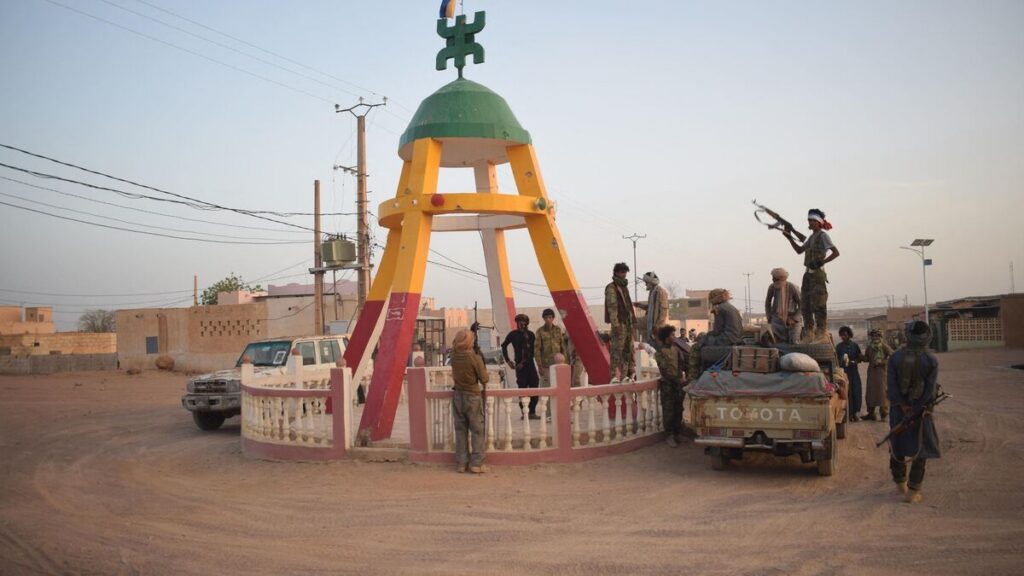
Tuareg rebels of the Azawad Liberation Front (FLA) coalition gather at the Kidal roundabout in Kidal, on April 26, 2026. April 25, 2026's shock attacks, synchronised by Tuareg rebels of the Azawad Liberation Front (FLA) coalition and the jihadist Group for the Support of Islam and Muslims (JNIM), targeted several areas in the vast arid country. Fighting resumed on April 26 in several areas, including Kita near Bamako, Kidal, Gao and Severe. Tuareg rebels meanwhile announced an agreement allowing Russian forces backing Mali's army to withdraw from the northern city of Kidal, which they claimed was "totally" under their control. (Photo by abdollah Ag Mohamed / AFP)
Russia’s africa corps expands influence in west africa amid Mali crisis
The shadowy Russian paramilitary force, Africa Corps, has been forced to retreat from a key Malian stronghold, yet remains a pivotal player in Moscow’s Sahel strategy.
Violent clashes rocked Mali over the weekend as jihadist forces allied with Tuareg rebels launched coordinated attacks on multiple strategic positions. In Bamako, the capital, the Malian defense minister was killed during an assault on his residence, while simultaneous operations targeted other major urban centers.
In eastern Mali, rebel factions reclaimed Kidal, a critical stronghold long held by the Africa Corps. After intense fighting and protracted negotiations, the Russian-backed paramilitary unit withdrew from the city, though its broader influence across the Sahel region remains intact.
Emerging in late 2023, Africa Corps was officially announced by military blogger Deux Majors on Telegram, with Kremlin-aligned commentator Igor Korotchenko citing its creation. The group operates under the oversight of Russian Deputy Defense Minister Yunus-bek Yevkurov, marking a more centralized and state-controlled approach compared to its predecessor, Wagner Group.
The transition from Wagner to Africa Corps coincides with the decline of the once-dominant paramilitary force. Founded in 2014, Wagner operated semi-autonomously to advance Russian interests abroad, particularly in Africa, until the deaths of its founders, oligarch Yevgeny Prigozhin and former intelligence officer Dmitry Utkin, in a 2023 plane crash amid Prigozhin’s brief rebellion against Moscow.
stated objectives of africa corps
Africa Corps has publicly declared its mission to conduct large-scale military operations across the continent, aiming to help nations break free from neocolonial dependencies, eliminate Western influence, and achieve full sovereignty. According to Korotchenko, the group seeks to counter foreign military presence while securing access to vital resources.
Unlike Wagner, which faced widespread accusations of war crimes and brutal repression, Africa Corps presents itself as a more disciplined and state-centric force. Its strategy focuses on strengthening ties with allied governments by providing military personnel and equipment. The group has expanded its footprint across West and North Africa, including Burkina Faso, Libya, Sudan, the Central African Republic, and Niger, following earlier deployments in Mali.
Russia’s strategic pivot in Mali
By 2024, Africa Corps had replaced Wagner in Mali, deploying hundreds—or potentially thousands—of fighters. Many former Wagner commanders and their troops integrated into the new force, reinforcing its operational capacity. The group has played a key role in propping up Mali’s junta in Bamako against Tuareg rebels, extending Russia’s regional influence in the wake of Western military withdrawals, including France’s Operation Barkhane.
Moscow’s objectives in Mali go beyond counterterrorism. The Kremlin seeks to control critical migration routes and secure access to valuable mineral resources, while challenging Western geopolitical dominance in the Sahel. Though Africa Corps is perceived as less overtly violent than Wagner, it has not escaped international scrutiny. In 2024, the United Kingdom sanctioned the group for alleged widespread human rights abuses and the exploitation of natural resources across the continent.