Senegal’s President Bassirou Diomaye Faye has marked a pivotal moment in his political journey by launching his own party, KIIRAAY – Les Patriotes Républicains, in Dakar on Saturday, July 25. The formal announcement, delivered during a founding general assembly at a capital city hotel, signals the President’s political emancipation from the PASTEF, the party that propelled him to victory in the March 2024 elections. The new party adopts the slogan « La Patrie d’abord », emphasizing national sovereignty and institutional strength from the outset.
Breaking ties with Ousmane Sonko
The establishment of KIIRAAY follows months of public disagreements between President Faye and his former mentor, Ousmane Sonko, who remains at the helm of PASTEF and serves as Prime Minister. Once seen as the dynamic duo driving Senegal’s political upheaval, their paths have diverged, culminating in this organizational split. For the President, a dedicated party structure eliminates political dependencies and aligns governance with his presidential agenda.
The name KIIRAAY carries deep symbolism. In Wolof, it translates to protection, a stark contrast to PASTEF’s confrontational rhetoric. While the former party championed sovereignty through opposition, the new formation prioritizes patriotism, republicanism, and institutional stability. This shift reflects Faye’s pivot toward a more institutional center of gravity as he consolidates power.
Patriotic and republican priorities
KIIRAAY’s roadmap centers on national interest, strengthening republican institutions, and upholding the rule of law. These priorities, outlined during the founding assembly, signal a departure from protest politics toward statecraft. The name Les Patriotes Républicains bridges two ideals: unwavering sovereignty—a hallmark of the Faye-Sonko alliance since the 2022 legislative elections—and adherence to republican norms, a message aimed at administrative, economic, and diplomatic elites.
This positioning holds significant implications for Senegal’s international partners. Since assuming office, President Faye has signaled openness to donors and investors while renegotiating key hydrocarbon and mining contracts. A party explicitly committed to institutional stability aims to reassure global markets of policy predictability, particularly as Dakar seeks to maintain access to financial markets and its relationship with the International Monetary Fund.
Reshaping Senegal’s political landscape
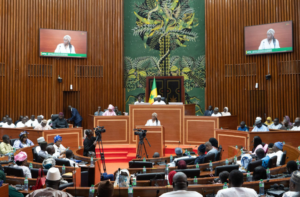
The emergence of KIIRAAY fundamentally alters the balance of power. PASTEF, now without presidential backing, retains a strong grassroots base but loses its most powerful symbolic asset—the presidency. Traditional opposition parties, from the Democratic Party of Senegal to factions of the former Benno Bokk Yaakaar coalition, must recalibrate their strategies in response to a presidential majority now equipped with its own partisan backbone. The migration of PASTEF lawmakers elected in November 2024 to the new party remains an open question.
The political calendar amplifies the stakes. Upcoming local elections and preparations for the 2029 presidential race will serve as critical tests for KIIRAAY. The party must quickly demonstrate its ability to build a territorial network, articulate a distinct policy agenda, and mobilize beyond the 2024 campaign’s core supporters. The battle will also hinge on controlling partisan resources, administrative networks, and regional economic ties.
For President Faye, this transition shifts the political equation from personal loyalty to the institutional construction of a presidential force. The move heralds a new phase in Senegal’s political evolution.