Signature: bYU9CuXMOMngPgmD6Q6vvKC/AMqfYm8InPRlBoYu3BbKkFJCbbzQFGHNU2u5WbR9kbW+lHFrWnRBzxbtxIsxfHTHlw4Lo4+sqf07CP0lw+FbYFXy67lKppEzQNi9ydsKLv2kL276J5hOLW3kH10CwVKlEWpzXjqh1/yH6wqGQ3WoF/S5QZJT3BBkpQWBtARZjbBqDz5SyS0dhWdP2+uo1UFY9ttamb4bgbCQJp4ZTIkDXIRepa/1nkmnPTjYI9IVW+AFMs/lDvqgK9b9aSTKwK3yDZTSHwH1tbBv5yGnmKLbiuEc/jzw7lLKm/vM4LZ8QVKdwV+VLYfjNv98+VUP0a80r09cuKXoyWmqlW35RgWUP3Evc7wLQmbmAK1cL3rPP50p7Nx9cYd3J+Q2CybMP2Cla8pNLC5nSde99C87+S8CHZt531D17q+g3BTb/bSKYxywmReS/AzIFuu3slAywbfWt4HYJBgZgN55HSx+enBkIhx8Kb42/9eWwhkSZmWIUKqfN40eCD1RwXv4xNril/DPrEXIM2OpgP6Sb9QNz4OYHEQyijoy/yuAvhtdjKLZpxf9gBCc7cyIdoQ7d0M8U7EfJF8uwcVt2h0e4cTq8dJuh9X4k1wwPJxtCi3sOMPHd//JEo/73e//rKHm8poYNLBd0EoiWsbIwM4CyaADIm3iXORxK/DUhFR2+p7hsK2U7M0hl3v3Kut++T/S9lpPYsIKgd+IwrrHSfPNEIBAZfq6Wjo+rRRYDVfuvrL4yXKoTjDfLtV+H756A/69KmZLDjwH9NF0PVNksc2GSiO6vFAg8530XS+2nUFdqNogFFMQDNx4O8g2TAs/2Lk+cGGFX46+fTV9MHt0OkL972Hh2Y9eZaVzcsTYZu1b+hkAZrf9PvAN5HyTEFNPJpgG/3SvmHPD3wqG8SG0GfQmgT86uzqDhVaq0dYFaxpb+8KHgjKFOQe0sE5oxww1bJZ8Dw8EzT9sKtB8w9FcVQdufNTH5HY=
Niger is witnessing a sharp deterioration in security conditions, with the Dosso region’s Loga department now facing severe repercussions. Hundreds of families have been forced to abandon their homes after a series of devastating attacks occurred in mid-July. Despite government pledges to enhance protection, communities remain vulnerable to incursions by militant groups, leaving civilians to suffer the consequences of unabated violence.
A wave of brutal attacks triggers mass exodus
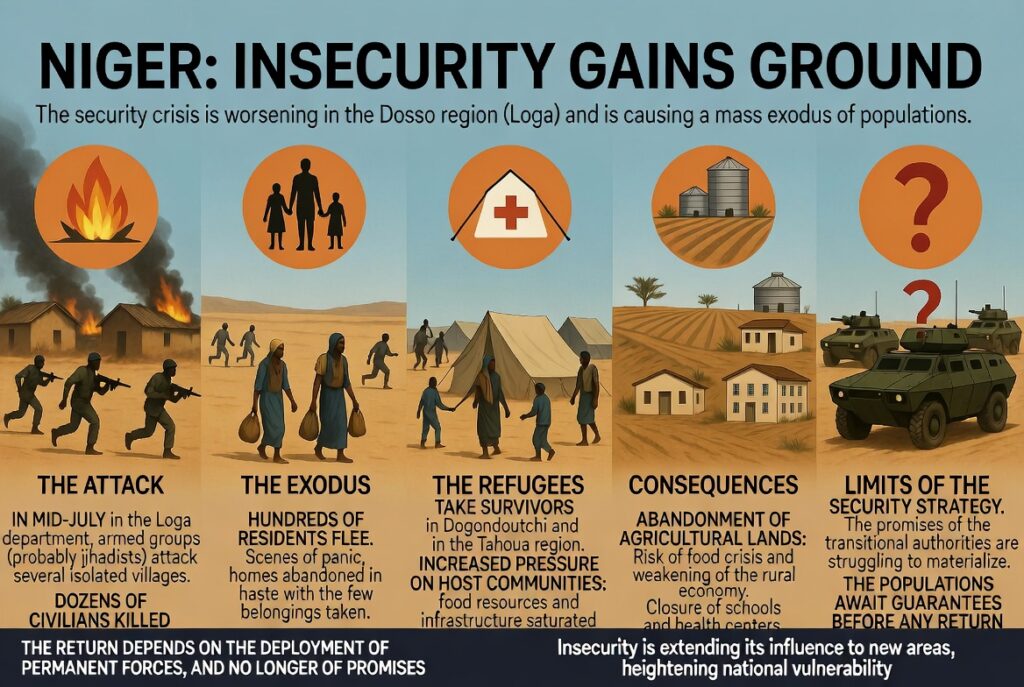
The recent violence, linked to extremist factions operating in the area, resulted in the deaths of dozens of civilians. Attackers targeted isolated villages, taking advantage of gaps in security measures to instill widespread fear. Survivors recounted harrowing scenes of panicked residents fleeing with only essential belongings, leaving behind homes and livelihoods in haste.
Many displaced individuals sought shelter in Dogondoutchi and other areas within the Tahoua region, hoping to escape the immediate threat. However, their arrival has strained host communities, which already face severe economic challenges, inadequate public services, and growing food shortages.
Security strategy under scrutiny amid ongoing violence
The surge in displacement highlights critical flaws in the transitional government’s approach to national security. Since the military took control, restoring stability has been declared a top priority. Yet, attacks persist across border regions and parts of the interior, casting doubt on the effectiveness of military initiatives and troop redeployments.
The displacement crisis also signals a deepening erosion of public trust in the state’s ability to protect its citizens. For many families, returning home is no longer just about ending hostilities but about concrete assurances that similar attacks won’t recur. Promises alone, they argue, are insufficient to justify a return to normality.
Economic and social fallout exacerbates humanitarian strain
The abandonment of agricultural lands due to insecurity threatens to disrupt upcoming harvests, worsening food insecurity and destabilizing rural economies already weakened by years of conflict. Critical infrastructure, including schools and healthcare facilities, is increasingly compromised, leaving communities more vulnerable than ever.
Humanitarian needs are escalating rapidly. Displaced populations urgently require food, clean water, medical assistance, and safe shelter. Aid organizations warn that existing resources are insufficient to meet the growing demands of those fleeing violence across Niger.
A widening security threat
The situation in Loga underscores a troubling trend: the conflict is no longer restricted to traditionally volatile zones. The expansion of attacks into new areas raises concerns about the militant groups’ growing capabilities and the ability of Niger’s security forces to counter their advances.
For the displaced residents of Loga, the path to recovery hinges on one unmet demand: the restoration of security. Without meaningful progress on this front, the cycle of displacement is likely to continue, deepening the humanitarian, economic, and social toll on a nation already struggling to stabilize.