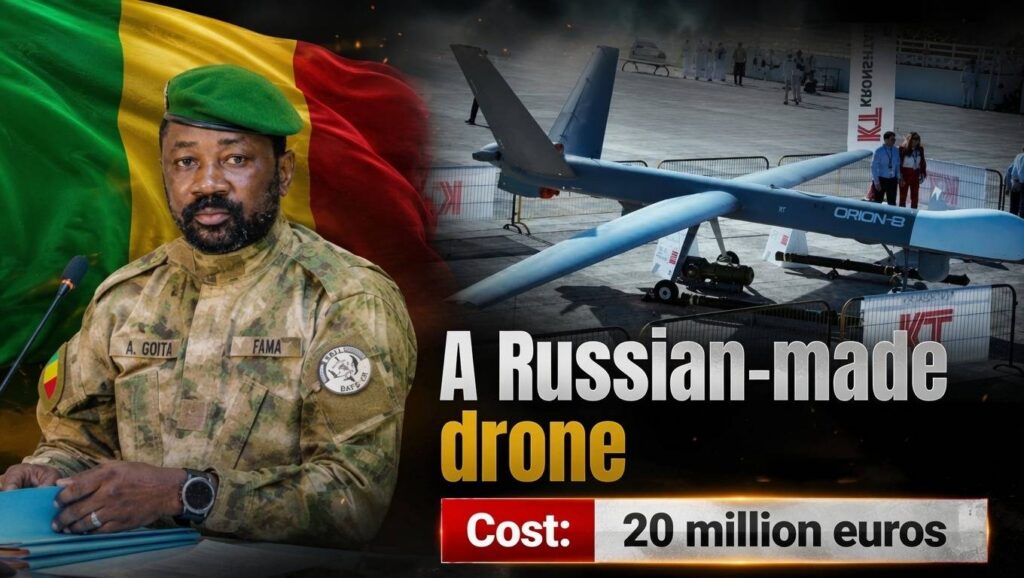
In a significant expansion of its aerial capabilities, the transition government in Bamako has taken delivery of the Orion, a Russian-made reconnaissance and strike drone. While officials celebrate this as a milestone in reclaiming national sovereignty, the arrival of this single, high-cost aircraft is raising serious concerns among defense analysts. The debate centers on whether such a sophisticated machine is truly suited for the realities of asymmetric combat or if it represents a massive financial drain.
The deepening military alliance between Bamako and Moscow
The Malian Armed Forces (FAMa) have officially integrated the Orion drone into their fleet, marking a new chapter in the country’s defense strategy. This Medium Altitude Long Endurance (MALE) system is designed for both extended surveillance and high-precision strikes, augmenting the arsenal provided by Russian partners in recent years.
For supporters of the current administration, this delivery serves as a testament to the growing power of the Malian military and its pivot away from traditional Western security frameworks. The Orion is marketed as a solution for monitoring Mali’s vast desert landscapes. However, beneath the official enthusiasm, the technical specifications of the drone suggest a more complicated reality on the ground.
Acoustic limitations in an invisible conflict
The primary challenge for this new asset is the nature of the Malian conflict itself. The FAMa are not fighting a conventional army but rather mobile, decentralized terrorist groups that excel at blending into their environment. In this context of asymmetric warfare, the Orion drone has a significant disadvantage: its loud acoustic signature.
The engine noise of the Orion is substantial, making it audible long before it reaches its target area. For insurgents accustomed to using the terrain for cover, this sound acts as an early warning, providing ample time to hide or scatter. Furthermore, the belief that such a drone can operate with total impunity is a dangerous assumption. Armed groups in northern and central Mali have demonstrated their ability to deploy anti-aircraft systems capable of hitting targets at medium altitudes. A large, loud aircraft like the Orion becomes a high-value target for man-portable air-defense systems (MANPADS).
The 20 million euro question: strategic investment or waste?
The financial scale of this acquisition has sparked intense debate. A single Orion unit costs approximately 20 million euros, or over 13 billion CFA francs. Given Mali’s current economic climate, characterized by tight budgets and urgent social needs, the wisdom of such an expenditure is being questioned.
Many analysts argue that spending such a vast sum on a single drone is a poor allocation of public funds. For the same price, Mali could have procured a large fleet of smaller, stealthier tactical drones that are easier to deploy across multiple fronts. By choosing a high-profile “prestige” system, Bamako appears to have prioritized political optics over tactical utility.
The challenge of covering a vast territory with a single unit
Mali is an immense country where many regions remain under the influence of extremist groups. From the remote reaches of Taoudénit to the forests of Kayes, the security threat is widespread. This geographical reality highlights the mathematical flaw in this purchase: one drone cannot be everywhere at once.
Despite its endurance, the Orion lacks the gift of ubiquity. If the drone is patrolling Gao, then Timbuktu or Mopti remains unmonitored. A single machine does not allow for a continuous aerial presence. The moment the aircraft lands for refueling or maintenance, the sky is clear once again, giving enemy forces total freedom of movement.
Hidden burdens: the high price of maintenance and infrastructure
The initial purchase price is only the beginning of the financial commitment. Operating a drone of this class requires extensive logistics and ongoing expenses. Sophisticated ground control stations must be established, along with climate-controlled hangars to protect sensitive electronics from the extreme Saharan heat. Specialized runways are also a necessity.
Beyond infrastructure, there are the recurring costs of specialized fuel, guided munitions, and spare parts that must be sourced exclusively from Russia. Perhaps most significantly, the technical expertise required to maintain the system is not yet fully available locally. This means Mali must pay a premium for Russian instructors and contractors to keep the drone operational. Without a constant flow of funding for these hidden costs, this 20 million euro investment risks becoming an expensive piece of grounded technology.
While the arrival of the Orion drone shows a clear intent to modernize the FAMa, it also highlights the risks of a defense strategy focused on prestige assets. In a conflict defined by agility and surprise, a single, expensive, and loud drone may be the wrong tool for the job. Long-term security in Mali may depend less on expensive symbols and more on a diverse array of flexible, sustainable military solutions.