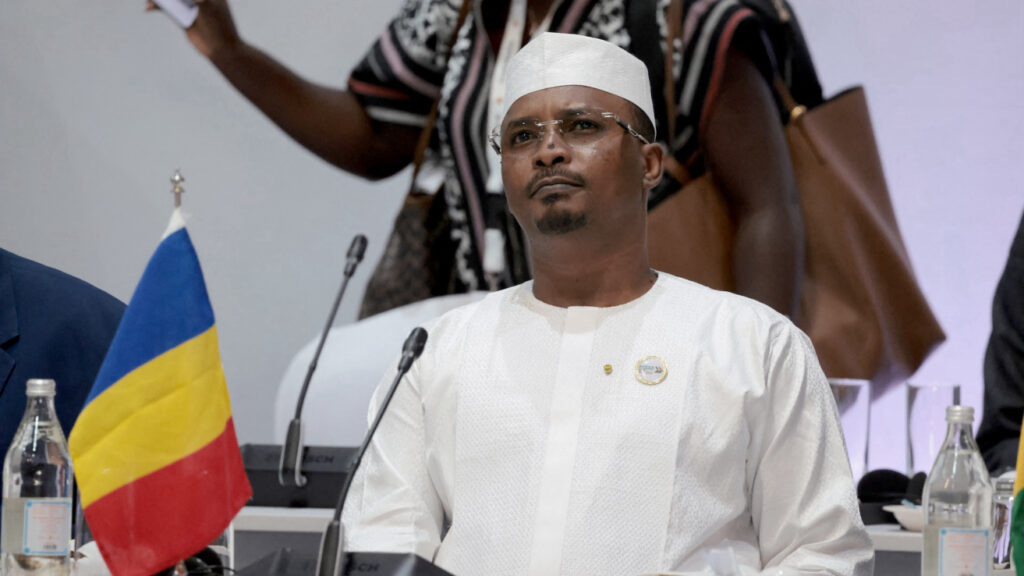
Chad's President Mahamat Idriss Deby attends the working lunch on reform of the international financial architecture at the Africa Forward summit in Nairobi on May 12, 2026. (Photo by Ludovic MARIN / AFP)
Tchad’s opposition leaders sentenced to eight years in prison as political space shrinks
Eight opposition figures, including members of the Groupe de concertation des acteurs politiques (GCAP), were handed eight-year prison sentences this month for allegedly plotting an anti-government protest scheduled for May 2. Their arrest and subsequent trial mark another step in N’Djamena’s tightening grip on dissent, following the dissolution of their coalition by the Supreme Court just days before the verdict.
The crackdown extends to Succès Masra, leader of the Transformateurs party, who was sentenced to 20 years in August 2025 for “inciting hatred.” With the opposition effectively silenced, the ruling Mouvement patriotique du salut (MPS)—led by President Mahamat Idriss Déby—faces no credible challenge, raising fears of a return to the authoritarian past.
Judicial repression replaces political opposition
Since assuming power in 2021, the transitional government has systematically banned public protests, with deadly consequences. In October 2022, at least 200 demonstrators were killed when security forces opened fire on crowds. The GCAP trial, described by legal teams as a sham proceeding, relied on charges of “criminal association” and “illegal arms possession,” accusations critics dismiss as fabricated to justify repression.
Lawyers for the detained leaders argue their clients were held without formal charges and denied due process. The swift sentencing underscores the judiciary’s role as a tool of political control, silencing dissent under the guise of national security.
From protest bans to lethal force: a pattern of escalation
The repression has extended beyond legal persecution. In late April, armed assailants attacked a Transformateurs gathering marking the party’s eighth anniversary, killing one, injuring two severely, and abducting the treasurer, who was later tortured. While authorities pledged investigations, such violence has become routine, signaling a normalization of state-sanctioned brutality.
Analysts warn that the disproportionate use of force risks radicalizing youth, particularly in a country with a history of violent coups and political instability. Since independence in 1960, Chad has endured repeated cycles of rebellion, coups, and authoritarian rule under leaders like François Tombalbaye (1960–1975) and Hissène Habré (1982–1990), both ousted in violent overthrows.
A constitutional shift toward permanent power
The current government has further tightened its control by amending the Constitution in October 2025 to extend presidential terms to seven years. This move, enacted despite a national dialogue designed to restore constitutional order, mirrors past manipulations under Déby Itno (1990–2021), who repeatedly revised term limits to retain power.
With opposition voices silenced and protests banned for over six years, Chad risks reverting to a one-party system where dissent is criminalized and dissenters imprisoned. Civic leaders and international observers stress the urgent need for dialogue to prevent further erosion of democratic norms and human rights.
What’s next for Chad’s democracy?
For the transition to succeed, the government must reverse course: restore freedoms of assembly and expression, ensure judicial independence, and revise security doctrines to prioritize proportional force. Regional bodies like the African Union and the Economic Community of Central African States (ECCAS)—which backed Chad’s constitutional return—must press for reforms rather than tacitly accepting authoritarian drift.
The path forward demands accountability, not just condemnation. Without credible opposition or legal safeguards, Chad’s democratic experiment hangs by a thread, threatening to plunge the nation back into the cycles of instability that have defined its post-colonial history.