Peru’s elected president Fujimori backs Morocco’s Sahara autonomy plan
- Keiko Fujimori, Peru’s incoming president, reaffirms support to Morocco’s territorial integrity
- This stance marks a clear shift from decades of ambiguous Peruvian policy toward the Polisario Front
- Sahara autonomy plan backing
- End to diplomatic ambiguity
- Historical flip-flops on Western Sahara
- Morocco strengthens its diplomatic push
In the early weeks of her administration, Peru’s elected president Keiko Fujimori has begun outlining key foreign policy priorities, with one major focus being her stance on Morocco’s territorial integrity and the Sahara issue.
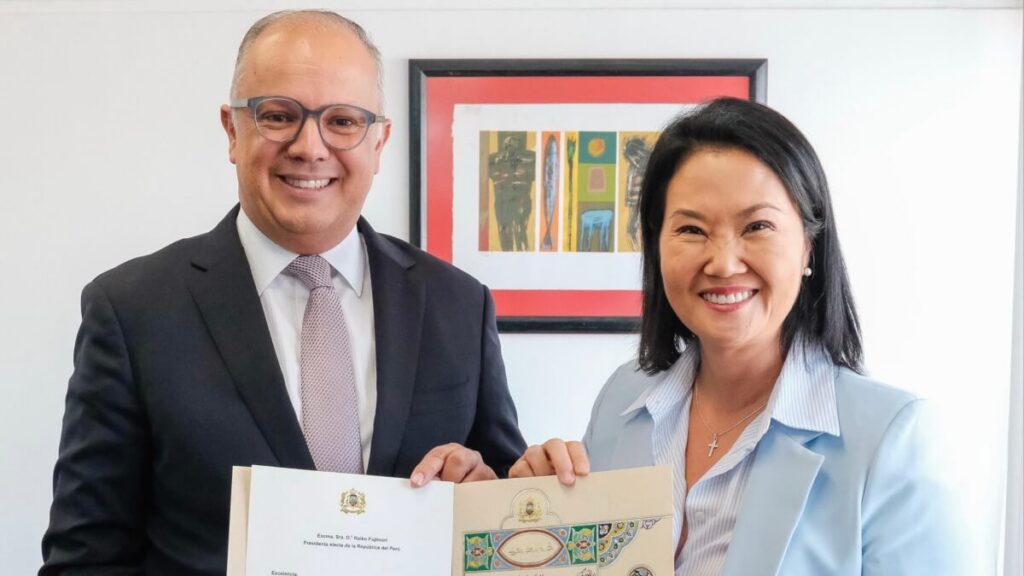
This stance became clear following a meeting with Morocco’s ambassador to Peru, Amine Chaoudri, who delivered a congratulatory letter from King Mohammed VI to the incoming president.
Sahara autonomy plan backing
According to a statement from Fujimori’s transition team, during her meeting with the Moroccan envoy, the president-elect confirmed that Peru would support Morocco’s territorial integrity and its autonomy plan for Western Sahara.
She also expressed full backing for UN Security Council Resolution 2797, which recognizes Morocco’s autonomy initiative as a viable path toward resolving the longstanding regional dispute.
During the meeting, Ambassador Chaoudri presented Fujimori with a letter from King Mohammed VI, in which the Moroccan monarch congratulated her on her election victory, noting, « On the occasion of your election as President of the Republic of Peru, I am pleased to convey my warmest congratulations for the trust you have earned from the Peruvian people in your commitment to fostering development and prosperity. »
The King also highlighted the « excellent relations » between Morocco and Peru, built on « strong friendship, mutual respect, and shared values, » and pledged to work toward « a new phase of multilateral partnership » for the benefit of both nations.
End to diplomatic ambiguity
Fujimori’s position carries significant weight, analysts say, as it signals a definitive break from previous Peruvian governments that maintained an ambiguous stance—often leaning toward recognition of the Polisario Front.
The shift is particularly notable given Peru’s historical involvement with the disputed territory. In 1984, under President Fernando Belaúnde Terry, Peru became one of the first South American nations to recognize the self-proclaimed Sahrawi Arab Democratic Republic (SADR). Diplomatic relations were established in 1987 and continued until 1996, when then-President Alberto Fujimori—Keiko Fujimori’s father—suspended them.
For the next 25 years, successive Peruvian administrations maintained this stance, with leaders including Valentín Paniagua, Alejandro Toledo, Alan García, Ollanta Humala, Pedro Pablo Kuczynski, Martín Vizcarra, Manuel Merino, and Francisco Sagasti refraining from altering the country’s position on the issue.
Historical flip-flops on Western Sahara
The brief administration of Pedro Castillo (July 2021–December 2022) marked a brief departure from this policy. In September 2021, Castillo re-established diplomatic ties with the Polisario Front, a move later overturned by then-Foreign Minister Miguel Ángel Rodríguez Mackat in August 2022. Rodriguez Mackat announced the suspension of recognition and the severing of relations with the separatist group, reaffirming respect for Morocco’s territorial integrity.
However, Castillo reversed course once more, reinstating relations with the Polisario just months before his impeachment following an attempted power grab. His successor, Dina Boluarte, maintained the status quo for several months before suspending ties with the Polisario in September 2023—without revoking the 1984 recognition or endorsing Morocco’s autonomy plan, leaving Peru’s position in a state of continued ambiguity.
Subsequent leaders, José Jeri and José María Balcázar, had such short tenures that they did not address the issue. Fujimori’s election, analysts note, signals a return to the position her father took in 1996—and goes further by fully backing Morocco’s territorial sovereignty, the autonomy initiative, and UN Resolution 2797.
Morocco strengthens its diplomatic push
Peru’s policy shift coincides with Morocco’s intensified diplomatic efforts across Latin America, where the Polisario Front had historically enjoyed strong support.
Through expanded economic, cultural, and academic cooperation, Morocco has forged closer ties with several nations in the region, positioning itself as a strategic gateway to Africa, Europe, and the Arab world. As a result, numerous countries that once recognized the SADR have since suspended recognition or severed diplomatic ties, including Colombia, Guatemala, Paraguay, the Dominican Republic, Haiti, Jamaica, El Salvador, Guyana, Ecuador, and Panama.