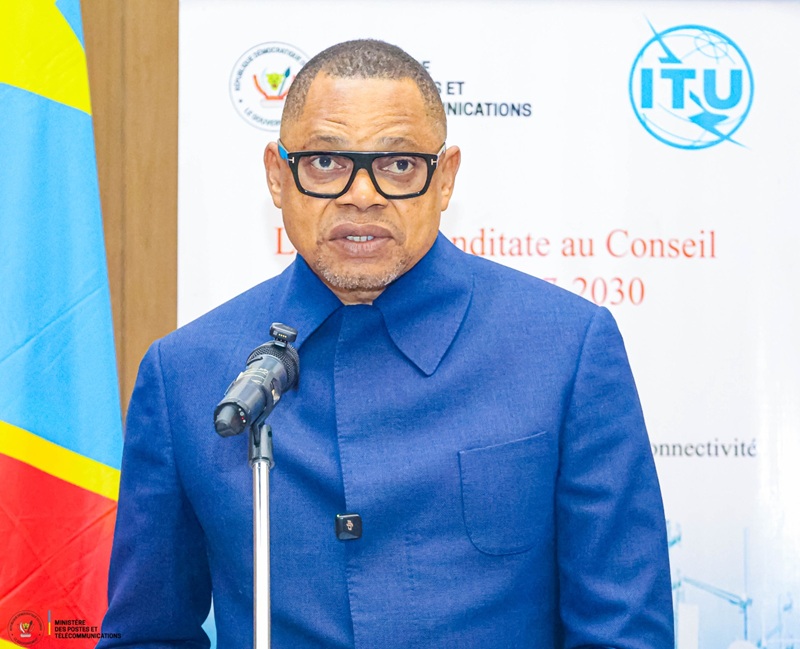
In a bold move to position the Democratic Republic of the Congo (DRC) as a key player in global telecommunications governance, Minister of Posts and Telecommunications Me José Mpanda Kabangu has launched an intensive diplomatic outreach campaign. The initiative, held at the Hilton Hotel in Kinshasa, brought together ambassadors, heads of diplomatic missions accredited in the DRC, and representatives of international telecom organizations.
The event marked the official announcement of the DRC’s candidacy for a seat on the Council of the International Telecommunication Union (ITU) during the upcoming Plenipotentiary Conference in Doha, Qatar, scheduled for November 2026. The mandate sought would cover the 2027–2030 period.
Speaking to the assembled diplomats, Me Mpanda emphasized the strategic importance of the DRC’s bid, framed as both a call for international solidarity and a commitment to openness in the digital age. He highlighted the country’s central location in Africa and its vast potential in telecommunications and digital transformation.
“Our candidacy to the ITU Council is rooted in our ambition to align the DRC with global standards in connectivity. It reflects our resolve to contribute meaningfully to shaping international telecom policies while amplifying the voice of Africa and developing nations on critical global telecommunications governance issues,” he told the diplomats, urging them to lobby on behalf of the DRC in their respective capitals.
Me Mpanda further stressed the country’s unique credentials: “With 13 African seats available on the ITU Council, the DRC—home to the African Telecommunications Union (ATU)—seeks to leverage its experience and commitment to support fellow African member states in developing telecom infrastructure. This includes improving connectivity, ensuring digital inclusion, strengthening human and technical capacity, and leveraging our vast energy resources essential for telecom and ICT services. It is only logical that the country hosting the ATU should have a voice in shaping the future of this vital sector.”
The minister made no secret of the DRC’s goal: to secure diplomatic backing from the attending representatives, whose support would be crucial in lobbying their governments, foreign ministries, telecom regulators, and relevant national agencies ahead of the vote.
Christian Katende, President of the Regulatory Authority for Posts and Telecommunications of the Congo (ARPTC), underscored the DRC’s growing significance in Africa’s digital ecosystem. With over 110 million people and nearly 74 million mobile subscriptions, the country is one of the continent’s largest digital markets.
“Our vision is clear: to transform the DRC into a digital hub for Central Africa and a major player in the continent’s digital economy. But our ambitions extend beyond our borders. We aim to empower Africa as a whole—strengthening its competitiveness, accelerating digital integration, and ensuring our continent speaks with one strong voice in global forums,” he stated.
Katende outlined four core commitments underpinning the DRC’s candidacy:
- Strengthening Africa’s voice within the ITU;
- Promoting investment in networks, satellites, data centers, and public digital infrastructure;
- Championing a digital governance model that balances innovation, security, digital sovereignty, and citizen protection;
- Enhancing the capacity of African regulators and governments through knowledge sharing, research, and innovation.
He concluded with a rallying cry: “Together, let’s make the next decade one in which Africa is not just a participant in global digital governance, but a leader shaping its future.”
Noëlla Ayeganagato, Deputy Minister of Foreign Affairs, reaffirmed the government’s full backing for the candidacy. Addressing the diplomats, she framed the ITU as a strategic partner in achieving the Sustainable Development Goals and called on friendly nations to actively support the DRC’s bid.
“The ITU plays a pivotal role in helping states achieve their development objectives. We extend our deepest gratitude to potential voting members and traditional allies. Let our message be clear, our commitments firm, and our diplomatic efforts—both bilateral and multilateral—fully mobilized to ensure this ambition becomes reality,” she said.
The formalization of the DRC’s candidacy is scheduled for November 2026 in Doha.