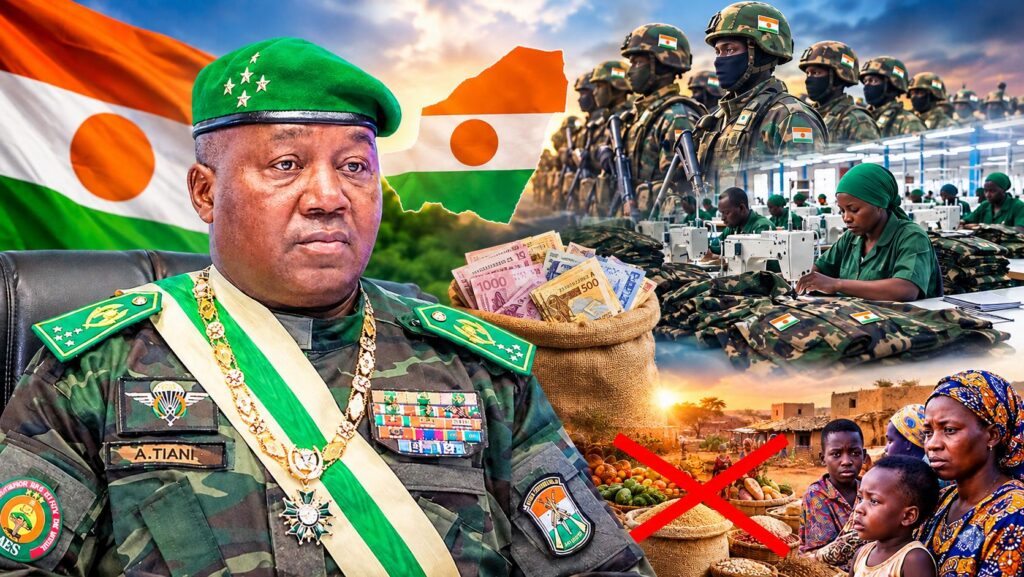
With the groundbreaking ceremony of a new military uniform production facility in Niger, capable of manufacturing 1,000 units daily on funds from the Fonds de solidarité pour la sauvegarde de la patrie (FSSP), the government faces scrutiny over its spending priorities. As the nation grapples with persistent insecurity and economic hardship, a critical question emerges: does this initiative align with the most urgent needs of the population, or does it divert resources from more pressing concerns?
From uniforms to broader security: evaluating the project’s core objectives
The facility’s stated capacity up to 365,000 uniforms annually prompts further inquiry into its intended impact. What exact demand does this production aim to fulfill? How many uniforms do Niger’s armed forces require each year, and how will distribution be managed to ensure efficiency and equitable access?
While uniforms are essential for operational readiness, they represent only one component of a broader security strategy. Sustained improvements in safety depend on robust intelligence networks, logistical support, personnel training, and community protection measures. The true measure of this project’s success will lie in whether it contributes meaningfully to these overarching goals, rather than serving as a symbolic gesture.
Transparency and accountability: the case for financial clarity
The FSSP, funded by national solidarity contributions, has underwritten this venture. Citizens rightfully demand transparency regarding how these public funds are allocated across competing priorities. With widespread economic strain and food insecurity affecting households, the government must justify its investment choices and demonstrate tangible benefits.
Key questions remain unanswered: What is the total project cost, and how much of the FSSP’s budget does it consume? How many jobs will the facility create, and what is its expected revenue timeline? Without clear metrics, stakeholders cannot assess whether this expenditure represents an optimal use of resources
Regional industrialization: a coordinated vision or duplicative efforts?
Niger’s initiative mirrors similar announcements across the Alliance des États du Sahel (AES), including Mali and Burkina Faso. While local production can reduce reliance on imports and bolster autonomy, the absence of a unified industrial strategy raises concerns. Are these projects driven by genuine economic needs, or do they reflect a trend of uncoordinated, high-profile announcements without sufficient feasibility studies?
True industrial progress hinges on sustainability: job creation, cost efficiency, raw material access, and market demand. Without these pillars, even well-intentioned investments risk becoming fiscal burdens without delivering long-term economic or social dividends.
Economic viability: matching production to real demand
The projected output of 365,000 uniforms annually assumes continuous, full-capacity operation a scenario unlikely without guaranteed orders and stable supply chains. Should demand fall short, the facility could operate at a loss, burdening public finances. Conversely, if military needs are underestimated, the project could alleviate supply shortages and reduce dependence on foreign manufacturers.
To validate its economic rationale, the government must publish detailed cost analyses, including per-unit production expenses and comparisons with imported uniform prices. Only then can stakeholders determine whether local manufacturing offers a cost-effective solution or an avoidable expense.
Beyond security: aligning investments with citizen welfare
The debate over military production cannot ignore the dire living conditions faced by Nigeriens. Inflation, food insecurity, and limited access to healthcare and education remain urgent priorities. How will this project intersect with policies addressing these crises?
For instance, could the facility’s resources be redirected to strengthen food security programs, support vulnerable households, or revitalize public services? A population with stable livelihoods and improved living standards is better positioned to withstand external shocks, reinforcing national resilience. The government’s response must demonstrate how industrial initiatives like this one contribute to holistic development, not just sector-specific goals.
Measuring success: what metrics will define this project’s legacy?
The true test of this venture lies in its outcomes. Will it deliver measurable security benefits, reduce procurement costs, and create sustainable employment? Or will it become another underutilized infrastructure, draining public funds without commensurate returns?
Niger’s leaders bear the responsibility of providing verifiable data, justifying expenditure decisions, and proving that this project fulfills a clearly identified need. For a nation where citizens contribute to collective efforts, results not announcements will determine the project’s legitimacy.
By Georges Essomba — Journaliste / Rédacteur