Mali confronts a pressing question: does a 121 million FCFA fund for returned migrants deliver real change or just symbolic gestures?
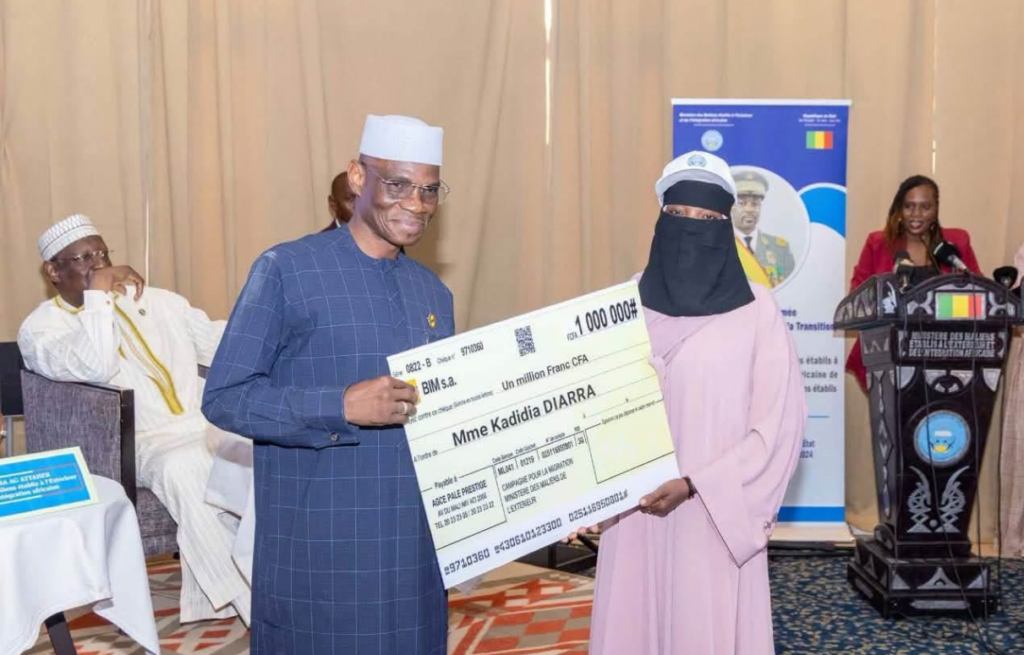
Last October, Mali’s Minister of Malians Abroad and African Integration, Mossa Ag Attaher, presided over the disbursement ceremony of 121 million CFA francs to 90 socioeconomic reintegration projects for returning migrants. The announcement followed a competitive selection process from 206 applications, with beneficiaries spread across Bamako and regional hubs such as Gao, Tombouctou, Nioro, Kita, and San. While the initiative aligns with national rhetoric on diaspora valorization and migration-turned-opportunity, serious questions linger about its transparency, equity, and long-term impact.
Opaque selection process fuels doubts over fairness and meritocracy
Despite the minister’s emphasis on “rigor” and “exemplary management,” no public criteria governed the selection of 90 projects from 206 submissions. No details have been disclosed about the composition of the selection committee, or whether decisions prioritized economic viability, vulnerability levels, return recency, or the presence of solid business plans. Past editions—75 projects (100 million FCFA) in 2025 and 40 projects led by civil society in 2024—also lacked transparency in their selection methods. The absence of clear, published benchmarks raises legitimate concerns about favoritism, patronage, or network-based selection rather than merit-based outcomes.
Missing transparency at every stage
Even basic information remains classified. The list of beneficiaries is not public, nor are the exact amounts allocated to each project or their precise nature. Given Mali’s fragile public trust in fiscal management, this opacity undermines accountability. How can citizens verify that funds reach intended recipients, not diverted en route? How can we ensure that relatives, political allies, or intermediaries aren’t skimming off the allocation? Without disclosure, skepticism is not just warranted—it’s essential.
Promised follow-up remains untested and undocumented
The minister emphasized “territorial follow-up” to ensure project sustainability. Yet no public evaluations of prior cohorts (2024 and 2025) have surfaced. How many projects survive beyond initial funding? What proportion generate stable income or create jobs? How many collapse once subsidies expire? Without performance indicators, independent audits, or published outcomes, this initiative risks resembling episodic charity rather than a credible public policy capable of being assessed or replicated.
Scale of need vs. scale of response: a stark disparity
Since 2022, the EU-funded MPRR-SSA program, implemented with IOM support, has assisted over 27,800 returnees and backed over 14,000 reintegration projects. Against that backdrop, 90 projects backed by 121 million FCFA appear symbolic at best. The national effort is real—but limited. Presenting a modest intervention as a transformative “local development lever” risks creating the illusion of large-scale impact, while the vast majority of returning migrants remain without structured support.
Unanswered questions reveal deeper structural gaps
Funding stems from Mali’s Special Investment Budget, but the origin of these 121 million FCFA—and the trade-offs involved—remains undisclosed. Are beneficiaries restricted to recent returnees, or do earlier returns qualify? How does this initiative intersect—or fail to intersect—with existing IOM and partner mechanisms? Without alignment, duplication or coverage gaps could persist, undermining overall effectiveness.
The stated intent—to help compatriots rebuild livelihoods after often traumatic migration experiences—is commendable. But a credible public policy must be judged by transparency, traceability, and measurable results. At present, this initiative remains largely a black box: applications received, projects selected, funds disbursed… and silence on the aftermath.
Transparency is non-negotiable in reintegration policy
Until the beneficiary list, selection criteria, and impact assessments of prior years are made public, skepticism isn’t just justified—it’s necessary. In a domain as sensitive as reintegration of returning migrants, doubt carries consequences. Without verifiable facts, this 121 million FCFA fund risks being remembered not as a catalyst for change, but as a well-intentioned gesture shrouded in opacity.