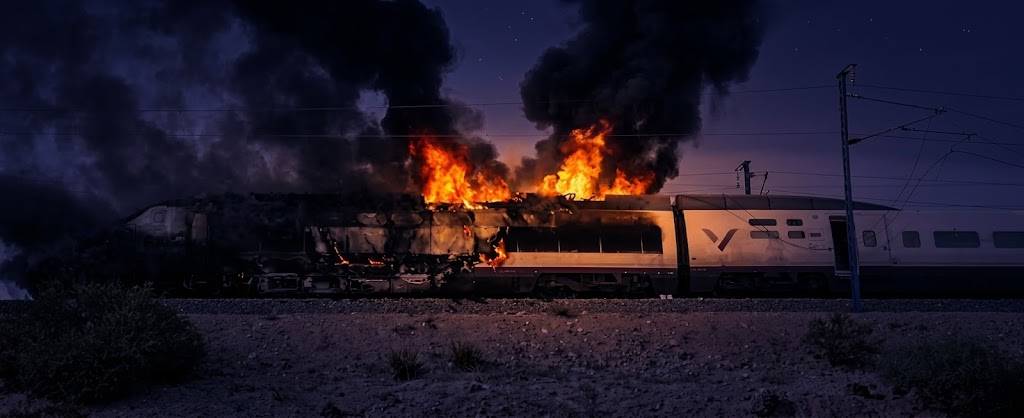
An unexpected blaze aboard an AVE high-speed train, traveling the busy Madrid-Barcelona route, has sent shockwaves through Spain’s rail network. The October 12 incident near Ricla forced 283 passengers into an emergency evacuation, raising urgent questions about safety standards and operational resilience in the country’s flagship high-speed rail system.
What really happened aboard the AVE train near Saragossa
The fire erupted around 4:05 PM on a Monday afternoon, just outside Ricla in the province of Saragossa. The train, which had departed Madrid’s Puerta de Atocha station at 2:27 PM, was en route to Figueres via Barcelona when smoke was detected in the rear cabin. Within minutes, alarms triggered a rapid-response protocol, leading to a full-scale evacuation of all 283 passengers. Firefighters arrived swiftly and brought the flames under control without any reported injuries.
While the evacuation was executed flawlessly, the incident’s timing—during Spain’s national holiday and at the tail end of a long weekend—compounded the disruption. Thousands of travelers relying on the AVE line found themselves stranded, their plans thrown into uncertainty as the entire Madrid-Barcelona high-speed route ground to a halt.
Why did the entire rail corridor shut down—and what it cost passengers
The immediate closure of the line was not an overreaction, but a necessary precaution. Emergency services needed full access to the site, and safety checks on the infrastructure had to be conducted before any trains could resume service. As a result, dozens of scheduled departures were canceled, and passengers were left scrambling to adjust their travel arrangements.
The consequences were felt both locally and across the country. With this being one of Spain’s busiest rail corridors—especially during holiday periods—thousands of commuters, tourists, and business travelers faced unexpected delays or had to seek alternative transportation. The economic impact extended beyond inconvenience: businesses relying on fast, reliable rail links between Madrid and Catalonia faced logistical disruptions, and tourism operators reported last-minute cancellations.
How Renfe responded to the crisis
Spain’s national rail operator, Renfe, quickly activated contingency measures to support affected passengers. Travelers were given the option to modify their tickets for free or request full refunds, easing some of the financial burden. The company also communicated openly about the recovery timeline, though the exact duration of the disruption remained unclear for several hours after the blaze was extinguished.
Technical teams worked through the evening and into the next day, conducting thorough safety inspections of the tracks and signaling systems. The gradual restoration of service began only after authorities confirmed that all conditions for safe operation had been met. While no official timeline was announced immediately, Renfe later confirmed that the line was fully operational again within 12 hours.
What caused the fire—and what it means for Spain’s high-speed rail future
As of now, the precise origin of the fire remains undetermined. Investigators are examining multiple possibilities, including electrical faults, mechanical failure, or even external factors. The lack of a definitive cause underscores a critical vulnerability: even a minor technical issue on a high-speed train can escalate into a major crisis when traveling at 300 km/h through densely populated regions.
This incident is not an isolated case. In recent years, Spain’s high-speed rail network—the largest in Europe—has faced growing scrutiny over maintenance standards, aging infrastructure, and emergency response protocols. While the AVE system is renowned for its punctuality and efficiency, events like this one force a reevaluation of whether safety protocols are robust enough to handle unpredictable emergencies.
Safety experts point out that high-speed rail evacuation procedures are complex and time-sensitive. The Madrid-Barcelona line carries over 15 million passengers annually, making rapid, organized evacuations a non-negotiable requirement. Any delay or misstep in emergency protocols could have catastrophic consequences in a real fire scenario.
Could this fire signal a turning point for Spain’s rail safety?
The evacuation itself was executed flawlessly, with zero injuries—a testament to the training of train staff and coordination with emergency responders. But the broader implications are harder to ignore. A single fire, even if managed safely, has exposed underlying concerns about infrastructure reliability, preventive maintenance, and real-time crisis management.
Industry analysts suggest that this incident could accelerate calls for enhanced safety regulations, including stricter inspection cycles, automated fire detection systems, and better emergency communication tools. Renfe has yet to announce long-term changes, but the pressure is mounting for a transparent review of its operational safety framework.
Lessons for travelers and the rail industry
For passengers, the key takeaway is to remain calm and follow crew instructions during any onboard emergency. While rare, train fires demand immediate, disciplined action—and the Madrid-Barcelona incident proves that Spain’s rail operators are capable of managing such crises safely.
For the rail industry, the challenge is to turn this incident into an opportunity for improvement. Spain’s AVE network remains a global benchmark, but with increasing passenger volumes and aging equipment, maintaining that status will require proactive safety investments and a culture of continuous improvement.
As investigations continue and the infrastructure recovers, one question lingers: will Spain’s high-speed rail system emerge stronger—or will this fire mark the beginning of a more challenging chapter in its journey forward?