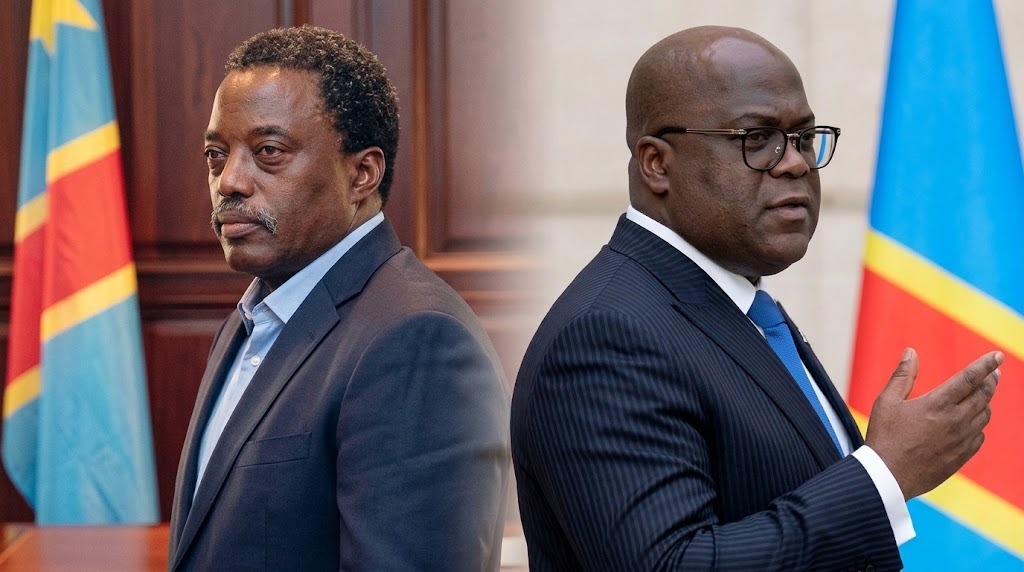
In a bold strategic move, former Democratic Republic of Congo president Joseph Kabila has assumed leadership of the Front for National Rebirth (FRN), a newly formed politico-military platform unveiled in Goma. This restructuring brings together key figures from the Congo River Alliance (AFC) and March 23 Movement (M23), signaling a potential realignment of power dynamics in eastern DRC where diplomatic efforts to end the conflict continue.
The announcement, made in Goma on October 12, 2026, follows months of speculation about the FRN’s formation and its implications for the region. While the M23 has controlled Goma since January 2025, this new alliance represents a more ambitious attempt to consolidate rebel factions under a unified structure.
From AFC-M23 to FRN: a strategic reboot of Congo’s rebellion
The FRN isn’t merely a name change—it signifies a deliberate reorganization of the political and military command structure opposing President Félix Tshisekedi’s government. According to the Goma declaration, the new front succeeds the Congo River Alliance while maintaining close ties with the M23.
Among the prominent figures rallying behind Kabila are Corneille Nangaa, Bertrand Bisimwa, and Sultani Makenga, each representing critical components of this new alliance. The lineup combines former presidential leadership with rebel commanders, creating a complex dynamic where political legitimacy meets armed resistance.
Key questions remain unanswered: Will this restructuring strengthen the rebel coalition or introduce new internal fractures? How will the M23’s institutional role evolve within this broader framework? The answers may reshape Congo’s conflict landscape in unpredictable ways.
Rwanda’s shadow over eastern Congo’s rebellion
The regional dimension remains impossible to ignore. International observers, including UN experts, have consistently documented Rwanda’s military support for the M23, though Kigali denies these allegations. The Rwandan government frames its involvement as a response to genuine security threats along their shared border.
Kabila’s leadership of the FRN adds a political dimension to this volatile mix. By bridging former presidential authority with rebel leadership, the new platform could expand its influence beyond purely military objectives. This development risks further complicating diplomatic efforts to resolve the conflict, particularly as Kinshasa now faces a challenger that blends national political opposition with regional alliances.
For diplomatic negotiators, the FRN’s emergence presents unprecedented challenges: Who represents the rebel movement in peace talks? How will command structures be verified? Can any agreements be enforced on the ground?
Joseph Kabila’s controversial presence in the FRN leadership
The former president’s role brings additional complexities to the conflict equation. In September 2025, Congo’s courts sentenced Kabila to death in absentia for treason—a verdict he has consistently dismissed as politically motivated.
This judicial backdrop adds another layer of tension to the FRN’s formation. While Kabila’s supporters view his leadership as a unifying force, opponents see it as an escalation that could further destabilize the region. The move also raises questions about the FRN’s long-term strategy: Is this a genuine attempt at political mobilization, or simply a tactical alliance to strengthen military coordination?
Uncertain futures for eastern Congo’s civilian populations
Amid the political maneuvering, the people of North Kivu and South Kivu bear the heaviest consequences. Ongoing violence has displaced hundreds of thousands, disrupted local economies, and created a humanitarian crisis that shows no signs of abating.
The FRN’s creation introduces a new phase whose outcomes depend on several critical factors:
- The alliance’s ability to maintain internal cohesion amid diverse political and military agendas
- Its relationship with external supporters, particularly Rwanda
- The Congolese government’s response to this expanded challenge
One certainty emerges: The conflict in eastern DRC has evolved far beyond a simple confrontation between government forces and the M23. With Joseph Kabila’s official integration into this politico-military structure, the crisis now encompasses political ambition, military strategy, and regional geopolitics in ways that could prove both destabilizing and potentially unpredictable.
Can this new rebel alliance bring resolution or further fragmentation?
The FRN’s formation forces a fundamental question: Will this consolidation of rebel forces lead to a more coherent negotiating position? Or will it create additional divisions that complicate peace efforts?
Observers note that successful rebel movements typically balance military cohesion with political unity. The FRN’s challenge will be to maintain this equilibrium while navigating the complex relationships between its diverse components. The international community’s response may prove equally decisive in determining whether this new structure leads toward dialogue or deeper confrontation.
As eastern Congo stands at this critical juncture, one thing is clear: The FRN’s emergence marks a new chapter in a conflict that has already reshaped the region’s political and military landscape in ways that will take years to fully understand.