In a West African landscape already strained by geopolitical tensions, Niger’s transitional authorities have taken a bold commercial step that has left regional traders and analysts perplexed.
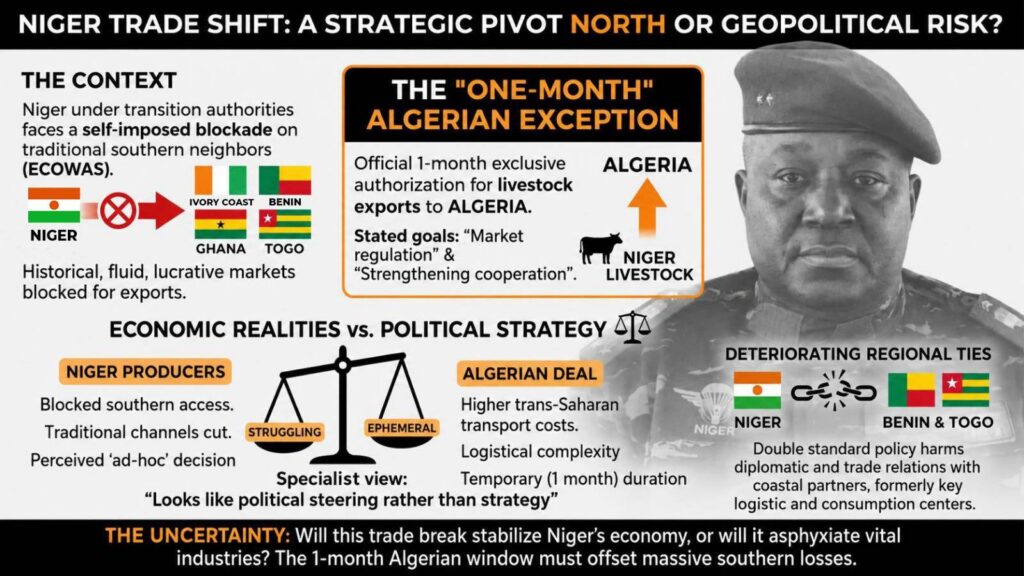
While borders with Gulf of Guinea nations—namely Côte d’Ivoire, Bénin, Ghana, and Togo—remain tightly controlled or completely closed to exports, Niamey has unexpectedly unlocked a one-month window for livestock shipments to Algeria.
An exceptional concession for Algeria
The Nigerien government has justified the temporary measure as part of an initiative to “stabilize domestic markets” and “enhance economic collaboration” between Niamey and Algiers. Yet beneath the official rhetoric, the move reveals deeper economic contradictions.
Historically, Gulf of Guinea countries have served as the most accessible and profitable outlets for Niger’s pastoral sector. Blocking these traditional markets while granting a fleeting opportunity to the North raises serious questions about the government’s long-term economic priorities.
“Prioritizing Algeria over neighboring CEDEAO states by locking out southern partners for a single month suggests ad-hoc political maneuvering rather than a coherent economic plan,” noted a specialist in Sahelian cross-border trade, speaking on condition of anonymity.
Regional alliances under strain
The divergent trade policy—favoring distant partners over immediate neighbors—is deepening diplomatic fissures across the region. Bénin and Togo, long-standing logistical hubs and vital consumers for Nigerien goods, now find themselves sidelined in favor of a more complex Saharan trade route.
With decisions perceived by some as hasty and detached from the realities of local producers, pastoralists across Niger are increasingly caught in the crossfire of shifting foreign policy. A 30-day window to Algeria may do little to offset losses from blocked markets in Côte d’Ivoire, Bénin, or Ghana, especially when the high cost of trans-Saharan transport threatens to erode potential gains.
Will this gamble pay off?
The coming weeks will reveal whether this economic pivot stabilizes Niger’s fragile economy—or further stifles the country’s vital agricultural value chains. One thing is certain: in a region where trust is already fragile, such abrupt policy shifts risk doing more harm than good.