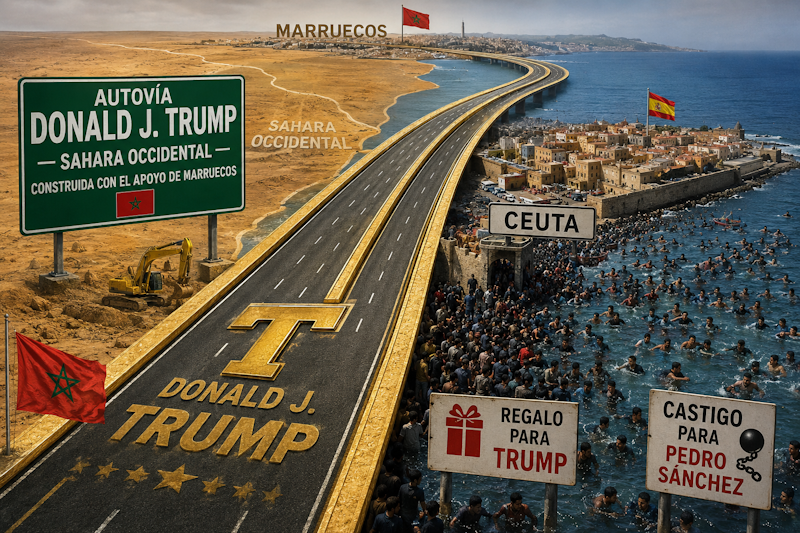
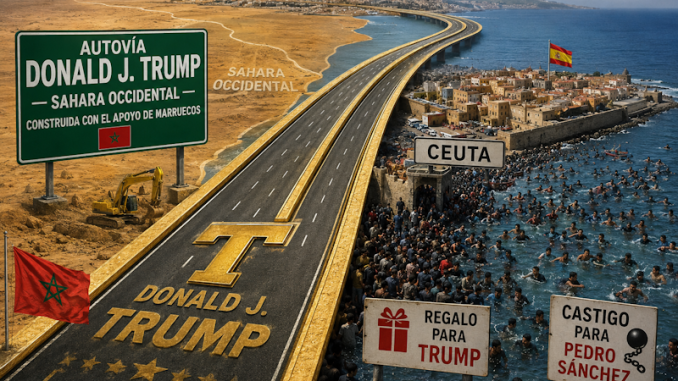
Between a symbolic roadway tribute to the American president and heightened migratory pressure on the Spanish enclave, Rabat is employing diverse tactics to secure decisive support from Washington regarding the Western Sahara issue. While the Tiznit-Dakhla highway, now bearing the name of the White House occupant, doesn’t directly reach Ceuta, Morocco is leveraging a different approach to influence Spain.
The summer of 2026 has unfolded as a period of intense diplomatic activity involving Morocco, the United States, and Spain. With Donald Trump back in the White House, Rabat is intensifying its efforts to solidify American backing for its claim over Western Sahara, a contested territory Morocco has asserted as its own since Spain’s withdrawal in 1975.
A highway named Trump
The gesture carries significant symbolism. Following a royal directive from King Mohammed VI, the 1055-kilometer Tiznit-Dakhla highway has been officially named the “Donald J. Trump” highway. In a letter released by the MAP agency, the monarch articulated his intention to express gratitude to the American president for his “historic recognition of Morocco’s sovereignty over its Sahara in 2020.”
This infrastructure project, described by the King as the “longest road network in all of Africa,” connects the southern regions of the country to Dakhla, passing through Laâyoune, which lies at the heart of Western Sahara. This strategic artery, as emphasized by the sovereign, “unites the north and south of Morocco and links Europe to the African continent.”
Donald Trump promptly responded on his Truth Social platform, stating, “What a tremendous honor! I eagerly anticipate driving the entire length of this magnificent highway someday, hopefully soon!”
Ceuta, another leverage point
However, Morocco’s strategy to advance negotiations extends beyond highway naming. A far more crucial element is the issue of migration. In late July, nearly 60,000 migrants crossed into the Spanish enclave of Ceuta within a few hours, triggering a major humanitarian and diplomatic crisis.
According to Spanish authorities, at least 57 individuals lost their lives while attempting the crossing, either by drowning or being trampled. Morocco, whose border guards reportedly remained disengaged, officially acknowledged 11 fatalities.
The enclave of Ceuta, one of only two land borders between the European Union and Africa, represents a critical point in Hispano-Moroccan relations. Morocco has consistently refused to recognize Spanish sovereignty over these territories, viewing them as “occupied territories.”
History’s echo
This unfolding scenario is not unprecedented. In May 2021, a similar migratory surge (with 8,000 arrivals) compelled Madrid to reassess its stance on Western Sahara. Spain subsequently abandoned its historical neutrality to endorse Morocco’s autonomy plan, a shift that occurred after it provided medical care to Brahim Ghali, the leader of the Polisario Front.
“Morocco believed that Spain supported its autonomy project for Western Sahara, but this isn’t enough, as Morocco seeks recognition of its full sovereignty,” explained Carlos Ruiz Miguel, director of the Centre for Western Sahara Studies at the University of Santiago de Compostela.
This time, the context is distinct. The latest crisis emerged just ten days after Pedro Sánchez’s visit to Algiers, where Spain sought to mend ties with Morocco’s regional rival. This overture evidently did not go unnoticed by Rabat.
A multi-pronged approach
Analysts see a clear correlation in these events. “Morocco aims to disrupt Spain’s constitutional space,” asserted Alejandro del Valle, a professor of international law, suggesting that Rabat perceives Madrid as a “geostrategic adversary.”
The Moroccan strategy appears to rest on three key pillars:
– To flatter Trump with a powerful symbolic gesture (the highway), thereby reaffirming American recognition of its sovereignty over Western Sahara.
– To utilize migratory pressure on Ceuta as a means to remind Spain of its vulnerability and reliance on Moroccan cooperation.
– To secure Washington’s robust support for the matter, particularly as UN negotiations on Western Sahara remain stalled.
The United States’ role
The Trump administration has openly expressed its backing for Morocco. Secretary of State Marco Rubio recently reiterated that “the United States recognizes Moroccan sovereignty over Western Sahara.” Donald Trump himself described Morocco’s autonomy proposal as the “sole basis for a just and lasting solution,” adding that “any other path prolongs the status quo and is unacceptable.”
The White House also voiced criticism of Spanish migration policies, with a spokesperson warning that Spain risked “compromising its own survival.”
Europe under pressure
The Ceuta crisis has sent ripples across the European Union. Italy temporarily suspended its Schengen agreements with Spain, a move soon followed by Finland and Denmark. Georges-Louis Bouchez, president of the Belgian MR party, called for a partial suspension of Spain from the Schengen Area.
For Paul Melly, a researcher at Chatham House, this crisis underscores a new geopolitical reality: “Morocco has already demonstrated its willingness to deploy migratory pressure as a retaliatory tactic against Spain, which is particularly vulnerable due to its two North African enclaves.”
A clear message emerges
While the Trump highway does not physically pass through Ceuta, an equally explicit message is being conveyed: Rabat holds the keys to Europe’s southern border. By combining symbolic gestures towards Washington with migratory pressure on Madrid, Morocco is weaving a diplomatic tapestry where each thread seems designed to strengthen its position on Western Sahara. This is a lesson that Spanish and European negotiators have now fully absorbed.