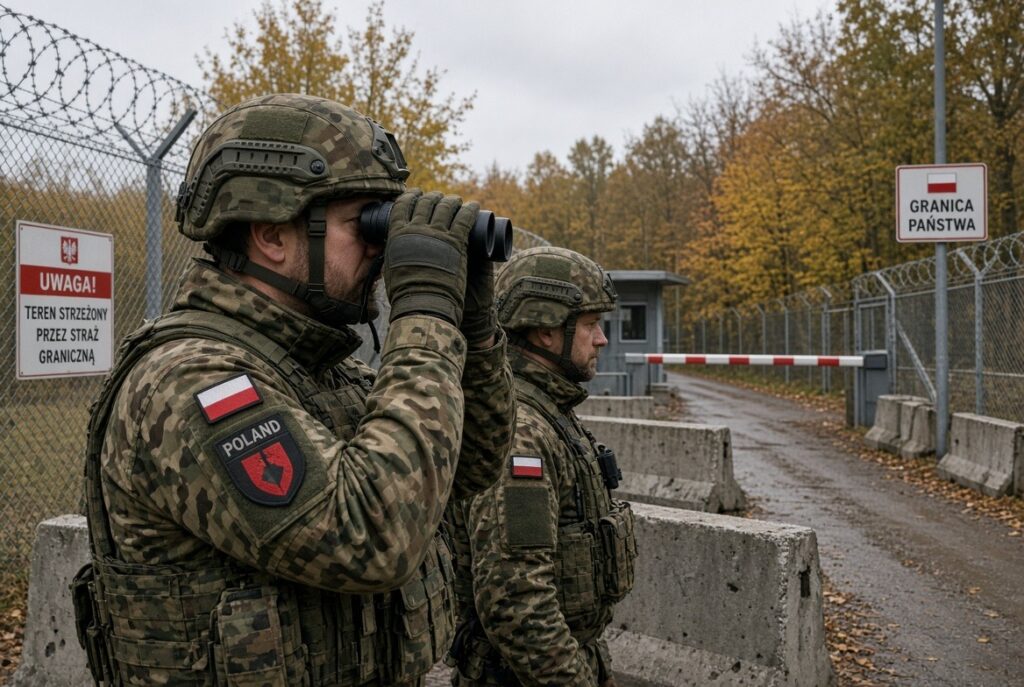
The geopolitical fault line running through Europe’s northern flank has deepened dramatically, with Poland now facing the direct consequences of Moscow’s escalating hybrid warfare tactics. Along the Baltic coast, where the NATO alliance meets the highly militarized Russian exclave of Kaliningrad, Warsaw has launched an unprecedented security operation to shield its territory from covert infiltration, sabotage, and drone incursions—risks that now threaten both national stability and economic prosperity.
From suspicion to necessity: why Poland’s borders now demand martial vigilance
What began as scattered intelligence reports and isolated border incidents has evolved into a clear pattern of Russian-backed provocations. Repeated incursions by unidentified drones, unauthorized overflights of critical infrastructure, and the emergence of sophisticated sabotage networks have forced Polish authorities to treat their northeastern frontier not as a routine security zone, but as a potential flashpoint for large-scale destabilization. The stakes could not be higher: failure to contain these threats risks plunging the region into a cycle of instability that extends far beyond military skirmishes.
A layered defense: how Poland is turning the Baltic into a fortress
The security architecture now in place along the Polish-Baltic border represents a paradigm shift in European defense strategy. Beyond traditional patrol units, the operation integrates specialized counter-sabotage teams, cyber-defense battalions, and rapid-response commando units—all under a unified command structure. Key components of this fortified perimeter include:
- Zero-tolerance border enforcement: reinforced checkpoints, thermal imaging drones, and real-time AI monitoring to detect unauthorized movement across the frontier.
- Critical infrastructure lockdown: 24/7 armed patrols around energy grids, telecommunications hubs, and transport corridors to prevent cyber-physical attacks.
- Joint military-police task forces: specialized units trained to respond to hybrid threats ranging from electronic warfare to staged migrant surges orchestrated by hostile actors.
This multi-layered approach reflects a harsh reality: in today’s conflict landscape, a visible military presence is no longer enough. Protection now requires anticipatory defense—identifying vulnerabilities before they are exploited.
The human and economic toll: why Kaliningrad’s shadow war matters
While global attention remains fixed on the war in Ukraine, the Baltic theater has quietly become a testing ground for Russia’s hybrid playbook—and Poland is bearing the brunt. The economic repercussions are already visible: disrupted supply chains, surging insurance costs for coastal businesses, and wary investors pulling back from high-risk regions. Local communities near the border report rising anxiety, with smallholders and fisheries facing interference from unauthorized drone surveillance and occasional sabotage of equipment.
Polish officials have warned that prolonged exposure to these tactics risks normalizing crisis conditions, eroding public trust, and deterring foreign investment in one of Europe’s fastest-growing economies. The message is clear: if left unchecked, hybrid aggression today could metastasize into full-blown conflict tomorrow.
Deterrence in action: Warsaw’s message to the Kremlin
By transforming its Baltic border into a near-impenetrable barrier, Poland is not merely responding to threats—it is actively shaping the region’s security calculus. The deployment of advanced missile defense systems, electronic warfare units, and rapid-deployment brigades sends a single, unambiguous signal: any attempt to destabilize Polish sovereignty through covert means will be met with overwhelming force. This is not an abstract policy declaration—it is a live operational doctrine, tested daily on the ground.
In this high-stakes environment, Poland’s actions reflect a broader European awakening. The Baltic Sea is no longer a quiet flank of the continent—it is a contested zone where the future of deterrence is being written in real time. And with Warsaw leading the charge, the message to Moscow is unmistakable: the age of plausible deniability in hybrid warfare is over.