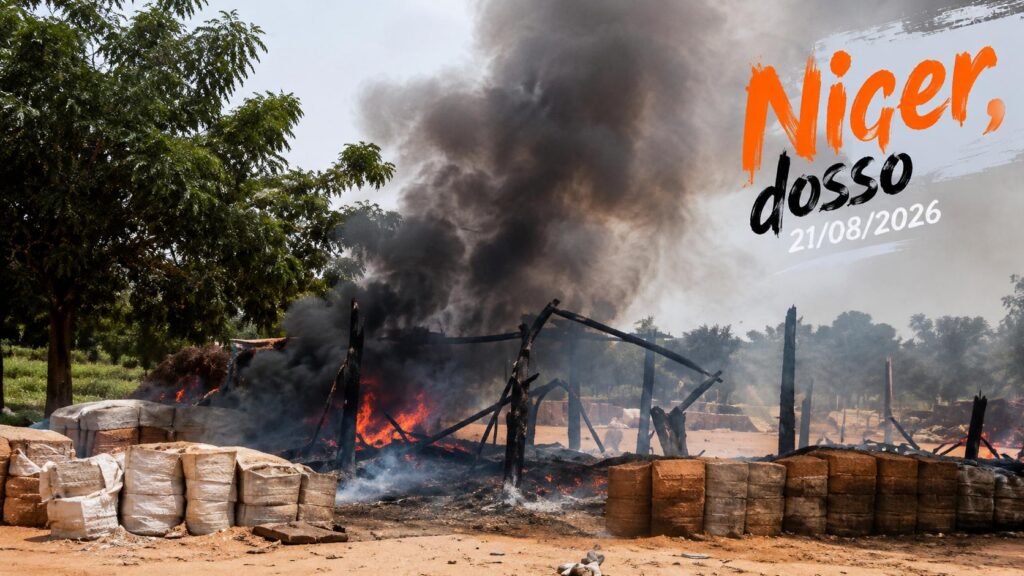
In a brazen and exceptionally violent raid, the rural commune of Tessa, located in the Dosso region of southwestern Niger, was struck by armed assailants on the evening of August 21, 2026. Local reports confirm that 18 gendarmes were killed during the assault, which also resulted in significant material damage and disrupted the local economy.
An unprecedented attack in Tessa
Tessa, a rural municipality in the Dosso department, is home to several dozen villages and serves as a key administrative hub in the region. The attack unfolded with a level of brutality rarely seen in this part of Niger.
According to eyewitness accounts, the assailants arrived in groups on a fleet of motorcycles—nearly a dozen in total—before launching a coordinated assault on the local security post. The ensuing firefight was intense, culminating in the complete destruction of the gendarmerie camp by fire.
Human and economic toll of the violence
The attack has left residents in a state of shock. Many describe the assailants as highly organized, using rapid mobility and overwhelming firepower to overwhelm the security outpost. The loss of 18 gendarmes has shattered the sense of safety that had, until now, allowed communities in the region to function despite growing security concerns.
The destruction of the gendarmerie camp is more than a military setback—it is a blow to the confidence of local residents. Security forces play a critical role in enabling daily life, from commerce to access to essential services. Their absence or weakening can have ripple effects across an entire region.
Adding to the chaos, the assailants targeted two local money transfer agencies—Nita and Amana—which were subsequently looted. These institutions are vital to the rural economy, facilitating cash flow for traders, families, and workers who rely on remittances from urban centers. The disruption to their operations could force temporary closures and leave residents struggling to access their funds, further destabilizing the local economy.
Regional security concerns grow
The Dosso region, while not traditionally viewed as one of Niger‘s most volatile areas, is increasingly exposed to spillover threats from neighboring regions. The attack on Tessa raises serious questions about the vulnerability of rural communities where security presence is often limited.
The attackers’ use of motorcycles highlights a persistent challenge for security forces: the ability of armed groups to traverse vast rural landscapes swiftly, strike, and vanish before reinforcements arrive. This mobility allows them to exploit gaps in surveillance and project violence into areas previously considered safer.
For authorities, the task now is twofold: to restore security in Tessa and prevent rural areas from becoming safe havens or launching pads for armed groups. The balance between protecting populations and maintaining economic stability has never been more precarious.
Unanswered questions and the path forward
As the dust settles, several critical questions remain unanswered. Who precisely carried out the attack, and to which group do they belong? How many assailants were involved, and were there any casualties on their side? Were reinforcements deployed, and have any suspects been apprehended?
The official confirmation of the 18 gendarmes killed is still pending. In the immediate aftermath of such an event, information is often fragmented, and figures may evolve as authorities conduct investigations and identify victims. A definitive assessment will be essential to understanding the full scope of the attack.
For the residents of Tessa, the priority now is to regain a sense of normalcy. Rebuilding trust in security and restoring access to financial services will be key to preventing long-term economic damage. Meanwhile, authorities face the challenge of strengthening their presence in rural areas without allowing the aftershocks of this attack to linger.
The assault on Tessa stands as a stark reminder that insecurity in Niger is not confined to urban centers. When security is weakened in rural communities, the consequences ripple through the economy and daily life, leaving lasting scars on the fabric of society.