Signature: r02wBNG529OLZuJ2svFw/OSP5EA38UxBfH+gBoG/E5i0chnXeI+yDnQoD9JA8oVtWhkP5li8LaaZeLU6ph4O8H95+yjA6J2WmN+x02nNSuWICQVKLcktVRQX9/Ei4CuZBicex8qlbhOsr875ZTR15Iafx5N0VZZFU1Q0PzXamjQiVIq4BSNwUDZ+3Djrh1BZJj+tLiZneekSm4DUbRfWjQBaLfyUlrbYYG6tjDo/waPfbgkW5a648uLpgPJVMJ0LIjeTUq4ys5RLcv/g8Ikm3WNMsV3Yj0fsqhKIVzo2IAustVezt02dWUWGk0EMkKpZNk8ZoXFaCAiXbi/yekMqOiBE3O9O5X76PurTEX8KQRGB/VPwlBoQvwXc0ogV5QU1nPGXl5uCZizBtNuRZ1WOH7AC/u0rY4oNjaemupki9+fmKqMbNSeaxDpctS3jefYVzZrSQ/jSGsMkcScAM+OSQ9jUHkJDULW0K25DDr09FOZFEDn2MDvsg0l5aWq/+Xj0mpjg3v6LuR5fmOvv9Gp5pK5+Ux1+CjBL3GyifYXWkQycxLkAqS/b9maIst0/LdkawFGEqQc4H4AusxDl/uIdS5NNam2Pbnjx/ixxvNIFGG/h3FCtdTUgL6he+HdHUqqrB7NLXkC+Jpz0H3B6glm37YAMKpkLTDA5hcU8ar1fHlsVJoaWhdWNC5Sn0NeGuEY0k2bKvawVHI2KiwoNzN3MVcr9U/LSs+223PZLy77x4r9CitNBquLFjJ4g7fevAP1oTZLIBAtIEmY1hi84AoErl/QWa0L01utIMryHtMuZtllP2fKWJpJcnz0w/qx9BPlwEC6f6DDsB351xelFUC9YlZ1Hbkuo2FvZ2aF16g4oy+YXUk+kUbWtDmDxdjaAGIv1jglb0lGUQhltTAJS8nPR80ObuIxOZ0btTc5FJfilyG0XcwbPLP5n/CKJ7iD/W3U3yY62k7mH0L2znW+1aVsbYthpAPm/4v219ZG1vxdGGjY=
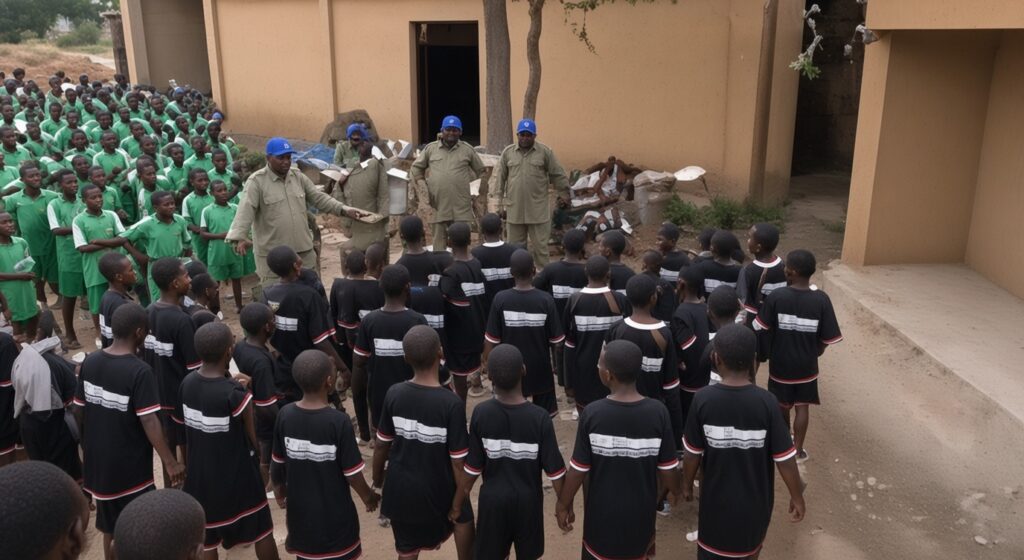
The recent inauguration of a training camp by General Abdourahamane Tiani, uniting over 300 young Nigeriens, has sparked debate regarding its underlying objectives. While framed as a civic engagement initiative, a national awakening, and a foundation for rebuilding, the program closely mirrors Burkina Faso’s approach under Captain Ibrahim Traoré. However, beneath the carefully crafted rhetoric celebrating an “engaged youth,” a more concerning reality may be emerging: the Nigerien military regime appears to be laying the groundwork for early militarisation under the guise of patriotism.
Childhood and adolescence: an inappropriate setting for militarisation
At such a formative stage of life, the priorities for young individuals should revolve around education, vocational training, cultural development, sports, and civic education not the systematic inculcation of military discipline, unquestioning obedience, or perpetual mobilisation. Exposure to an environment where weapons and confrontation are normalised risks distorting the natural process of intellectual and emotional development.
The political message: a worrying shift in values
The true concern lies not solely in the nature of the camp itself, but in the political signal it sends to an entire generation. When a military administration presents youth mobilisation as a patriotic duty, it risks prioritising blind loyalty to the regime over the cultivation of critical thinking. Genuine civic engagement requires more than conformity; it demands the capacity to question, debate, and advocate for the common good.
The line between civic education and indoctrination becomes dangerously thin when young participants are continually exposed to rhetoric centred on combat, sacrifice, and the defence of the nation. While a mobilised youth can serve the country, it must never be reduced to a human resource pool to prop up a military regime indefinitely.
Misplaced priorities: ideology versus tangible development
A critical question arises: why allocate significant resources to ideological mobilisation when thousands of young Nigeriens urgently require functional schools, accredited vocational training, employment opportunities, robust infrastructure, and viable pathways to the future? Patriotism, though admirable, cannot substitute for a diploma, nor can it alleviate hunger or unemployment.
The promotion of mandatory “civic duty” may serve as a convenient political smokescreen. By projecting an image of disciplined, enthusiastic youth prepared to make sacrifices, the government may deflect attention from pressing economic challenges, systemic educational failures, widespread youth unemployment, and the social consequences of political instability.
Long-term consequences: a society conditioned for militarisation?
Another concern is the sustainability of this model. A generation raised in the culture of perpetual mobilisation may come to view militarisation of society as the norm. What is currently presented as an exceptional initiative could, over time, evolve into an institutionalised framework for the political and paramilitary indoctrination of youth.
Learning from Burkina Faso: caution against a cycle of militarisation
The comparison with Burkina Faso demands careful scrutiny. The proliferation of initiatives aimed at rallying youth around patriotism and national defence should not push Sahelian states into a dangerous competition of youth militarisation. While the security context remains dire, the solution to insecurity must not involve systematically transforming every new generation into potential combatants.
The youth of Niger deserve more than to be instrumentalised in the public relations strategy of a military regime. They are entitled to quality education, market-relevant skills, meaningful employment, intellectual freedom, and the ability to engage in democratic life without being coerced into adhering to a political or military doctrine.
A robust state is not defined by how early it teaches children to obey and fight, but by how effectively it equips them with knowledge, freedoms, and opportunities to shape their nation’s future. Real patriotism lies not in prematurely moulding young minds into instruments of war, but in fostering citizens capable of building, innovating, and defending their country through legitimate democratic means when required.
Niger must ensure that the fight against insecurity does not become a justification for the enduring militarisation of childhood and adolescence.