As Benin’s Senate opened its first ordinary session on October 28, 2026, in Cotonou, its president, Patrice Talon, underlined the chamber’s pivotal role in averting political deadlocks that threaten public services and economic progress. The timing of this declaration is significant, coming amid ongoing budget disputes in neighboring Senegal, where prolonged disagreements between lawmakers and the executive have disrupted critical financial planning.
Can a newly empowered legislative body serve as a stabilizing force when political tensions threaten to derail national priorities? This question resonates deeply in Benin, where institutional reforms have given the Senate expanded oversight, and in Senegal, where a standoff over a revised 2026 budget law highlights the fragility of governance during fiscal disputes.
Benin’s Senate: A new pillar of institutional mediation
The Senate of Benin, established under the 2025 constitutional reform and comprising 25 members, is tasked with far more than legislative review. According to Senate President Patrice Talon, its core mission is to act as a moderator in political conflicts—preventing escalation that could paralyze government functions or erode public trust.
The chamber’s responsibilities are broad and strategic:
- Protecting democratic institutions: Ensuring that political rivalries do not undermine the integrity of elections, parties, or constitutional processes.
- Overseeing high-stakes laws: Reviewing bills that amend the constitution, regulate political parties, or organize elections before they become law.
- Preventing legislative deadlocks: Offering a second reading mechanism to resolve disputes between the presidency and National Assembly—though notably, this does not apply to budget laws.
- Upholding social cohesion: Acting as a buffer against political violence or instability that could disrupt public services and economic activity.
Talon emphasized that the Senate’s role is not to eliminate disagreement—an inevitable part of democracy—but to ensure that conflicts do not fester into crises that derail national development.
Senegal’s budget battle: a cautionary tale
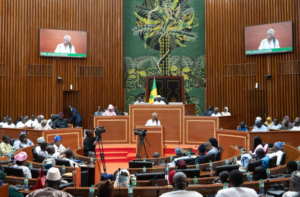
In Senegal, the government’s attempt to revise the 2026 budget has exposed how quickly fiscal disputes can paralyze governance. On October 23, 2026, the National Assembly’s Finance Committee rejected the government’s revised budget proposal and two accompanying amendments, signaling deep divisions even within the ruling majority. The rejection delayed critical funding for public services, social programs, and economic stimulus measures, leaving citizens and businesses in limbo.
While the full assembly had not yet voted on the budget by October 27—when Finance Minister Cheikh Diba requested a return to committee for further negotiations—the episode underscored the real-world cost of political gridlock. Delayed budgets mean delayed salaries, stalled infrastructure projects, and uncertainty for investors, all of which weigh on economic confidence.
This situation in Senegal is not an isolated incident but a reflection of how budgetary disputes can become proxy battles for political influence, often at the expense of effective governance.
Beyond procedure: protecting citizens from political fallout
The contrast between Benin’s approach and Senegal’s experience highlights a critical question: How can institutions prevent political disagreements from harming the very people they are meant to serve? In Benin, the Senate’s mandate includes preventing disputes from escalating into prolonged crises, while in Senegal, the government’s attempt to renegotiate the budget reflects the fragility of consensus when institutions are tested.
For Benin’s Senate, the challenge lies in balancing its oversight role with the need to preserve democratic debate. Its interventions must be seen as legitimate and impartial, not as tools of political control. The chamber’s effectiveness will depend on how it navigates disputes between the presidency and the National Assembly, particularly on non-budgetary matters where its mediation role applies.
The ultimate test will be whether Benin’s Senate can transform its constitutional powers into tangible stability—ensuring that political disagreements do not lead to economic slowdowns, service disruptions, or eroded public trust. The stakes are high: a functioning state is one that can govern, spend wisely, and deliver results to its people, regardless of partisan divides.
The path ahead: can Senegal and Benin learn from each other?
While Benin’s Senate does not have jurisdiction over budget laws—unlike Senegal’s National Assembly—its broader mission of fostering dialogue and preventing crises offers a model for institutional resilience. By positioning itself as a neutral arbiter, the chamber could help Benin avoid the types of deadlocks that have recently plagued Senegal.
However, the Senate’s success is not guaranteed. Its credibility will hinge on transparent processes, fair arbitration, and a commitment to constitutional balance. If it fails to deliver on these fronts, it risks becoming another layer of bureaucracy rather than a stabilizing force.
For both countries, the lesson is clear: institutions matter, but their effectiveness depends on how they are used. The real impact of Benin’s Senate will be measured not by its structure, but by its ability to keep the wheels of government turning—even when politics turns contentious.
Key takeaways for citizens and businesses
- Stable institutions protect economic growth: Political deadlocks can delay budgets, freeze investments, and disrupt services essential to daily life.
- The Senate’s role is preventive: It aims to resolve disputes before they escalate, safeguarding Benin’s development trajectory.
- Senegal’s experience offers a warning: Even within ruling majorities, fiscal disputes can derail governance and harm public welfare.
- Accountability matters: The Senate’s interventions must be seen as fair and impartial to maintain public trust.