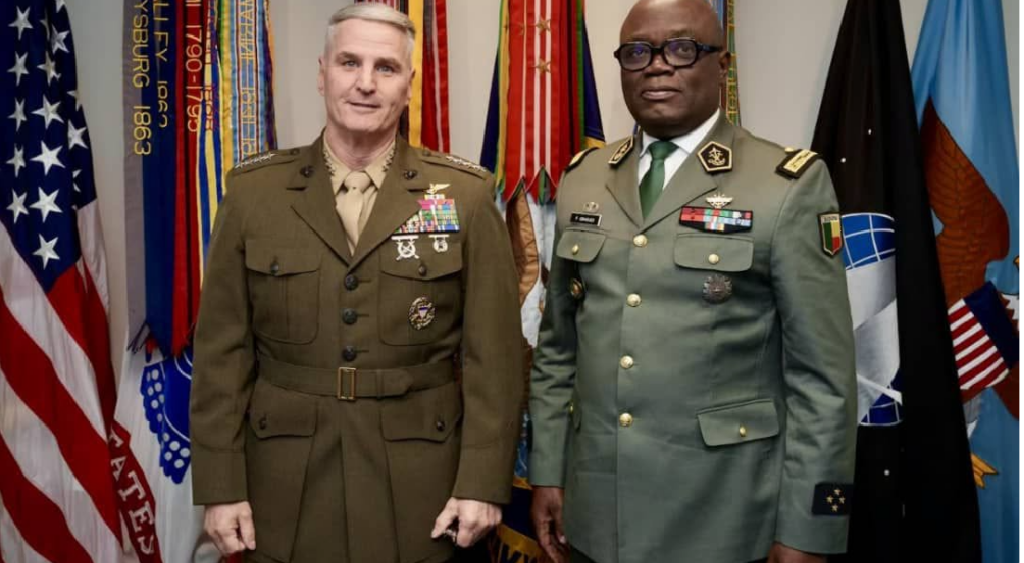
From Cotonou to Washington, a consistent message emerges: strengthening national capabilities, expanding partnerships, and upholding democratic values as pillars of regional stability. The recent meeting between Bénin’s top military official and U.S. defense leaders underscores a strategic approach aimed at avoiding reliance on any single partner.
Strengthening Bénin’s Security Partnerships
The high-profile visit of Lieutenant-General Fructueux Gbaguidi, Chief of Staff of Bénin’s Armed Forces, to the Pentagon on August 25, 2026, symbolizes more than diplomatic protocol. It reflects Cotonou’s growing role in America’s West African security strategy. The meeting with U.S. Joint Chiefs of Staff Vice Chairman General Christopher J. Mahoney highlighted the robust and enduring nature of the defense ties between the two nations.
The discussions, captured in an official U.S. statement, centered on regional threats, joint initiatives, and AFRICOM-supported security assistance. A key takeaway was Washington’s recognition of a stable, secure, and democratic Bénin as vital for regional peace—a testament to the country’s credibility in countering terrorism.
Strategic Responses to Regional Instability
As armed groups advance from the Sahel toward coastal nations, Bénin has adopted a proactive stance. Rather than waiting for threats to reach urban centers, the government is systematically enhancing military capabilities, intelligence networks, territorial presence, and cross-border cooperation.
This approach is rooted in the reality of asymmetric and transnational warfare, where no single nation can independently address complex threats like terrorism, illicit trafficking, or border insecurity. Effective solutions now demand integrated efforts in intelligence-sharing, troop mobility, training, equipment, and operational coordination.
The U.S.-Bénin security relationship, though longstanding, has intensified in response to evolving terrorist activity in northern Bénin. Earlier evaluations by AFRICOM in 2025 already positioned Cotonou as a strategic security partner, emphasizing the need for deeper collaboration against emerging threats.
Beyond Washington: A Diversified Security Policy
Bénin’s strength lies in its diplomatic diversification. While ties with the U.S. remain critical, Cotonou is also expanding military partnerships across Africa and beyond. This strategy aligns with the shifting security alliances in West Africa, where traditional frameworks are being reshaped.
Notable collaborations include:
- A bilateral military commission with South Africa in May 2025, focusing on asymmetric threat response and experience-sharing.
- Enhanced cross-border mechanisms with Nigeria to bolster community resilience against insecurity and transnational crime.
These efforts reflect a pragmatic understanding: terrorism ignores borders, and so must the response. By engaging multiple partners, Bénin ensures operational flexibility and reduces dependence on any single ally.
Democracy as a Strategic Asset
In a region marked by institutional instability and military takeovers, Bénin’s commitment to democratic governance stands out. For Western partners, this stability is a key trust-building factor. The U.S. statement linking security, stability, and democracy underscores this dynamic—Cotonou is valued not just as a military ally but as a stabilizing force in the region.
This positioning grants Bénin diplomatic leverage, allowing it to maintain open channels with Western partners, African states, and regional organizations. In essence, democratic resilience has become a form of capital—one that strengthens both security and international standing.
Tensions with the Sahel Alliance: A Collective Blind Spot
Despite shared threats, security cooperation between Bénin and the Alliance of Sahel States (AES)—comprising Burkina Faso, Mali, and Niger—remains limited. This paradox is striking, given the deep interconnections among populations, trade routes, and border communities.
Bénin has repeatedly signaled willingness to engage. In June 2026, a state visit by President Romuald Wadagni to Ouagadougou reaffirmed commitments to joint counterterrorism efforts and cross-border crime prevention. Burkinabè officials described the talks as a revitalization of bilateral ties, stressing urgency in consolidating security cooperation.
Yet, political distrust persists. While AES nations have forged their own unified security architecture—including a joint force and coordinated operations—this inward focus risks excluding critical neighbors like Bénin.
The fight against armed groups demands exactly the opposite: seamless intelligence exchange, joint patrols, command coordination, early-warning systems, and, where feasible, cross-border operations. The absence of closer Bénin-AES collaboration represents a collective vulnerability—one exacerbated by the Sahel states’ reluctance to engage.
Bridging Divides for Collective Security
The stakes transcend diplomatic tensions. Northern Bénin remains exposed to incursions from Sahel-based militants, prompting heightened vigilance from European partners, including France and the Netherlands, along the Burkina Faso and Niger borders.
In this landscape, no nation can succeed in isolation. Bénin’s diversification strategy, U.S. recognition of its strategic value, and the AES’s internal security efforts all point to a shared goal: aligning these efforts rather than letting them clash.
Looking Ahead: From Partnerships to Capabilities
The Pentagon meeting signals a new phase in U.S.-Bénin defense cooperation. Washington’s emphasis on a secure, stable, and democratic Bénin—and its intent to deepen AFRICOM-led initiatives—sets the stage for tangible outcomes: enhanced intelligence, surveillance, mobility, training, and coordination.
The ultimate diplomatic victory, however, would be the reintegration of Sahel neighbors into a unified security framework. Terrorism does not recognize passports or borders; neither should the response. While Bénin has made commendable strides in fortifying its alliances, the region’s long-term resilience depends on transcending political divisions to embrace collective action.
The visit of General Gbaguidi to Washington serves as a reminder: in a rapidly evolving threat environment, the most effective strategies blend sovereignty, cooperation, diversified partnerships, and institutional stability. Bénin appears to have embraced this model. The question now is whether its neighbors will choose to turn shared threats into shared solutions rather than vulnerabilities.