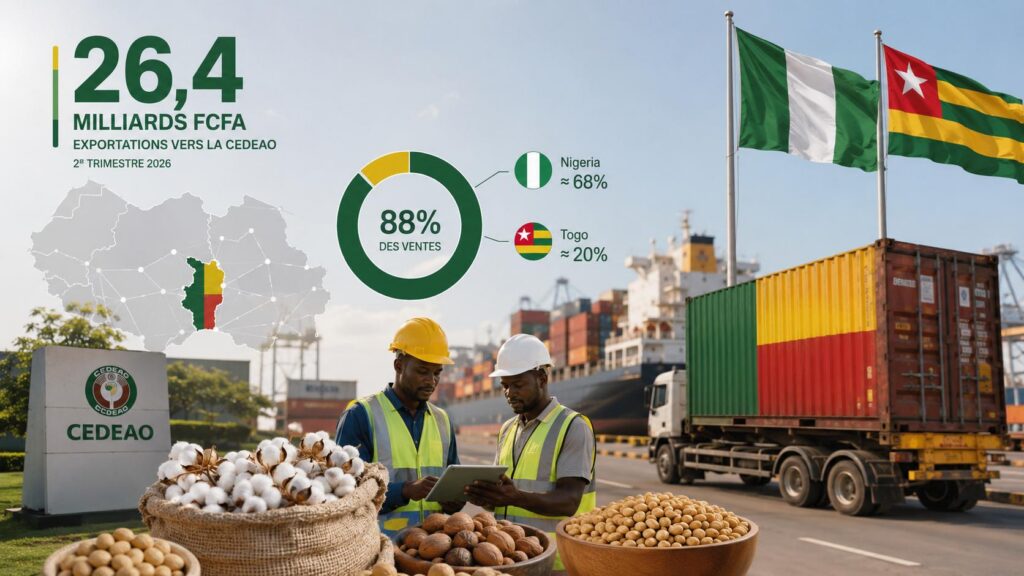
The latest trade figures from the second quarter of 2026 reveal a significant milestone for Benin‘s economic ambitions. Exporting 26.4 billion FCFA worth of goods to ECOWAS member states, the country is reinforcing its position as a key player in West African commerce. This surge, driven largely by demand from Nigeria and Togo, underscores both the untapped potential of regional trade and the success of policies focused on industrialization, competition, and economic integration.
The second-quarter data paints a promising picture for Benin‘s economic trajectory. Out of the total national exports, 26.4 billion FCFA—equivalent to 14%—were directed to other ECOWAS nations, marking a notable step forward in diversifying trade partners.
Nigeria and Togo: the twin engines of Benin’s regional trade
Nigeria, the region’s economic powerhouse and Benin‘s immediate neighbor, accounted for 56.1% of the country’s ECOWAS-bound exports. Close behind, Togo absorbed 31.7%, while Côte d’Ivoire contributed 5.1%. Together, these two neighbors represent a staggering 87.8% of Benin‘s regional trade, highlighting both the opportunities and challenges ahead.
This concentration of trade partners offers a dual lesson. On one hand, it reflects a reliance on a few key markets, but on the other, it presents a strategic opportunity to deepen economic ties and foster regional integration. Strengthening these connections could unlock new avenues for production, investment, and employment across Benin and its neighbors.
Nigeria: a gateway to high-value exports
The commercial relationship with Nigeria stands out as particularly vital. Geographical proximity, a massive consumer base, and cross-border trade dynamics make this market indispensable for Beninese businesses. During the second quarter, exports to Nigeria were dominated by petroleum oils and bituminous minerals, totaling 7.6 billion FCFA and over 8,500 tons. Reinforcing this trend, iron and steel bars destined for re-export fetched 3.3 billion FCFA, while soya bean oil and its fractions accounted for 2.3 billion FCFA.
These transactions are more than mere statistics—they represent entire supply chains, from farmers and transporters to port operators and manufacturers. The fluidity of these exchanges is critical not only for businesses but for the thousands of workers whose livelihoods depend on them.
From raw materials to added value: the transformation agenda
Since 2016, Benin‘s government has prioritized economic modernization, infrastructure development, and agricultural transformation. The goal is clear: shift from exporting raw materials to creating higher-value products domestically. This strategy is already bearing fruit in trade with Togo, where cotton seeds, solid residues, and unprocessed fabrics are among the top exports, totaling 4.4 billion FCFA combined.
The cotton sector exemplifies this evolution. Once confined to agricultural production, it now feeds into a burgeoning textile industry, offering employment opportunities and boosting local revenues. This transformation is supported by new industrial zones and infrastructure projects designed to attract investors and streamline production.
A ripple effect on jobs and infrastructure
The benefits of expanded regional trade extend far beyond export figures. Increased sales abroad drive demand for production, packaging, storage, and logistics, supporting a wide network of workers—from farmers to drivers, logistics providers, and service providers. This economic momentum translates into stronger revenues for businesses, greater investment, and improved production capacity.
For Beninese households, the advantages are tangible. A thriving export sector creates jobs, especially for young workers, while upgraded infrastructure eases transportation and commerce. New industrial units diversify employment opportunities beyond traditional sectors, fostering broader economic resilience.
Modern infrastructure—roads, logistics hubs, ports, and industrial parks—plays a pivotal role in reducing costs and delays, key factors in maintaining competitiveness. These developments are not just about trade; they are about laying the foundation for sustainable growth.
Côte d’Ivoire: a rising partner in West African trade
While Nigeria and Togo dominate Beninese exports, the presence of Côte d’Ivoire in the top three highlights the potential for further diversification. Exports to Côte d’Ivoire included unprocessed cotton fabrics worth 1 billion FCFA, alongside paints, varnishes, and certain plastics, totaling significant volumes.
Expanding into new markets like Côte d’Ivoire reduces dependence on a single trading partner and strengthens Benin’s resilience against market fluctuations. The challenge ahead is to build on this momentum, leveraging the country’s strengths in agriculture, textiles, and agro-processing to capture higher-value segments of regional demand.
Diversification: the next frontier for Benin’s economy
The current concentration of exports in Nigeria and Togo is a double-edged sword. It demonstrates the strength of these markets but also underscores the need for diversification. The path forward involves expanding into Côte d’Ivoire and other ECOWAS economies while introducing new processed products.
Areas such as agricultural processing, textile manufacturing, food industries, and finished goods hold immense potential for increasing the value of Beninese exports. The ultimate goal is not merely to sell more but to produce more, add value locally, and command higher prices in regional markets.
Building a sustainable economic future
The 26.4 billion FCFA in ECOWAS exports for the second quarter of 2026 is more than a statistical achievement—it is a testament to Benin‘s growing integration into West Africa’s economic landscape. Positioned at the heart of a region with hundreds of millions of consumers, Benin can leverage its proximity to Nigeria and its connections to other ECOWAS nations to drive sustained growth.
Since 2016, government strategy has centered on infrastructure, industrialization, agricultural modernization, and improving the business environment. While trade figures alone cannot capture the full scope of economic transformation, they provide a clear indication of Benin‘s progress in strengthening regional ties and maximizing its inherent advantages.
The next phase must translate this commercial dynamism into tangible benefits for the population: more jobs, higher incomes, and increased domestic value addition. By positioning regional trade as a catalyst for sustainable development, Benin is not only boosting its exports but also laying the groundwork for long-term prosperity.