Niamey welcomes new AES parliament as democratic concerns mount
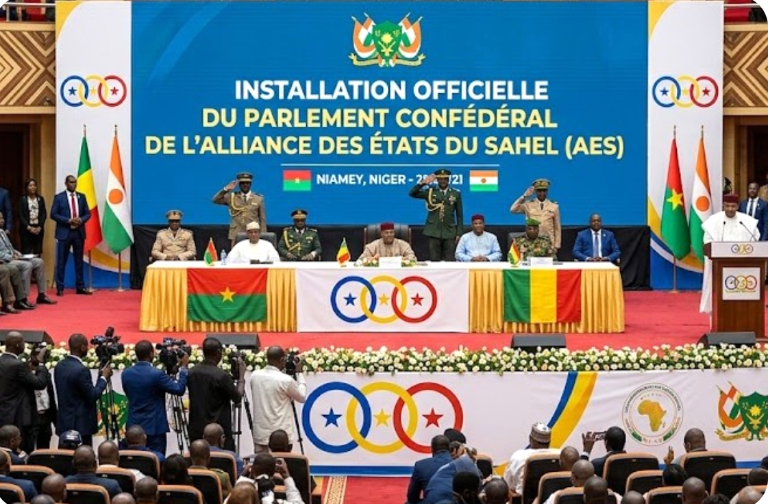
The Alliance of Sahel States (AES) has reached a milestone with the establishment of its confederal parliament in Niamey, but serious questions linger about its democratic foundations. The newly formed institution, composed of 45 deputies (15 from each member state—Burkina Faso, Mali, and Niger), has already adopted internal rules and set up three key commissions focused on defense, diplomacy, and development.
A mirror of regional institutions without popular mandate
The AES parliament’s structure closely resembles that of the Economic Community of West African States (ECOWAS), despite the alliance’s criticism of the bloc’s alleged lack of sovereignty. Both feature a confederal design and shared political bodies, though the AES version raises critical concerns about representation.
While ECOWAS’s parliament aims to eventually elect representatives through universal suffrage, the AES assembly was formed through selections from national assemblies in Burkina Faso, Mali, and Niger—all now under military rule following recent coups. The contrast between institutional ambition and democratic deficit is stark.
Military regimes and the erosion of political freedoms
The three countries driving the AES project—Burkina Faso, Mali, and Niger—have all experienced prolonged transitions under junta leadership. Burkina Faso’s interim leader, Ibrahim Traoré, has publicly dismissed democracy as incompatible with the nation’s needs, going so far as to dissolve political parties. Meanwhile, Mali’s 2020 and 2021 coups entrenched military control, delaying elections indefinitely. Niger, under similar circumstances since 2023, has also seen its political landscape shrink.
These developments underscore a troubling paradox: the AES seeks to replace ECOWAS’s perceived flaws with its own institutions, yet risks replicating them without addressing the core issue of popular legitimacy. How can a parliament claim to represent citizens when those citizens lack the right to freely choose their leaders?
Sovereignty at the expense of citizen rights
The AES champions sovereignty in all forms—political, economic, and military—yet the concept’s most essential dimension is missing: the sovereignty of the individual. The alliance’s focus on external independence overshadows the need for domestic accountability, where freedoms of speech, assembly, and political participation remain severely restricted.
Millions across the Sahel face daily threats from armed groups, economic hardship, and collapsing public services. While institutions like the AES parliament may promise regional integration, they offer little immediate relief to those grappling with insecurity and poverty. A parliament, no matter how well-structured, cannot substitute for functioning schools, hospitals, or security.
Togo’s shifting role in the regional puzzle
Though not an AES member, Togo’s evolving political alignment with the alliance’s military regimes warrants attention. Since adopting a parliamentary system in 2024, President Faure Gnassingbé has consolidated power under the guise of constitutional reform, sparking protests and crackdowns. Restrictions on media and civil society, along with arrests of dissenters, have fueled concerns over Togo’s democratic trajectory.
Recent incidents, including the detention of foreign journalists and bans on international broadcasters, further highlight the country’s tightening grip on dissent. As Lomé deepens ties with Niamey, Ouagadougou, and Bamako, its own democratic backsliding raises alarms about the broader regional trend.
The road ahead: democracy or institutional facade?
The AES parliament’s creation marks a pivotal moment for the Sahel, but its legacy will hinge on whether it prioritizes citizens or consolidates junta rule. True sovereignty demands more than anti-Western rhetoric; it requires transparent governance, free elections, and protections for fundamental freedoms.
Without these, the alliance risks becoming a hollow replica of ECOWAS—built on ceremony and commissions, yet devoid of genuine democratic substance.