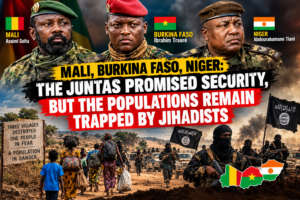
The military leaders of Mali, Burkina Faso, and Niger are convening in Bamako for a two-day summit starting Monday. This second session of the Alliance of Sahel States (AES) heads of state assembly will assess progress since the Niamey founding summit on July 6, 2024, evaluate security, diplomatic, and developmental challenges, and appoint a new confederation president.
According to the Malian government, the meeting aims to review the implementation of the roadmap during the confederation’s first year and advance the operationalization of its institutions. Regional and international stakes will also feature prominently in the December 22-23 discussions.
The roadmap has already enabled the functioning of confederation bodies and strengthened coordination among the three member states. The Malian presidency highlights additional notable progress made during the AES’s first year.
What is the AES Unified Force?
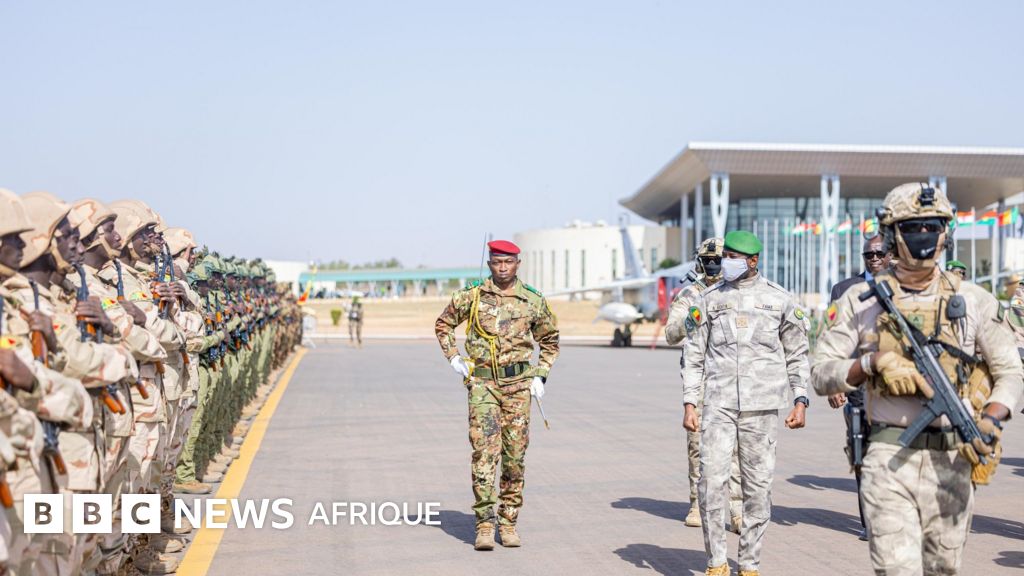
The AES Unified Force (FU-AES) was officially launched in Bamako on December 20 during a ceremony presided over by Malian Transition President and AES Confederation President, General Assimi Goïta. This multinational force comprises 5,000 soldiers from Mali, Burkina Faso, and Niger, led by Burkina Faso’s General Daouda Traoré.
The three countries, facing persistent security challenges, including armed attacks, border instability, and the mobility of armed groups operating across borders, have prioritized military coordination. This includes intensifying exchanges between military leaders, enhancing information sharing, and synchronizing operations to reduce risks in vulnerable border areas.
The activation of the AES Unified Force in Bamako last weekend marks a critical step toward achieving these shared security objectives.
How can the unified force achieve its objectives?
The AES Unified Force represents an irreversible commitment by the three member states to mutualize their resources and strategies. As stated by General Sadio Camara, Mali’s Defense Minister: « Peace, security, and sovereignty cannot be delegated. » He emphasizes that this force embodies a strategic collaboration rooted in Sahelian values of solidarity and dignity.
However, challenges remain. Armed groups continue to operate actively across the tri-border region, posing serious threats to the states. A stark example is the blockade imposed by the JNIM on fuel supplies to Mali.
Fiacre Vidjenagninou, Senior Researcher at the Behanzin Institute in Cotonou, Benin, and Senior Associate Researcher at the Egmont Institute in Brussels, emphasizes that the AES Unified Force will only gain credibility if it delivers tangible results on the ground, alleviating the suffering of local populations.
For Vidjenagninou, the force’s effectiveness hinges on several critical factors:
- Operational efficiency: Command structures, decision-making processes, intelligence sharing, logistics, casualty evacuation, and post-operation territorial control are all vital components.
- Sustainable strategy: Instead of strike-and-retreat tactics, the force must establish long-term control over critical areas, secure markets, protect villages, and reassure communities. Simply striking enemy positions and withdrawing allows armed groups to regroup and resume activities.
- Governance and trust: Victory in battle alone is insufficient. Without minimal governance—addressing local justice, resolving land disputes, and fostering community confidence—the force cannot achieve lasting stabilization.
Vidjenagninou advocates a « intelligence-action fusion » approach: « Collect information, merge it, strike swiftly, and hold the ground. » He warns that fragmented efforts or superficial operations will not suffice in countering the adaptive and resilient nature of armed groups.
Should the force expand to include other countries?
Vidjenagninou advises caution. Expanding the force to include more countries could complicate coordination due to divergent interests and doctrines, sometimes fueled by distrust. His recommended approach is phased and pragmatic:
- Prove the model works: Demonstrate effectiveness with the current three-member alliance.
- Operational cooperation with neighbors: Coordinate targeted operations across specific corridors and strengthen cross-border pursuit agreements.
- Formal integration: Only after establishing trust and proven success should formal expansion be considered.
The AES Unified Force marks a significant political milestone for the three countries. However, its credibility will ultimately be determined by its ability to:
- Unify command structures and decision-making processes.
- Sustain control over territory and protect civilians.
- Deliver lasting results that improve the security and livelihoods of local populations.
During the Bamako summit, the heads of state will hold discussions with the Unified Force’s command. The meeting will also formally establish the Television of the AES (headquartered in Bamako) and the radio station Daandè Liptako, the Voice of Liptako (based in Ouagadougou). Additionally, the Confederation Investment and Development Bank (CIDB), with an initial capital of 500 billion CFA francs, will be a focal point of the agenda.
The creation of the AES follows coups in Mali (August 2020), Burkina Faso (September 2022), and Niger (July 2023). The Economic Community of West African States (ECOWAS) imposed sanctions and threatened military intervention, particularly in Niger. In response, the three states withdrew from the regional bloc and established the Alliance of Sahel States in September 2023, signing the Liptako-Gourma Charter. The alliance evolved into a formally established confederation on July 6, 2024, in Bamako.