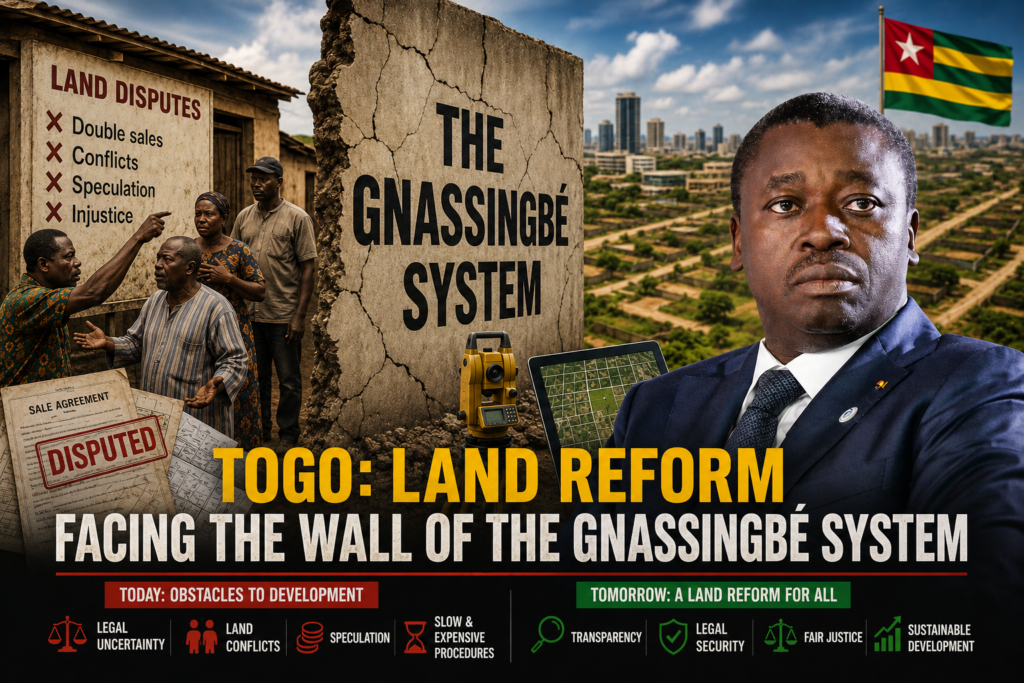
The Togolese government has set out to overhaul its land management system after decades of what many describe as chaotic governance in the sector. While the proposed reforms aim to unlock economic potential, they face significant hurdles rooted in systemic inefficiencies and entrenched practices.
Underlying structural challenges
At the core of the issue lies a pervasive problem of land disputes, exacerbated by practices such as double sales, contested ownership claims, and gaps in record-keeping. The lack of reliable documentation and opaque transaction processes undermine the very concept of secure private property. Even with formal title deeds or purchase agreements, landowners often find themselves entangled in competing legal claims, leaving their investments vulnerable and casting doubt on the legitimacy of their holdings.
This legal uncertainty discourages private investment, erodes household savings, and in some cases, traps individuals in financial liabilities tied to disputed land. The repercussions extend beyond individual households, affecting broader economic stability and investor confidence.
Administrative bottlenecks and inequality
The sluggish pace of administrative procedures further complicates matters. Citizens and businesses alike face cumbersome, costly, and opaque processes when seeking land-related services. Limited access to accurate land information and inconsistent transparency measures disproportionately disadvantage those without financial means, political connections, or insider knowledge. A meaningful reform must prioritize not only the issuance of more land titles but also equitable access to verifiable land histories before transactions are completed.
Judicial delays and unequal justice
Protracted land disputes are more than administrative inconveniences they can devastate families, stall inheritance processes, and block economic development. Timely, equitable, and enforceable judicial decisions are essential to resolving conflicts without bias. However, when land cases drag on for years, the influence of social status, political pressure, or financial leverage often tilts outcomes unfairly. Without an independent, well-resourced, and efficient land judiciary, no administrative reform can achieve lasting impact.
Political and economic entanglements
The land sector involves a complex web of stakeholders, including customary owners, intermediaries, surveyors, local authorities, and state agencies. When ties between these actors and dominant political or economic networks foster conflicts of interest, the risks of favoritism and corruption intensify. A credible reform must dismantle these gray areas rather than perpetuate them under new guises.
The specter of speculation looms large, particularly in rapidly urbanizing areas where land values escalate. Wealthier investors often exploit ambiguities in property rights, leading to multiple sales of the same parcel, land grabs, and manipulations that leave vulnerable populations marginalized. Land, once a family asset, increasingly becomes a speculative commodity accessible only to those with substantial capital.
Social fractures and unresolved customary rights
Land conflicts frequently pit family members against one another, divide neighboring communities, or pit generations against each other over inheritance disputes. Until customary land rights are harmonized with modern legal frameworks and secured with robust safeguards, such tensions will persist. A comprehensive reform should emphasize conflict mediation, preventive measures, and public education on legal procedures to foster broader understanding and compliance.
The role of digital solutions
Digitalization could play a transformative role, but it must go beyond superficial administrative upgrades. A reliable, accessible, and up-to-date land database could drastically reduce instances of double sales and streamline verification processes. However, digital systems alone cannot eradicate fraudulent practices if underlying data is incomplete, susceptible to manipulation, or unevenly accessible.
Transparency as a cornerstone
Clear documentation must extend to the institutions governing land management. Transparent allocation processes, verifiable transaction criteria, and robust accountability mechanisms are essential. Citizens need to know who grants land parcels, under what conditions, and how irregularities are addressed. Without such clarity, skepticism will persist, and each new reform initiative will be met with justified doubt.
Economic stakes and the path forward
A secure land tenure system enables individuals to invest, businesses to expand, financial institutions to assess collateral accurately, and the state to plan territorial development effectively. Conversely, persistent land insecurity immobilizes capital, stifles projects, and fosters an economy rooted in distrust. The stakes are high, affecting not just property owners but the nation’s economic trajectory.
The critical question is not whether reform can be implemented, but whether the political will exists to enforce meaningful change. This requires unwavering transparency, meaningful penalties for fraudulent practices, faster justice delivery, stronger administrative oversight, and enhanced protections for vulnerable groups. Without dismantling entrenched interests and reinforcing the rule of law, any new legislation risks becoming little more than cosmetic adjustments. Until the protection of public interest prevails over private or partisan agendas, land will remain a source of conflict rather than the engine of growth it was meant to be.