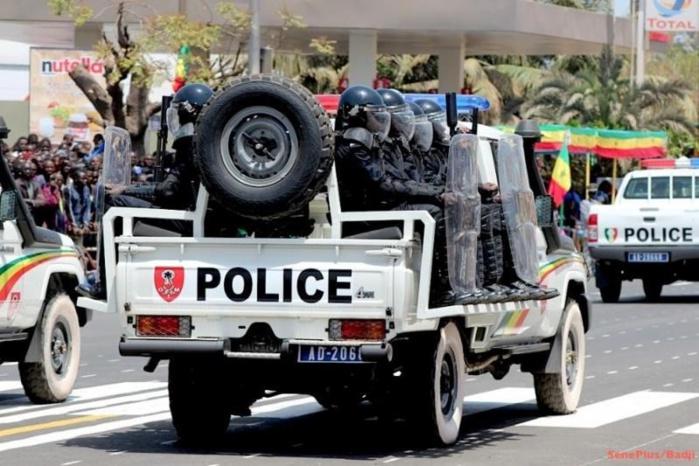
Dakar has seen a sharp increase in police checks targeting foreigners in recent weeks. According to official figures, 490 individuals were verified in just eight days, with 36 subsequently referred to the prosecutor’s office for irregular stay. While authorities frame these operations as routine administrative checks, civil society and immigrant communities express growing unease over what they describe as a climate of rising suspicion.
a student’s unsettling experience
Amadou Bangoura, a 30-year-old student from Benin who has lived in Senegal for five years, recently found himself at the center of one such check. Returning home late from the gym in the Liberté 6 district, he was stopped by police and asked for his papers. Unable to produce them on the spot, he feared the worst: deportation, imprisonment, or a summons before the prosecutor. After verifying his documents at his residence, the officers confirmed everything was in order and closed the case. Yet the incident left him shaken.
His experience is far from unique. Similar checks have multiplied across Dakar and its outskirts in recent weeks, under the banner of enhancing security for both people and property.
numbers reveal intensified operations
Between June 30 and July 8, 2026, the Direction de la police des étrangers et des titres de voyage (DPETV) carried out sweeping verification campaigns in multiple neighborhoods of Dakar and surrounding areas. Official data shows nearly 490 foreigners of various nationalities were checked during this period, and 36 were referred to the prosecutor for irregular stay in the country.
civil society voices strong concerns
These measures have sparked sharp criticism. On July 13, a joint statement by several organizations — including Legs Africa, Frapp, Nawle, Afrikajom Center, and Diwan Citoyen — raised alarm over what they call the proliferation of administrative measures targeting foreigners living or staying in Senegal.
The groups acknowledge that every state has the sovereign right to control its borders, regulate foreign entry and stay, and combat irregular migration. However, they caution against conflating sovereignty with arbitrariness. Their main concern is the shifting perception of foreigners in Senegal: what worries them is not the existence of migration policies per se, but the creeping normalization of a climate of permanent suspicion toward foreigners. In their view, this risks reducing legal stays to a series of bureaucratic ordeals, turning foreigners from rights-bearing individuals into potential administrative liabilities.
balancing security and hospitality
Elimane Kane, president of Legs Africa, stresses that control operations should not be framed as a trade-off between security and hospitality — values long associated with Senegal. While he agrees that border control and identification of entrants are state responsibilities, he warns against interpreting these measures as a rejection of foreigners.
“Security does not exclude otherness,” he insists, calling for better coordination among security forces to prevent checks from being perceived as persecution rather than neutral administrative procedures. Kane also highlights the global reality of labor mobility: “Just as Senegalese go abroad to work, foreigners have the right to come here and work.” He argues that the solution lies not in blaming migrants, but in creating opportunities so young Senegalese can access available jobs.