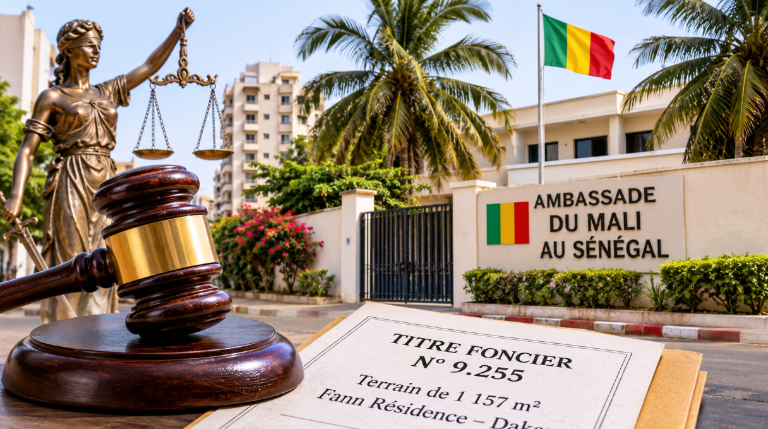
In a landmark legal ruling with far-reaching consequences, Senegalese courts have ordered the eviction of Mali’s embassy from a 1,157 m² plot in Dakar’s Fann Résidence district. The decision, which strips diplomatic immunity of the land dispute context, has set a precedent that could reshape how sovereign property claims are adjudicated on foreign soil. With both countries’ reputations and bilateral relations now in the balance, the case is far more than a routine land dispute—it’s a test of legal sovereignty versus diplomatic protections.
Why the ruling against the Mali embassy matters beyond Dakar
The court’s decision hinges on a foundational real estate claim brought by Immoland SARL, a Senegalese development firm that holds Land Title No. 9.255 to the disputed parcel. The company argues that the Malian embassy has been occupying the site without valid legal title, effectively nullifying any claim to sovereign immunity in this specific instance. The verdict sends a clear message: diplomatic missions are not exempt from property law when their occupancy lacks legal foundation.
But the implications stretch beyond the courtroom. For Immoland SARL—a company with significant stakes in Dakar’s booming real estate market—this ruling validates years of legal struggle and opens the door to reclaiming valuable urban land. For the Malian state, it challenges the long-standing assumption that embassies possess automatic rights to the property they occupy abroad.
The legal framework: when diplomacy meets property rights
The Convention of Vienna on Diplomatic Relations (1961) grants embassies inviolability and immunity from most legal processes. However, these protections do not extend to disputes over ownership or occupancy rights once a sovereign entity occupies land without clear title. The Senegalese court appears to have applied this principle directly, distinguishing between diplomatic immunity and property law. The ruling suggests that while embassies remain protected from coercive measures, their occupancy claims can still be legally contested.
This nuanced interpretation introduces a fragile balance: one that respects diplomatic privileges while upholding national sovereignty over land ownership. It raises urgent questions for international law practitioners and diplomats alike: Can a state enforce property rights against a diplomatic mission when the mission’s presence lacks legal title? And under what conditions can such a ruling be executed without violating diplomatic norms?
Potential fallout for Mali and Senegal’s bilateral ties
The timing of the ruling intensifies its diplomatic weight. Bilateral relations between Senegal and Mali have already faced strain due to regional instability and shifting alliances. Now, with Mali’s embassy at risk of eviction, the dispute risks exacerbating tensions. While the court’s decision targets a legal technicality—occupancy without title—its real-world effect could trigger retaliatory measures, strained consular services, or even reduced economic cooperation.
Malian authorities have yet to publicly respond, but the absence of an official statement does not diminish the potential consequences. Should Mali challenge the ruling through diplomatic channels or international arbitration, the case could escalate beyond national courts and into multilateral forums. That scenario would not only complicate bilateral relations but also test the resilience of West African diplomatic protocols.
What happens next? A timeline of unresolved questions
The court’s order is not yet a fait accompli. Several critical steps remain before the eviction becomes a reality:
- Appeal or compliance: Will Mali file an appeal? Does Immoland SARL seek immediate enforcement or await further legal clarity?
- Evacuation logistics: How will the embassy’s occupants and assets be safely removed without violating diplomatic immunity protocols?
- Property transfer: Will the land revert to Immoland SARL, or could it be subject to third-party claims or government intervention?
- Diplomatic countermeasures: Could Mali impose restrictions on Senegalese diplomats, trade, or consular services in response?
Each of these factors will determine whether the dispute remains a legal footnote or evolves into a full-blown diplomatic crisis. With public scrutiny mounting and regional partners watching closely, the next phase of this case could redefine how African states resolve property disputes involving embassies.
Why this case could reshape Dakar’s real estate landscape
Beyond its diplomatic dimensions, the ruling has the potential to ripple through Senegal’s property market. Fann Résidence, already a prime target for developers, may see increased interest in ownership claims tied to disputed parcels. Immoland SARL’s victory could embolden other firms to pursue similar claims, accelerating legal battles over urban land in a city where real estate demand far outstrips supply.
The case also highlights the risks of opaque land titling systems and slow dispute resolution. If unaddressed, such conflicts could deter foreign investment, chill real estate development, and deepen public distrust in judicial processes. For developers and investors, the ruling serves as both a warning and an opportunity: while legal victories are possible, they come with unpredictable diplomatic and economic costs.
Key takeaways for stakeholders
- Diplomatic missions: Occupancy without clear title is a legal vulnerability—embassies must ensure their property rights are unassailable.
- Developers and investors: Legal challenges to land ownership can yield high stakes—due diligence and aggressive legal strategies may be necessary.
- West African governments: Clarifying property laws for embassies could prevent future disputes and protect bilateral relations.





