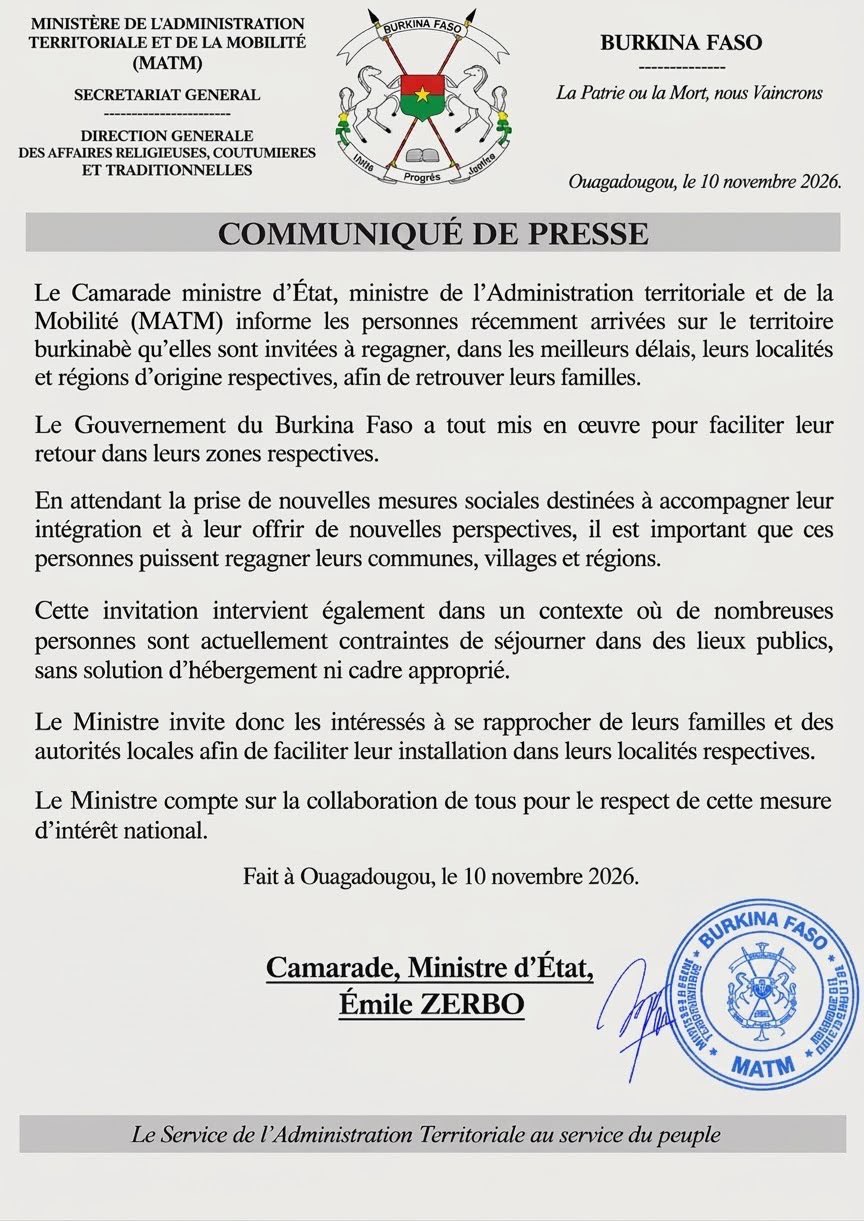
President Ibrahim Traoré’s vision of economic sovereignty is under scrutiny as thousands of Burkinabè miners expelled from Guinea return to a country struggling to provide viable economic opportunities. The crisis extends beyond diplomatic tensions, exposing a harsh reality: the absence of concrete solutions for these returnees, whose livelihoods have been abruptly severed.
The illusion of economic sovereignty for returning miners
Burkina Faso’s leadership has long championed the reclaiming of national resources as a cornerstone of economic independence. Yet the mass expulsion of Burkinabè miners from Guinea has laid bare a glaring contradiction: while the government emphasizes control over gold resources, it offers little in the way of sustainable alternatives for those who once relied on artisanal mining for survival.
The authorities’ response urging returnees to return to their villages and families lacks the structure of a genuine reintegration program. Without clear funding mechanisms, measurable objectives, or a defined timeline, this approach amounts to administrative damage control rather than a solution to the economic void left by their expulsion.
From gold fields to unemployment: the human cost of expulsion
For many of these miners, artisanal gold mining was not a choice but a necessity. In regions where formal employment is scarce, the extraction of gold provided a critical, if unstable, income stream for families. The abrupt loss of this livelihood forces returnees into a precarious position, where unemployment and financial instability threaten their ability to meet basic needs.
The government’s proposed alternatives agriculture, livestock, and vocational training are presented as solutions, yet they fail to address the fundamental barriers to success. Access to arable land, capital for equipment, and reliable markets are not guaranteed. Without these, the shift from mining to farming or craftsmanship remains a theoretical transition, not a practical one.
Why agriculture and livestock are not quick fixes
Transitioning from artisanal mining to agriculture requires more than good intentions. It demands:
Access to fertile land and agricultural inputs
Financial resources to purchase seeds, tools, and livestock
Technical training and veterinary support
Stable markets for selling produce or livestock
Similarly, vocational training programs often touted as a solution must be paired with funding to launch small businesses. A few weeks of training without capital or follow-up support offers no guarantee of employment or income generation.
The funding gap: a critical missing piece
The financial hurdle is one of the most daunting for returnees. Many left Guinea with little more than the clothes on their backs, having spent their savings on the journey home. Without access to microfinance, startup grants, or low-interest loans, the prospect of restarting an economic activity is bleak.
A viable reintegration program must differentiate between returnees with existing agricultural experience and those with no background outside mining. It should also account for the social ripple effects of unemployment families left without income, children pulled from school, and mounting debts. These are not abstract concerns; they are daily realities for thousands of Burkinabè families.
A mining policy that must include small-scale workers
The government’s push for greater control over gold resources cannot ignore the 30,000+ Burkinabè who once depended on artisanal mining. To claim sovereignty over gold while failing to integrate these workers into the formal economy is a paradox that undermines the entire narrative of economic revival.
For a policy to succeed, it must:
Establish regulated artisanal mining sites with improved safety standards
Facilitate the formation of functional cooperatives with access to equipment and markets
Create official gold-buying channels to reduce reliance on informal traders
Invest in infrastructure to support small-scale economic activities
Without these measures, the government risks perpetuating the very issues it seeks to resolve: clandestine mining, environmental degradation, and the economic marginalization of its citizens.
Ibrahim Traoré’s moment of truth
The expulsion crisis is more than a diplomatic challenge; it is a test of governance. While defending the rights of Burkinabè abroad is essential, the true measure of leadership lies in addressing the needs of those who return home. Concrete actions not rhetoric will determine whether the vision of economic sovereignty extends beyond slogans.
The questions are clear: How many returnees will secure stable employment in the coming months? How many will access the capital needed to restart their lives? How many will escape poverty through the government’s proposed programs?
Until these questions are answered with tangible results, the promises of reintegration will remain hollow. Sovereignty is not declared; it is demonstrated through the ability to provide work, income, and dignity to every citizen.
By Georges Essomba — Journalist





