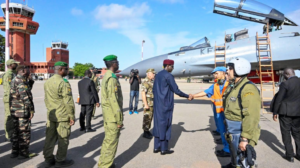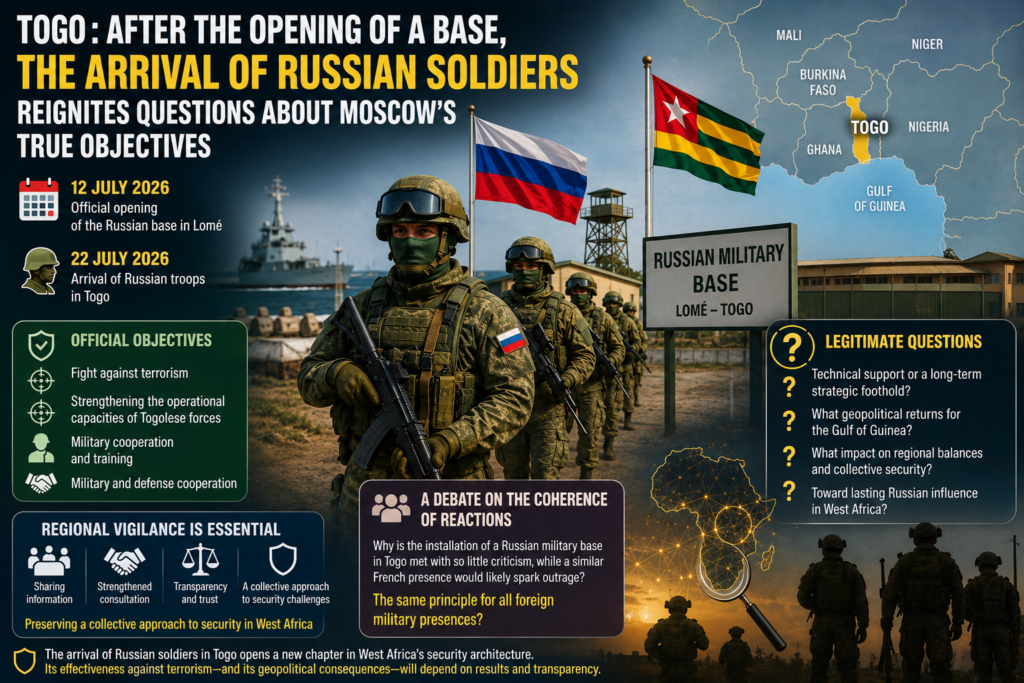
The arrival of Russian military personnel in Togo, following the inauguration of a Russian base on July 12, 2026, marks a significant escalation in security cooperation between Lomé and Moscow. Officially, these forces are deployed to assist in counter-terrorism efforts and to enhance the operational capabilities of the Togolese armed forces.
However, this development has prompted considerable inquiry among observers of West African security. While military cooperation is an inherent sovereign choice for Togolese authorities, the establishment of a lasting foreign military presence in a region grappling with persistent terrorist threats is poised to reshape sub-regional strategic dynamics.
For several years, Russia has steadily augmented its footprint across the African continent through defense agreements, training initiatives, military equipment deliveries, and, in some nations, the deployment of its own military personnel. The presence of Russian soldiers in Togo aligns with this broader trend of deepening security partnerships between Moscow and various African states.
The crucial question now revolves around the ultimate scope of this collaboration. Is it exclusively technical assistance aimed at bolstering Togolese forces in their fight against armed groups active in the country’s north, or does this establishment also signify a long-term Russian strategic objective within the Gulf of Guinea?
These inquiries warrant careful consideration. A foreign military presence extends beyond mere operational support. It can also strengthen cooperation in intelligence sharing, training, logistics, defense industry collaboration, and diplomatic engagement, with implications that transcend the purely military domain.
A debate on the consistency of reactions
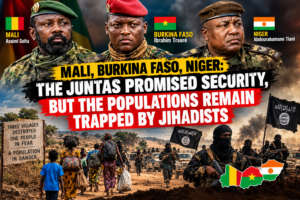
Another element fueling public debate is the apparent divergence in reactions depending on the origin of the military partner. Numerous analysts observe that if a French military base had been opened in Togo under similar circumstances, social media responses would likely have been far more vehement. Authorities from the Alliance of Sahel States (AES) and many of their supporters have frequently denounced the French military presence in West Africa, often characterizing it as interference or a destabilizing factor.
Conversely, the establishment of a Russian base and the deployment of Russian troops in Togo have, thus far, elicited relatively muted criticism from these same circles. This stark contrast prompts further questions from some observers, who perceive a differential appreciation based on the foreign partner’s identity rather than a principled stance against the presence of external military forces.
For these analysts, such an asymmetry raises issues of consistency. If any foreign military presence is deemed a violation of national sovereignty or a risk to regional stability, this principle should be applied uniformly, irrespective of the partner involved. Conversely, if certain presences are deemed acceptable while others are not, it becomes imperative to articulate the criteria underpinning this distinction to foster a public discourse grounded in verifiable arguments rather than solely geopolitical considerations.
For neighboring states, this new strategic reality necessitates heightened vigilance. Without questioning Togo’s sovereign right to choose its defense partners, countries in the sub-region have a vested interest in closely monitoring the evolution of this cooperation to assess its effects on collective security, regional cooperative mechanisms, and diplomatic balances across West Africa.
In an environment where terrorist threats transcend borders and rivalries for influence among external powers intensify, transparency emerges as a critical factor for trust. Regional partners would benefit from enhanced information sharing and consultation mechanisms to mitigate misunderstandings and sustain a collective approach to security challenges.
The establishment of a Russian military presence in Togo thus initiates a new chapter in West Africa’s security architecture. Its effectiveness in counter-terrorism, alongside its geopolitical ramifications, will only become clear through observable results on the ground and the evolving relationships among Lomé, Moscow, and the other states in the region.