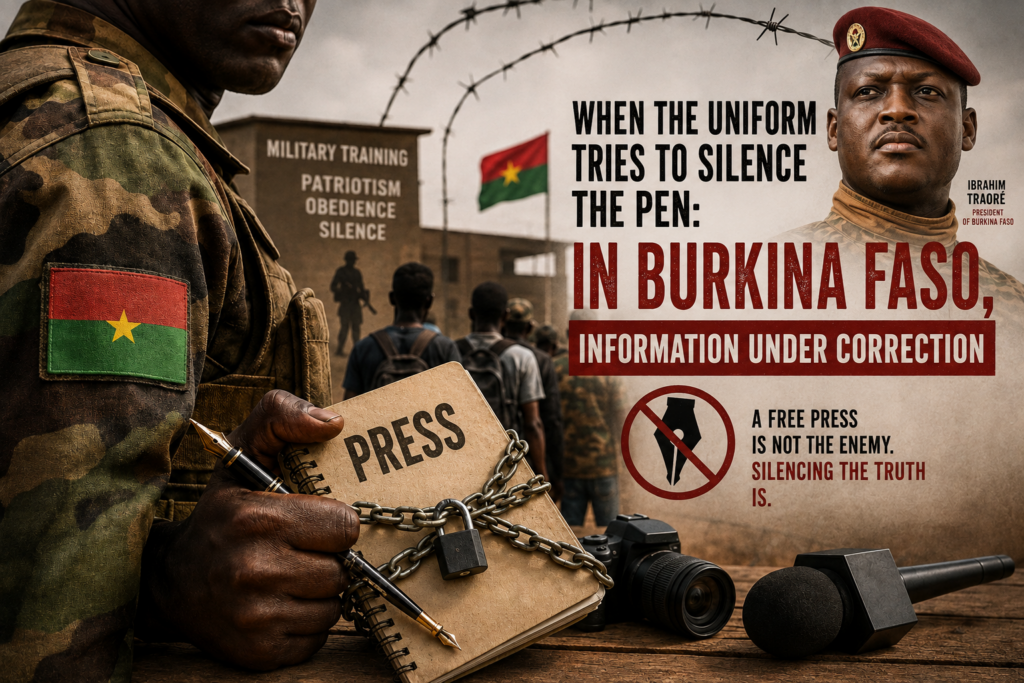
Military Training Disguised as Civic Instruction A Threat to Press Freedom
In a disturbing development for advocates of fundamental freedoms, a recent military-style training programme near Ouagadougou has seen over forty Burkinabè journalists undergo what was officially described as a « patriotism workshop ». Beneath the polished rhetoric of civic duty, however, lies a far more sinister agenda: an attempt to re-educate and subjugate independent journalism under the pretext of national loyalty.
The implications are profound. In today’s Burkina Faso, the act of reporting on security failures, civilian suffering, or institutional shortcomings is increasingly treated as a transgression one that can lead to accusations of « treason » or « unpatriotic conduct ». By compelling journalists to participate in undisclosed military-style re-education camps, the authorities are not fostering informed citizenship; they are manufacturing compliant mouthpieces for state propaganda.
This calculated strategy signals a dangerous shift. It is no longer simply a matter of a military administration responding to a complex security crisis. Rather, it reflects the consolidation of an unchecked authority seeking to impose an absolute model of governance across all spheres of public life. By monopolising the public discourse and silencing dissenting voices, the regime positions itself as the sole arbiter of national truth.
When Journalism Becomes a Tool of State Control
True journalism cannot coexist with enforced ideological conformity. When reporters are coerced into wearing the intellectual uniform of state-sanctioned narratives, the profession ceases to exist in any meaningful sense. The consequences extend beyond individual freedoms: a silenced press leaves citizens adrift, vulnerable to misinformation, hearsay, and arbitrary decision-making.
Patriotism, in this context, appears to demand the abandonment of truth in deference to the ruling power. Yet history has shown that a democracy cannot thrive when its citizens are denied access to reliable information. Transparency, contradiction, and the ability to challenge official narratives are not luxuries they are the bedrock of public trust and collective resilience.
Who Owns the Right to Inform in Times of Crisis?
During periods of heightened insecurity, governments may legitimately request that media outlets exercise caution regarding operational details, troop movements, or sensitive military data. However, such legitimate security concerns must never be exploited to justify the suppression of broader public scrutiny.
The line between necessary confidentiality and political censorship must remain clear. Protecting national security should not become a pretext for converting journalists into instruments of regime stability. The two objectives defending the nation and safeguarding political power are not interchangeable.
This raises a critical question: What does « patriotism » truly entail? Does it require unquestioning allegiance to those in power, or does it permit and indeed demand independent scrutiny of government actions in the service of the people?
A Journalist’s Duty: To Bear Witness, Even When It Discomfits
A journalist deeply committed to Burkina Faso’s future does not serve the nation by echoing official pronouncements. They serve it by investigating the challenges faced by communities, documenting displacement, questioning authorities, and exposing systemic failures that weaken the state from within. In a functioning democracy, the role of the press is not to protect the image of the government but to serve the public’s right to know.
Governments may challenge published reports, present counter-evidence, or utilise legal avenues to address perceived inaccuracies. What they must never do is dictate in advance what journalists are permitted to think or publish.
The Paradox of a Controlled Narrative
The attempt to dominate public discourse by force carries a paradoxical risk: it does not eliminate unchecked information it merely drives it into the shadows. When credible media outlets refrain from reporting on sensitive issues, the resulting vacuum is swiftly filled by unverified rumours, social media speculation, and clandestine narratives. Far from restoring order, such censorship erodes trust in institutions and fuels uncertainty among the populace.
Trust is not decreed by decree; it is earned through openness, accountability, and the freedom to verify official claims. A society in which certain truths become dangerous to tell is one in which doubt permeates every aspect of public life.
Militarising Journalism: A Dangerous Convergence of Roles
There exists a fundamental incompatibility between military discipline and journalistic independence. The former is governed by command, secrecy, and obedience. The latter thrives on verification, contradiction, and editorial autonomy. To merge these paradigms is to risk reducing the press to an extension of state authority.
This raises broader concerns: if journalists are now required to demonstrate their patriotism through ideological conformity, which professions might be next? Academics, judges, artists, civil society leaders could they soon face similar ideological evaluations for daring to criticise government policy?
A Democratic Test: Can Criticism Be Separated from Hostility?
A resilient democracy is measured not by its ability to silence dissent but by its capacity to withstand scrutiny without branding every critique an act of betrayal. The historical record offers a clear warning: regimes that attempt to control all information rarely succeed in controlling reality. Facts have a way of persisting through personal testimonies, diaspora networks, social media, and international reporting.
The real challenge is not how to impose a single narrative, but how to create an environment where reliable information can flow freely. In a nation engaged in a protracted conflict, the responsibilities of journalists are immense. Yet so too are the responsibilities of those in power: to protect citizens without transforming national security into a permanent justification for the erosion of liberties.
Patriotism or Censorship? The Future of Burkina Faso’s Public Sphere
Patriotism should never be weaponised to silence truth. Nor should it be used to distinguish between « loyal » citizens and those who ask difficult questions. A journalist who exposes a state weakness is not betraying the country; they may be preventing that weakness from escalating into catastrophe.
The current trajectory in Burkina Faso raises a fundamental question about the kind of society the nation aspires to build. Is the goal a country where information must first receive state approval, or one where the state accepts that uncomfortable truths are an essential part of democratic life?
If patriotism today is defined as turning a blind eye to reality in order to please those in power, then the very foundations of Burkina Faso’s democracy are marching in lockstep toward authoritarianism. But if patriotism means serving the nation with integrity, then journalists must retain the right and the duty to face reality squarely, even when it challenges those who govern.