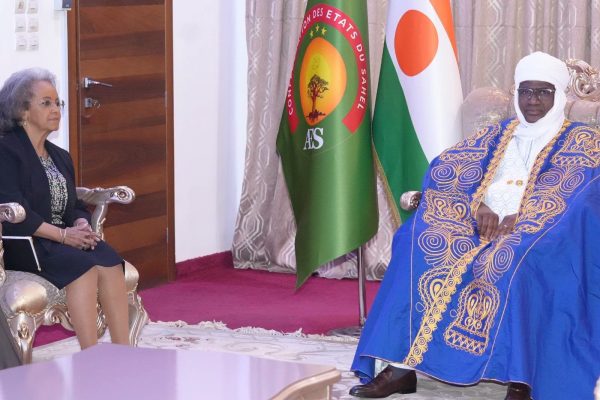
Niamey — Niger is stepping into the spotlight as discussions intensify on the future of the United Nations Office for West Africa and the Sahel (UNOWAS). In a pivotal meeting at the Presidential Palace, Dr. Mamoudou Harouna Djingarey, Chairman of the National Advisory Council for Refoundation (CCR), engaged with Sahle-Work Zewde, Ethiopia’s former President and Head of the Independent Strategic Review (ISR) mission evaluating UNOWAS. This high-level dialogue reflects Niamey’s commitment to shaping the bureau’s evolving role amid shifting regional dynamics.
The discussions unfolded against a backdrop of profound transformations across the Sahel, where security crises, political transitions, and humanitarian challenges have reshaped the landscape. The ISR mission, now in its final phase, is gathering input from regional leaders to assess UNOWAS’s effectiveness and propose reforms aligned with contemporary needs.
Niger’s refoundation priorities take the global stage
During the meeting, Dr. Djingarey outlined the CCR’s mandate, emphasizing its dual focus on strengthening national sovereignty and fostering social cohesion. These pillars, he stressed, are critical not only for Niger’s stability but also for addressing the broader Sahel crisis. The discussions covered governance, regional stability, conflict prevention, and cross-border cooperation frameworks.
Sahle-Work Zewde acknowledged the depth of the exchanges, highlighting Niger’s proactive approach to redefining its relationship with international institutions. The insights gathered from Niamey will be instrumental in shaping the ISR’s final recommendations, which aim to realign UNOWAS’s strategies with the realities of a changing Sahel.
Adapting UNOWAS to a new regional order
The ISR’s evaluation seeks to modernize UNOWAS’s mission, ensuring its interventions remain relevant in a region grappling with escalating insecurity, political transitions, and developmental hurdles. The bureau’s future role hinges on its ability to adapt to these challenges while maintaining regional trust and collaboration.
At the close of the meeting, Sahle-Work Zewde praised Niger’s leadership in articulating a vision for sovereignty and partnership. The CCR’s contributions, she noted, will directly inform the ISR’s conclusions and the broader conversation on UNOWAS’s strategic direction.
Sovereignty and diplomacy in focus
This engagement underscores Niger’s firm stance on diplomatic engagement—one that prioritizes national sovereignty while engaging constructively with global partners. Abdou Moustapha, General Rapporteur of the CCR, joined the discussions, reinforcing the Council’s role in bridging local priorities with international cooperation.
The meeting marks another milestone in the ISR mission’s consultations, with its findings expected to guide UNOWAS’s future trajectory as it navigates the Sahel’s complex challenges.