Niamey’s streets return to tranquility amid lingering tensions
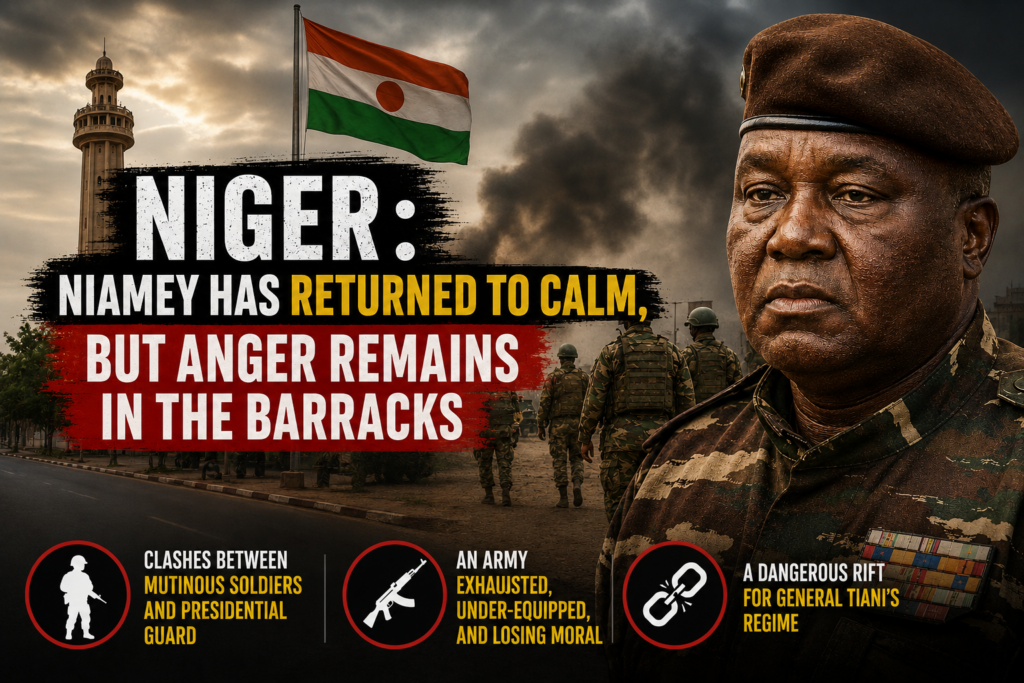
Following a turbulent weekend marked by intense gunfire and explosions, the streets of Niamey have reverted to their usual calm. However, beneath this apparent serenity, palpable tension persists within the capital’s barracks. The clashes, which erupted between mutinous soldiers and presidential guard units reinforced by Russian Africa Corps personnel have left an indelible mark on the military landscape.
Unaddressed grievances fuel discontent in the ranks
The official narrative from the National Council for the Safeguarding of the Homeland (CNSP) downplays the severity of the events, describing them as a mere “display of frustration.” Yet, this interpretation fails to address the underlying issues plaguing the armed forces. When soldiers tasked with defending a regime turn against their own leadership, the implications extend far beyond a temporary barracks incident. The episode raises critical questions about the army’s internal cohesion, operational conditions, and the trust or lack thereof between troops and their command structure.
Systemic challenges in the fight against insurgency
The mutiny did not arise in a vacuum. Reports from the front lines reveal a pattern of discontent among soldiers deployed to Niger’s most volatile regions. Years of relentless jihadist attacks have taken a severe toll: mounting casualties, operational fatigue, logistical shortfalls, and inadequate supplies. The disparity between the demands placed on soldiers and the resources provided to meet them has fostered a growing sense of abandonment.
Soldiers may accept the inherent risks of combat, but it is far more difficult to endure these risks without the assurance of proper equipment and support. This disconnect between expectation and reality is a pivotal factor in understanding the unrest.
The sovereignty narrative vs. battlefield realities
The CNSP’s emphasis on military sovereignty and strategic partnerships particularly with Russian forces has been central to its political discourse. While the regime champions self-reliance and reduced dependence on Western allies, the soldiers bearing the brunt of the conflict face a different reality. For them, the priority remains survival: Do they possess the necessary tools to secure their positions and return home alive?
Outdated weaponry, insufficient armored vehicles, logistical bottlenecks, and weak operational support are not abstract concerns but concrete threats to their safety. In asymmetric warfare, where adversaries exploit every weakness, such deficiencies can have devastating consequences.
Fatigue and disillusionment erode troop morale
The strain of prolonged conflict extends beyond physical exhaustion. Repeated losses, unrelenting attacks, and unmet promises of territorial recovery have eroded morale within the ranks. When soldiers perceive their sacrifices as unappreciated or their leadership as disconnected from their struggles, frustration can metastasize into defiance.
The unrest in Niamey’s barracks is not merely an isolated incident but a symptom of a deeper crisis. A demoralized and exhausted army is less effective, and its cohesion becomes increasingly fragile. The mutiny, regardless of its immediate outcome, underscores a fundamental question: How long can an institution endure the chasm between political ambitions and the daily realities of its soldiers?
Fractures within the military hierarchy
The mutiny may also reflect a widening rift between the upper echelons of the military command and operational units. While the regime champions sovereignty and strategic shifts, frontline soldiers often view these measures as insufficient against the immediacy of the threat. This divergence in perception is particularly perilous for a military-led government, whose legitimacy hinges on the unity of its armed forces.
A regime’s survival depends not only on the loyalty of units tasked with protecting its leaders but on the cohesion of the entire military institution. When fractures emerge, the consequences are both military and political.
The role of foreign forces under scrutiny
The involvement of Russian Africa Corps personnel alongside the presidential guard during the clashes introduces another layer of complexity. The deployment of foreign troops was framed as a means to enhance Niger’s military sovereignty and reduce reliance on Western partners. Yet, the necessity of foreign intervention in a conflict between Nigerien soldiers raises troubling questions: Can external support compensate for internal fractures within the national army?
Foreign partners can provide manpower, equipment, and expertise, but they cannot replace the cohesion, trust, and structural resilience that define a sovereign military. Nor can they single-handedly resolve the systemic issues plaguing the front lines.
The general’s silence deepens the mystery
The CNSP’s reluctance to disclose detailed information or provide a transparent assessment of the events has only fueled speculation. In an environment where communication is tightly controlled, the lack of clarity surrounding the mutiny leaves critical questions unanswered. The more a regime downplays a crisis, the greater the risk that its true dimensions will be obscured and misunderstood.
The return of calm to Niamey’s streets does not equate to a resolution of the underlying tensions. The gunfire may have ceased, but the grievances that sparked the unrest remain unaddressed. For the regime, this episode serves as a stark reminder that the battle against jihadist groups cannot be waged through political rhetoric or diplomatic alliances alone.
A clarion call for the military leadership
This crisis should prompt the regime to confront a fundamental truth: Victory in the fight against insurgency is contingent not only on strategic alliances or political declarations but on the welfare of the soldiers who carry out the mission. Properly equipped, supported, and motivated troops are the bedrock of any successful counterinsurgency effort.
If the malaise persists, the challenge will no longer be confined to quelling a single mutiny. The regime must address why soldiers tasked with defending the nation have turned against their own command. Niamey may have regained its peace, but within the barracks, the embers of discontent continue to smolder. For the Tiani administration, this silence is not the end of the story but a warning of fissures that could undermine the very foundation of its rule.