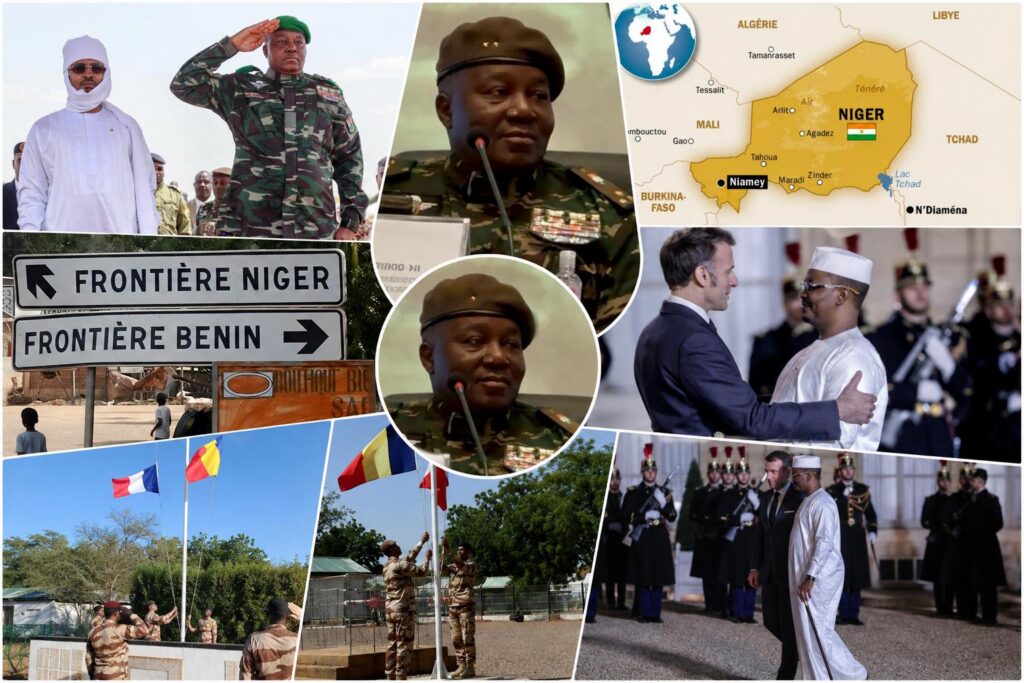
The Niger–Bénin border remains firmly shut, nearly three years after the July 2023 coup in Niamey. Despite renewed diplomatic efforts and technical frameworks addressing security, economic, and legal concerns, Niger‘s demands for guarantees—particularly regarding the absence of perceived hostile forces near its borders—continue to delay reopening this critical trade route.
General Abdourahamane Tiani has repeatedly emphasized that no border reopening can occur without assurances that Bénin will not serve as a staging ground for operations threatening Niger. Yet Cotonou vigorously denies these claims, rejecting accusations that foreign military bases operate within its territory.
Contradictions in Niamey’s stance
The debate intensifies as regional dynamics shift. While Niger insists on security guarantees from Bénin, neighboring Chad is quietly welcoming back French military support—raising questions about consistency in Niamey‘s foreign policy.
After severing military ties with France in late 2024, citing sovereignty concerns, N’Djamena has since engaged in low-profile cooperation with Paris. This pragmatic adjustment addresses pressing security challenges, including spillover from Sudan’s conflict, Boko Haram threats in the Lake Chad Basin, and critical gaps in intelligence and logistics.
For Niger, this presents a dilemma: if French military engagement in Bénin justifies border closure, why does a similar presence in Chad—also a neighboring state—warrant a different response? The geographical proximity of Chad to Niger makes this inconsistency even more glaring.
Sovereignty vs. strategic pragmatism
The situation underscores a broader regional divide. While Mali, Burkina Faso, and Niger have prioritized distancing themselves from former colonial powers, Chad has opted for selective re-engagement with France. This divergence tests the limits of Niamey‘s sovereignist doctrine.
If Niger claims the right to scrutinize its neighbors’ military partnerships, it must apply the same scrutiny uniformly. Otherwise, its position risks being perceived as inconsistent—or worse, politically motivated.
Economic and security stakes
The prolonged closure has exacted a heavy toll on border communities, disrupting trade and fueling tensions among local populations, transporters, and security forces. Cross-border violence involving Bénin, Niger, and Nigeria has surged, further underscoring the need for coordinated security measures.
Yet resolving the impasse requires moving beyond the French military debate. Niamey and Cotonou must anchor their discussions in verifiable security frameworks, mutual transparency, and reciprocal commitments—principles that should extend equally to all regional partners.
Diplomatic crossroads
The return of French military cooperation in Chad forces Niger to confront a fundamental question: Does sovereignty mean rejecting all foreign military partnerships by neighbors, or does it mean respecting each state’s right to choose its own defense arrangements? The answer will shape not only Niger–Bénin relations but the broader trajectory of Sahel diplomacy.
As the region grapples with evolving security threats, the crisis along the Niger–Bénin border may ultimately hinge on whether Niamey can reconcile its sovereignist rhetoric with the realities of regional cooperation.