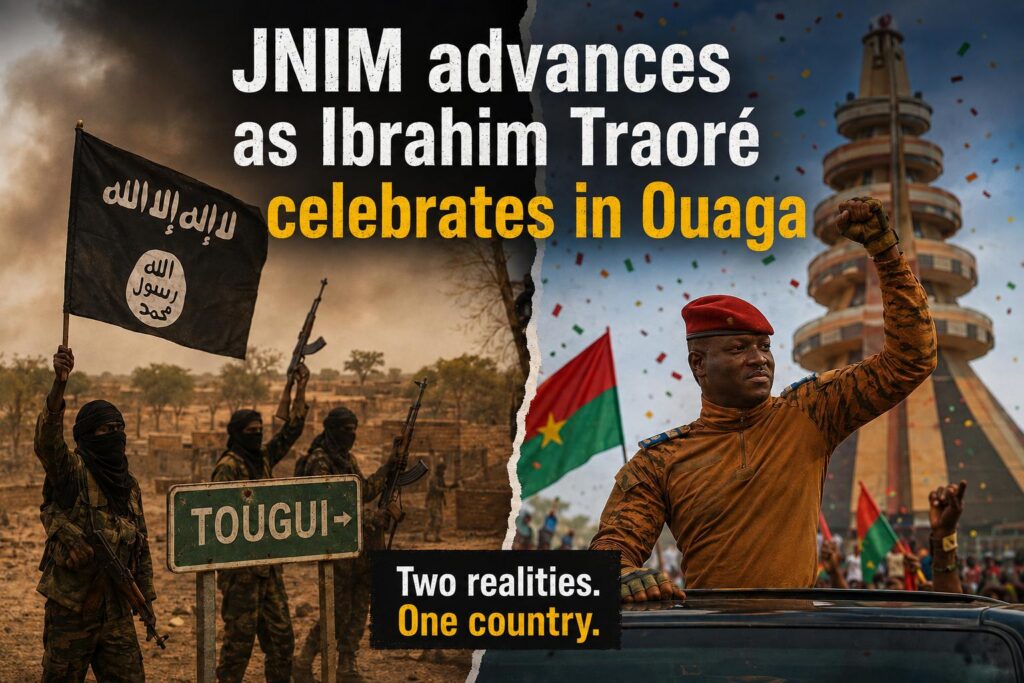
Contradictions between Official Narrative and Ground Reality
While official communications from Captain Ibrahim Traoré continue to highlight a systematic territorial recovery, recent events paint a markedly different picture. On the evening of August 26, 2026, the Group for the Support of Islam and Muslims (JNIM) claimed responsibility for seizing a military outpost held by local militias in Tougui, near Ouahigouya. Although such claims require independent verification, they underscore a critical inconsistency: if territorial recovery is advancing as proclaimed, why do armed groups retain the capacity to strike or contest strategic zones in northern Burkina Faso?
The incident in Tougui is more than just another confrontation; it serves as a reminder to scrutinize the alignment—or lack thereof—between political rhetoric, military announcements, and the lived experiences of local populations.
Territorial Control: A Question of Sustainability
Asserting control over a region is not merely about reclaiming land. True territorial mastery demands a sustained state presence, secured transport routes, protected civilians, and the ability to prevent armed groups from re-establishing themselves in recovered areas. The persistence of attacks and rival claims demonstrates how fragile this stability remains.
Recapturing a position does not automatically equate to long-term security. The return of displaced residents, reopening of schools, and resumption of economic activity are the true measures of success. Without these, military victories risk being temporary at best.
Vulnerabilities in Isolated Positions
The Tougui incident also highlights the precariousness of forward operating bases. When such positions rely heavily on local fighters and remain exposed to better-organized armed groups, their retention becomes increasingly tenuous.
Human Cost of Asymmetric Warfare
The reliance on civilian volunteers, known as the Volunteers for the Defense of the Homeland (VDP), bolsters troop numbers but places an unsustainable burden on local communities. Deploying armed civilians to defend rural areas shifts a disproportionate share of the conflict’s human cost onto those least equipped to bear it.
Beyond Numbers: The Limitations of Military Expansion
An increased fighting force does not guarantee improved security. Intelligence gathering, operational mobility, logistics, inter-unit coordination, and post-capture surveillance are equally vital. These factors often determine whether a regained area remains under control.
The Dangers of Unsecured Gray Zones
Between officially declared safe zones and areas truly accessible to civilians without risk, gaps persist. These intermediary spaces can become havens for armed groups to regroup, recruit, resupply, or maneuver. Such zones undermine broader security efforts by allowing insurgents to maintain operational capabilities.
The Risks of Selective Official Communication
While authorities frequently emphasize successful operations and localized improvements—such as a reported ‘continuous calm’ in the Nazinon region in July—such positive updates do not reflect the broader national landscape. A selective portrayal of progress risks obscuring the true state of affairs.
The absence of acknowledgment regarding setbacks fuels public uncertainty. In any conflict, operational challenges are inevitable. The greater issue arises when citizens lack clear information to differentiate between isolated successes and systemic security improvements.
Credibility Hinges on Balanced Reporting
The government has underscored the importance of combating misinformation and called for public vigilance against disinformation campaigns. However, a communication strategy focused solely on triumphalism risks eroding credibility. Transparency about challenges is essential for maintaining public trust.
Measuring Success Beyond Military Claims
The true benchmark for success should not be the number of operations conducted or positions reclaimed. Instead, it should be measured by tangible outcomes: villages that remain secure, displaced populations able to return home, functional schools and markets, and roads where civilians can travel without fear of attack.
Administrative revival is as critical as military presence. A region cannot be deemed truly recovered if security forces are deployed without the corresponding restoration of governance, healthcare, education, and economic infrastructure. Military victory must translate into lasting public authority.
The Paradox of Constant Victory Declarations
Each successful insurgent attack or contested position becomes politically untenable when authorities consistently present the situation as under control. The problem thus evolves from a military challenge to one of credibility.
The Urban-Rural Divide in Perceptions of Security
From the capital, reports of territorial recovery may suggest steady progress. Yet for residents in high-risk zones, security is measured by the ability to sleep safely, cultivate land, travel freely, trade, and send children to school. These are the benchmarks that matter most.
The Unproven Efficacy of Current Security Strategy
While the government points to national mobilization, VDP recruitment, regional cooperation, and military reinforcement as pillars of its approach, their ultimate success hinges on reducing violence sustainably and eliminating insurgent sanctuaries. These goals remain unmet.
The case of Tougui raises a fundamental question: if a strategic position in northern Burkina Faso can still be contested by armed groups, can the state truly claim full territorial control? This question warrants objective examination, free from propagandistic framing.
Rethinking Success: Concrete Results Over Rhetoric
A credible security strategy cannot be judged by patriotic slogans, political speeches, or social media triumphs. Its validity is determined by its ability to curb attacks durably and restore normalcy to civilian life.
While authorities continue to report security improvements in select areas, the persistence of insurgent incidents—such as the claim in Tougui—underscores a sobering truth: a war is not won simply because a government declares it so.
The final verdict belongs to the ground itself—and, above all, to the populations bearing its realities.