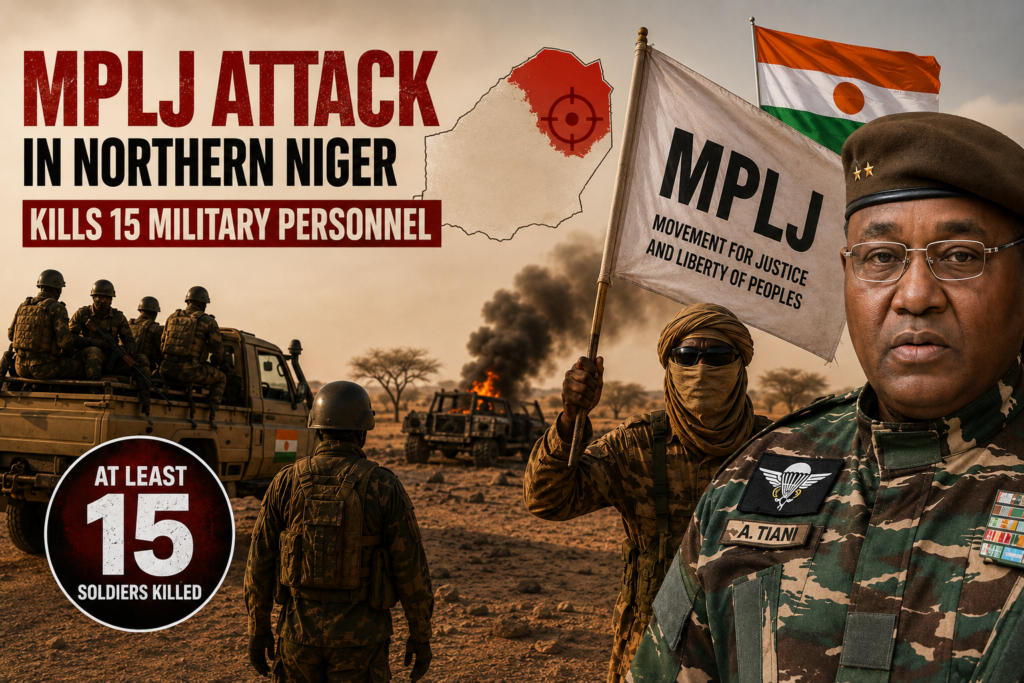
Northern Niger continues to grapple with escalating violence, as a fresh double assault attributed to the Movement for Justice and Liberty of the Peoples (MPLJ) leaves at least 15 soldiers dead. The attacks, unfolding in the vast and sparsely monitored desert regions, underscore the stark challenges facing the military-led government under General Abdourahamane Tiani, which has struggled to deliver on its core mandate: safeguarding citizens and asserting state authority across the country’s expansive terrain.
The limits of military response in a sprawling and porous frontier
The MPLJ’s latest strike is not an isolated incident but a symptom of a broader crisis. The Nigerien military faces an uphill battle in patrolling the nation’s immense, often unforgiving landscapes, particularly along its long borders with states struggling with their own armed insurgencies. These ungoverned spaces serve as ideal corridors for armed groups to regroup, rearm, and launch surprise attacks before melting back into the wilderness.
While immediate military retaliation may provide temporary relief, experts argue that a sustainable security strategy demands far more than firepower. Effective intelligence networks, consistent administrative presence, cross-border cooperation, and proactive measures to prevent armed factions from establishing permanent footholds are all critical components that remain underdeveloped.
A discourse of sovereignty versus ground reality
Since seizing power in July 2023, the military leadership in Niamey has built its legitimacy on promises of a radical break with past security policies. Sovereignty, resistance to foreign interference, and the cultivation of new strategic alliances have dominated official rhetoric. Yet for civilians in conflict-ridden zones, these declarations ring hollow. The true measure of state sovereignty is not measured in diplomatic declarations but in the ability to ensure basic safety: the freedom to move, work, and live without the constant threat of armed violence.
The paradox is glaring. While Niamey projects an image of geopolitical mastery on international stages, local realities tell a different story. Remote border and desert regions are slipping deeper into a security void, exploited by armed factions that thrive in ungoverned spaces. The disconnect between high-level sovereignty narratives and ground-level insecurity exposes a troubling gap in governance.
Diplomatic shifts and the search for scapegoats
With accusations previously directed at France, the Economic Community of West African States (ECOWAS), and regional neighbors, the government now faces a rhetorical dilemma. Will it turn its frustration toward Algeria, a key neighbor and long-standing partner, or will it challenge its newfound allies? The strategy of deflecting blame has reached its structural limits, failing to address the root causes of insecurity.
More critically, the pursuit of new alliances does not automatically translate into an improved security doctrine. What matters is tangible progress: timely intelligence, anticipation of attacks, protection of civilian areas, secure supply routes, and a consistent state presence in vulnerable zones. Diplomatic realignment alone cannot substitute for these fundamentals.
The human cost of unaddressed institutional fragility
It would be shortsighted to view every military setback as the sole responsibility of frontline troops. Their effectiveness hinges on a web of interconnected factors—intelligence quality, logistical support, command structure, air and ground capabilities, and a coherent long-term strategy. Losses in combat must prompt a comprehensive review of the entire security apparatus rather than a hasty search for external culprits.
In a nation where constitutional order was disrupted without an immediate return to safety, the role of national actors is paramount. For lasting stability and genuine protection, both military forces and civil society must critically assess the current trajectory. Restoring constitutional governance is not merely a political imperative—it is the foundation for rebuilding democratic legitimacy and forging credible alliances capable of tackling the terror threat.
Security cannot endure on sovereignty slogans alone. It demands resilient institutions, a clear national strategy, pragmatic regional cooperation, and an administration that reaches even the most distant communities. The MPLJ’s latest assault is more than another tragic chapter in the Sahel conflict—it is a reminder that true sovereignty begins when the state fulfills its most basic duty: protecting those it governs.