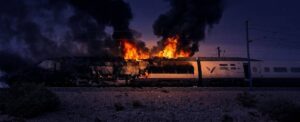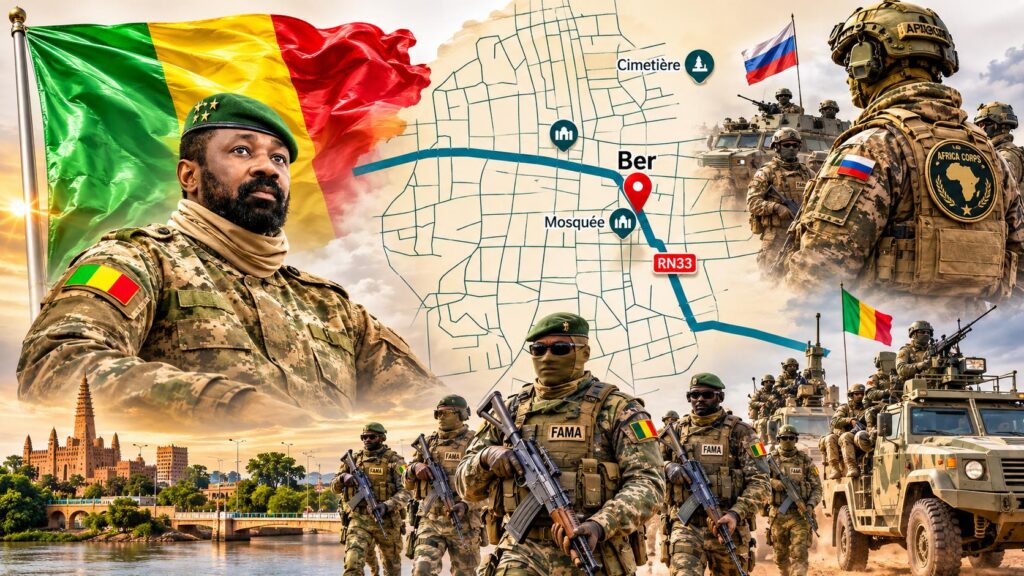
Northern Mali remains a powder keg as Mali’s armed forces discovered just how volatile the situation remains. A military convoy, including soldiers from the FAMa and Russian contractors from the Africa Corps, was ambushed this week near Ber, a strategic outpost in the Tombouctou region. Attackers deployed both small arms fire and improvised explosive devices, a signature tactic of armed groups operating across the country.
At this stage, no verified casualty figures have been released. The lack of confirmed reports underscores the challenges in assessing the true human and material toll of such attacks.
Ber: a crossroads of conflict
Ber, located in the Tombouctou region, has long been a flashpoint in Mali’s prolonged conflict. The area has witnessed repeated clashes between government troops, jihadist factions, and armed movements from the North.
In 2023, the outskirts of Ber saw intense fighting involving FAMa and their Russian allies, coinciding with the withdrawal of the United Nations peacekeeping mission MINUSMA and the military’s resumption of control over former international bases.
Yet three years later, the lesson is clear: holding a town does not mean controlling the roads that lead to it. Across Mali’s vast and often inhospitable terrain, convoys remain vulnerable to roadside bombs, small arms fire, and coordinated assaults.
Evolving threats from armed groups
Mali faces a fragmented threat landscape. The JNIM, an Al-Qaeda-affiliated coalition, remains a dominant force in the North. Meanwhile, separatist factions and shifting alliances continue to complicate the security environment.
Recent intelligence suggests tactical cooperation has emerged between the JNIM and the Front de Libération de l’Azawad (FLA), despite their ideological differences. This convergence targets FAMa and their Russian partners, contributing to a surge in attacks during the first months of 2026.
The result is a security puzzle: Mali is no longer fighting a single enemy, but an array of armed factions with shifting loyalties and varying objectives.
Russia’s Africa Corps at the frontline
Since pivoting away from Western partners, Mali has placed its security strategy in the hands of the Africa Corps, Moscow’s state-backed military unit that now operates alongside FAMa forces across the country.
For the Malian government, this partnership is framed as a step toward national sovereignty and reduced reliance on foreign powers. Yet recent setbacks—including heavy losses around Kidal and Anéfis—highlight the limits of this approach.
The ambush near Ber is not an isolated incident. It reflects a broader pattern of sustained attacks on government supply lines and troop movements, demonstrating that armed groups retain significant operational capacity.
The economic fallout of instability
The security crisis extends far beyond the battlefield, crippling Mali’s economy. The country boasts rich mineral deposits, particularly gold and lithium, but its growth remains tethered to volatile sectors like rain-fed agriculture and commodity exports.
In 2025, fuel supply disruptions—triggered by attacks on critical routes—paralyzed transport, industry, agriculture, and electricity generation. The World Bank reported a slowdown in economic growth, though it projects a rebound in 2026, driven by mining activity.
The International Monetary Fund is equally optimistic, forecasting growth of up to 5.5% in 2026, assuming improved security and a revival in gold production.
Gold: blessing or curse?
The gold sector is central to Mali’s economic prospects. A resolution in late 2025 to a dispute with a major gold producer is expected to boost output, with high prices potentially strengthening public revenue and export earnings.
Yet the same mines and their supply corridors remain exposed to armed groups. Instability in mining zones threatens to derail macroeconomic stability, making security a fiscal imperative for Bamako.
A nation under strain
Behind the statistics lies a population enduring over a decade of conflict. Displacement, disrupted livelihoods, restricted access to healthcare and education, food insecurity, and youth unemployment compound the crisis.
The World Bank estimates that 235,000 young people enter Mali’s job market each year, yet opportunities remain scarce. When roads are cut off, the impact is immediate: farmers cannot sell crops, traders halt operations, and rural communities lose access to essential services.
Political stakes in a fragile transition
Mali’s military-led government faces twin challenges: restoring security and navigating a contentious political transition following the 2020 and 2021 coups.
Through the Alliance of Sahel States (AES)—a partnership with Burkina Faso and Niger—Bamako is pushing for greater regional autonomy. The alliance has launched joint initiatives in security, investment, and development financing.The government frames this as a move toward sovereignty. But it also carries a heavy burden: proving that breaking ties with former allies and embracing new partnerships can deliver stability where others failed.
Ber as a turning point
The ambush near Ber arrives at a critical juncture. It exposes the fragility of military gains in the face of persistent insurgent activity.
For Bamako, the challenge is no longer just reclaiming territory—it is sustaining that control. Without secure supply routes, functioning public services, and safe passage for civilians, any military progress risks being temporary.
The battle for Mali’s future is not just fought in the desert or in barracks. It is waged on roads, in villages, in schools, in mines, and in markets. Until those fronts are secured, peace remains elusive.