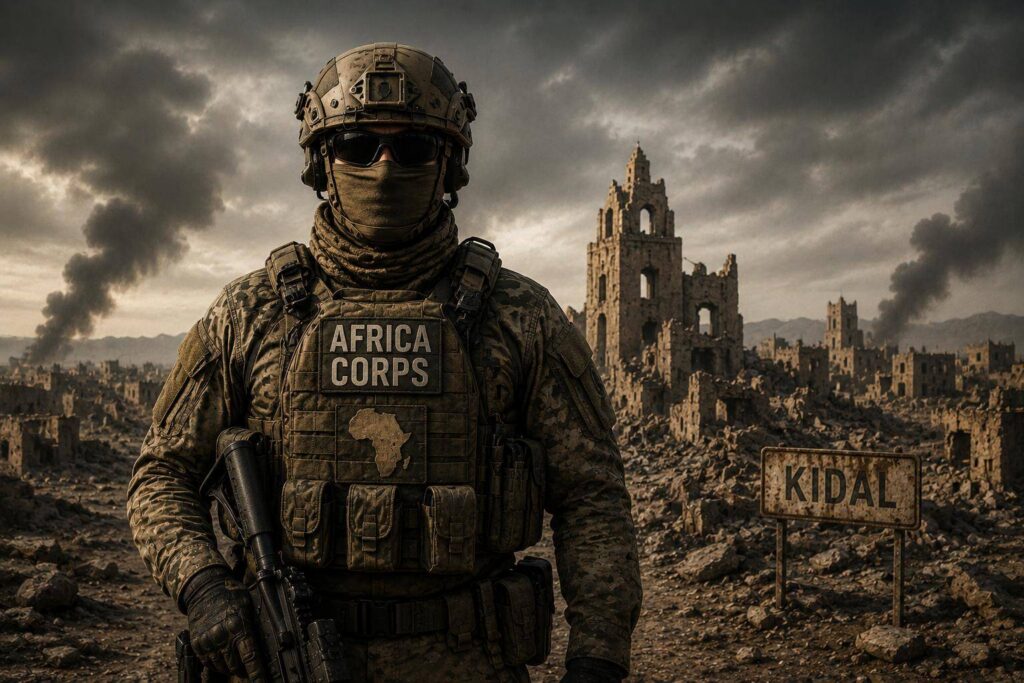
Recent analysis of a statement from the Africa Corps—a key ally of the Malian transitional government—reveals deeper strategic shifts unfolding in northern Mali. While framed in military terms, the wording suggests far-reaching political implications that could reshape the country’s future.
Two possible paths emerging from Bamako’s latest challenge
The Africa Corps’ latest communiqué, though presented as a tactical assessment, hints at a dramatic departure from earlier commitments. The statement’s phrasing—particularly its dismissal of Kidal’s strategic value—raises critical questions about Mali’s next moves and the reliability of its partners.
Could Bamako’s leadership face a political setback?
For months, transitional President Assimi Goïta has staked his legitimacy on reclaiming and holding every inch of Malian territory, with Kidal as the symbolic stronghold. His repeated declarations framed the city’s recapture as a non-negotiable priority—a cornerstone of national pride.
Now, the Africa Corps’ assessment that Kidal is “worthless” and should be avoided directly contradicts this narrative. If the alliance withdraws its support for the city’s defense, it leaves Goïta’s government exposed, forced to confront the impossible task of defending promises it can no longer fulfill. The move signals a potential political rupture, one that could erode public confidence in the transitional leadership.
Is a shadow agreement with armed groups already in motion?
An alternative interpretation suggests a more calculated strategy. By downplaying Kidal’s importance, the Africa Corps may be laying the groundwork for a controversial compromise—one that involves tacit or formal agreements with rebel factions, including the Front de Libération de l’Azawad (FLA) and the Jama’at Nusrat al-Islam wal Muslimin (JNIM).
The phrasing—“We haven’t lost; we’re avoiding a desert trap”—serves as a carefully crafted justification for disengagement. In reality, this language could be masking a prearranged deal, allowing armed groups to consolidate control over northern regions under the guise of “avoiding conflict.” The shift implies that the Africa Corps’ original military objectives have collapsed, leaving Bamako with two stark choices: either sever ties with Goïta’s hardline stance or formalize a non-aggression pact that effectively cedes territory to armed factions.
What this means for Mali’s future
The Africa Corps’ statement isn’t just a military update—it’s a political earthquake. Whether through abandonment or secret negotiations, the implications for Mali’s stability and sovereignty are profound. The coming weeks will reveal whether Bamako can navigate this crisis without losing further ground—or whether the transition’s promises were always destined to unravel.