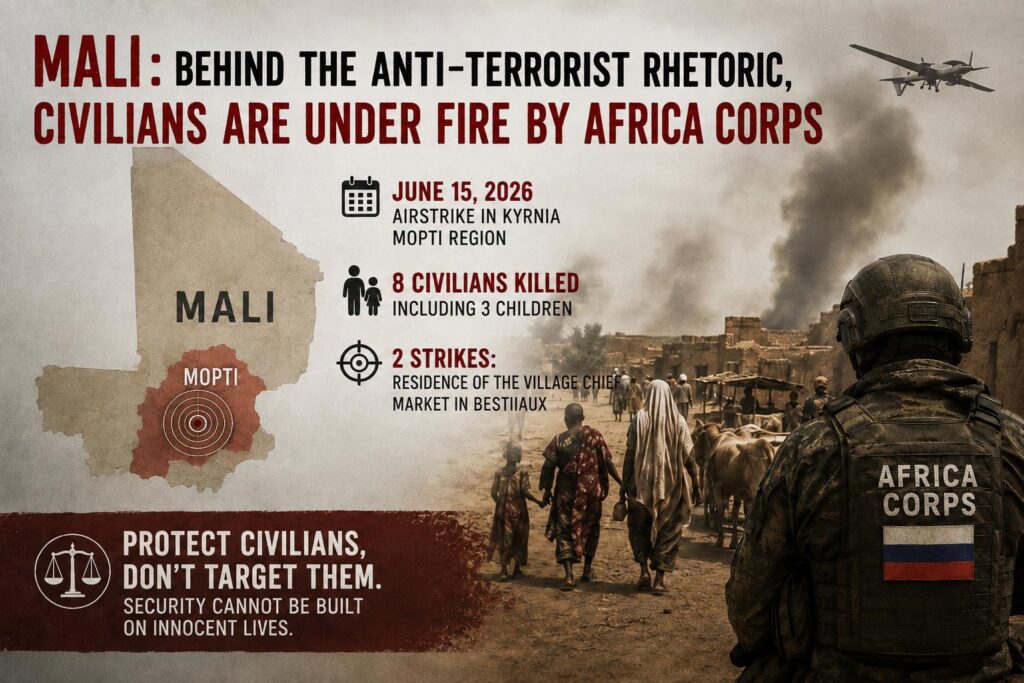
The tragic events of June 15, 2026, in the village of Kyrnia, located in Mali’s Mopti region, have cast a harsh light on the humanitarian consequences of military operations conducted under the banner of counterterrorism. According to findings, an airstrike attributed to Africa Corps Russia’s successor to the Wagner Group resulted in the deaths of eight civilians, including three children. The attack targeted the vicinity of the village chief’s residence and a livestock market, with no evidence suggesting the presence of armed combatants among the victims.
Questioning the legitimacy of military operations
This incident raises critical questions about the proportionality and legality of operations carried out in the name of security. Human Rights Watch (HRW) conducted an independent investigation, interviewing 19 witnesses, analyzing satellite imagery, and examining a video released by Africa Corps along with associated photographs. The evidence suggests that the strike violated international humanitarian law, as it failed to distinguish between civilian and military targets.
The presence of a drone over Kyrnia the day before the attack and reports of JNIM fighters in the area do not, in themselves, justify the indiscriminate targeting of civilian infrastructure. The operation’s stated objective neutralizing terrorist leaders appears inconsistent with the outcome, as no armed group members were among the casualties. This discrepancy underscores the need for greater transparency and accountability in military communications.
Military strategy and its unintended consequences
The Malian junta’s reliance on Africa Corps as part of its counterinsurgency strategy has intensified scrutiny over the effectiveness and ethical implications of such partnerships. While the government of Assimi Goïta has framed this collaboration as essential to regaining sovereignty, the human cost of these operations demands reevaluation. The protection of civilians must remain a non-negotiable priority, regardless of the operational framework.
Rural communities, particularly those belonging to the Fulani ethnic group, have borne the brunt of these operations. Accusations of collaboration with armed groups have led to widespread abuses, further deepening societal divisions. The case of Kyrnia exemplifies the risks of insufficient intelligence and inadequate precautions, where the presence of a few fighters does not justify the targeting of entire villages.
The erosion of trust and the cycle of violence
When civilians become the unintended victims of military operations, the consequences extend beyond immediate loss of life. The resulting fear and resentment can fuel recruitment by armed groups, who exploit local grievances to expand their influence. In Mopti, where insecurity already looms large, these dynamics risk destabilizing communities further.
Moreover, the lack of credible mechanisms for accountability exacerbates the problem. HRW has documented numerous violations by Malian forces, Africa Corps, and armed groups, yet few perpetrators face consequences. This impunity not only undermines justice for victims but also erodes public trust in institutions tasked with ensuring safety.
A call for accountability and strategic reform
The tragedy in Kyrnia serves as a stark reminder that military victories cannot be measured solely by the number of operations conducted. A sustainable security strategy must prioritize the protection of civilians, reliable intelligence, and rigorous adherence to international law. The Malian government must take concrete steps to ensure that all military operations whether conducted independently or in partnership with foreign forces comply with humanitarian standards.
For the families of Kyrnia, the eight lives lost represent more than a statistical failure; they are a human tragedy. The true measure of success in Mali’s fight against terrorism will not be found in the volume of strikes launched but in the ability to restore peace without sacrificing the very communities it aims to protect.