Sabcé under siege: a terrifying dawn attack in Burkina Faso
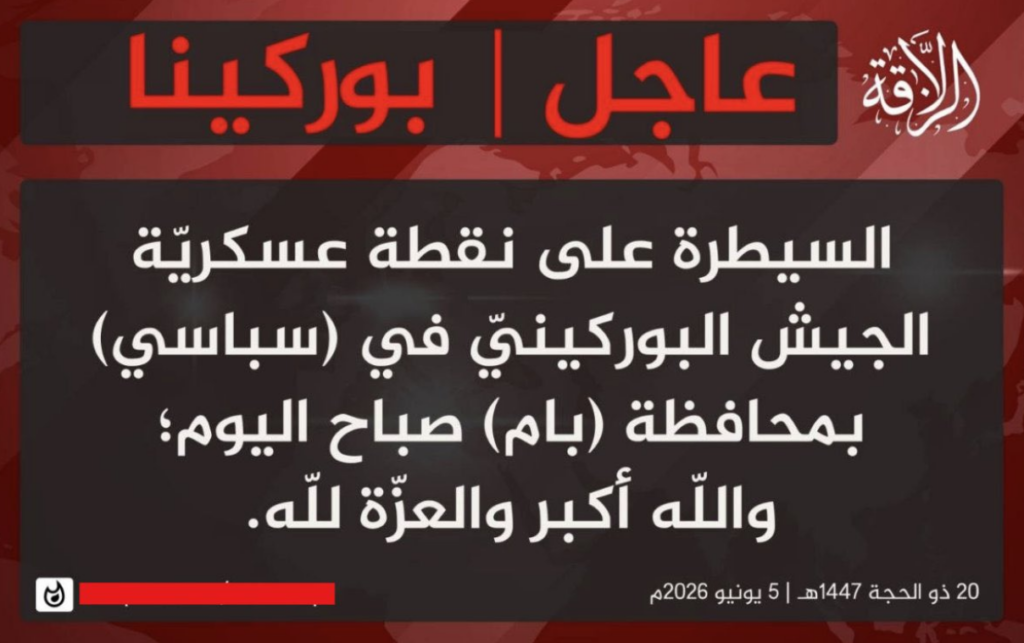
The tranquility of Sabcé, a strategic military outpost in Burkina Faso’s Bam Province, was shattered at first light on Friday, June 5, 2026. Armed militants from the Group for the Support of Islam and Muslims (JNIM) launched a meticulously planned assault, exploiting the cover of dawn to overwhelm the position. Heavily armed fighters, moving swiftly on motorcycles, converged on the base, triggering intense gunfire that sent shockwaves through the local community.
Despite a valiant defense by Burkinabè soldiers and Volunteers for the Defense of the Homeland (VDP), the attackers temporarily seized control of the facility. Witnesses described scenes of chaos as the militants ransacked the site, seized critical logistical supplies, and fled before aerial reinforcements could arrive. While official casualty figures remain pending, the attack underscores the persistent vulnerability of key transport routes connecting the North-Central region to the rest of the country.
Security failures demand urgent rethinking of Burkina Faso’s strategy
The brazen attack on Sabcé is not an isolated incident but a stark reminder of the limitations of Burkina Faso’s current security approach. Despite bolstering troop numbers, upgrading military hardware, and mobilizing civilian defense volunteers, the nation’s security apparatus continues to face relentless threats. Analysts point to systemic gaps: static defense models fail to counter the mobility and adaptability of terrorist groups like JNIM, which repeatedly isolate detachments, sever communication lines, and strike high-value targets.
Local experts emphasize two critical weaknesses: the lack of proactive tactical intelligence and the sluggish response times of ground reinforcements. These deficiencies leave the military perpetually on the back foot, unable to anticipate or neutralize threats before they escalate. The Sabcé assault serves as a grim testament to the urgent need for a paradigm shift in Burkina Faso’s defense strategy.
Bénin’s bold call for regional unity gains urgency after Sabcé assault
In the wake of this latest security crisis, the recent diplomatic overtures by Beninese President Romuald Wadagni have taken on renewed significance. Wadagni, who has made regional cooperation a cornerstone of his administration, recently undertook high-level visits to Niamey and Ouagadougou to advocate for a unified military response to the Sahel’s insurgency.
« Terrorism knows no borders. Our armies can no longer afford to operate in isolation, » Wadagni declared during the unveiling of his regional security initiative. His proposal calls for deepened military collaboration, including real-time intelligence sharing, joint cross-border operations, and mutual pursuit rights among neighboring states. This vision, widely praised for its pragmatism, contrasts sharply with the fragmented responses of the past and offers a glimmer of hope for collective resilience.
Breaking borders to choke terrorism’s lifelines
The JNIM and other armed factions have long exploited porous borders as safe havens and transit corridors. To dismantle these networks, Wadagni’s initiative proposes a coordinated regional framework that transcends national silos. Key measures include:
- Real-time intelligence sharing: Leveraging satellite and communication networks to track militant movements across borders.
- Joint military operations: Conducting synchronized patrols and strikes to deny terrorists sanctuary in shared ecological zones, such as the Parc W region.
- Cross-border pursuit rights: Enabling military forces to pursue attackers into neighboring territories without bureaucratic delays.
The Beninese president’s push for unity comes at a pivotal moment. Burkina Faso’s security apparatus, though resilient, is stretched to its limits. The Sabcé attack is a clarion call: Ouagadougou must act swiftly to revamp its tactics and embrace regional partnerships, starting with Wadagni’s vision. The future of Burkina Faso’s stability hinges not only on its own efforts but on the collective resolve of its neighbors.
Sabcé as a turning point for the Sahel
The assault on Sabcé is more than a tactical setback—it is a strategic wake-up call. It exposes the fragility of isolated security models in a region where militants operate with impunity across borders. For Burkina Faso, the path forward requires reimagining its defense posture and seizing the opportunity for collaboration that Wadagni’s initiative presents.
The hour for decisive action is now. The Sahel’s future will be written not by individual nations but by a united front willing to break down barriers and confront the terror threat together.