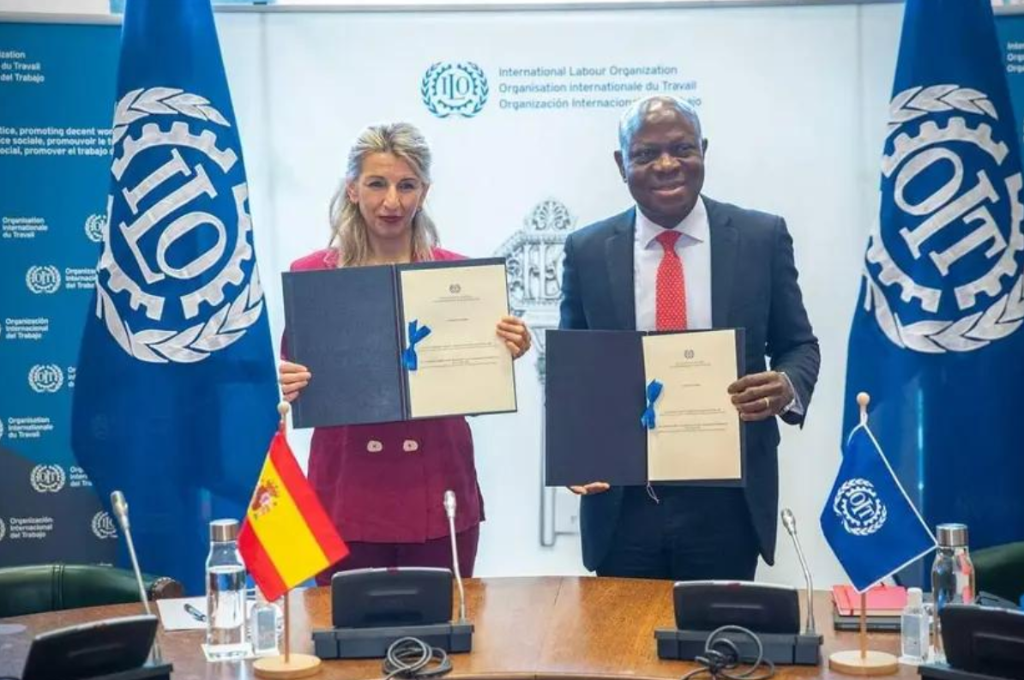
The re-election of Togolese diplomat Gilbert Houngbo as Director-General of the International Labour Organization (ILO) has triggered fresh debates about the agency’s financial stability and governance, following the last-minute withdrawal of Spanish Labour Minister Yolanda Díaz. While Díaz’s decision spared the organization a divisive vote, her exit speech exposed deep-seated concerns about the ILO’s management, budget shortfalls, and strained social dialogue.
Financial instability threatens the ILO’s global mission
The outgoing administration under Houngbo faces sharp criticism for leaving the ILO in a precarious financial state, one Díaz describes as the organization’s most severe crisis in decades. A combination of delayed and unpaid contributions from key member states—particularly the United States—has led to drastic spending cuts and staff reductions. These measures, intended to balance the books, are now under fire for disproportionately impacting the very workforce the ILO was created to protect.
Critics argue that fiscal austerity measures risk undermining the agency’s core mandate: safeguarding workers’ rights and fostering social justice. With annual deficits projected to persist, the new leadership will need to navigate a delicate balance between financial sustainability and operational integrity.
The United States’ unpaid dues: a growing liability for global labor standards
Among the most pressing financial challenges is the overdue financial obligations from major contributors. The United States, a longstanding top funder, has accumulated significant arrears, leaving the ILO with fewer resources to support labor programs worldwide. The shortfall not only threatens day-to-day operations but also sends a worrying signal about the stability of multilateral institutions.
Erosion of social dialogue within the ILO
Beyond financial woes, Díaz highlighted a paradox: an agency dedicated to promoting workers’ rights is grappling with internal mismanagement and fractured communication between management and staff. Union representatives at the ILO have publicly contested restructuring plans, arguing that staff consultation mechanisms have failed to reflect their concerns.
Díaz’s withdrawal underscored a deeper issue—the growing disconnect between the ILO’s leadership and its employees. Her statement emphasized the need for a renewed commitment to inclusive dialogue, warning that the organization’s credibility hinges on how it treats its own workforce.
Strategic missteps and the exit of rival candidates
José Díaz’s decision to step aside followed the withdrawal of Peruvian candidate Javier González-Olaechea, further consolidating Houngbo’s path to a second term. The move came despite resistance from sections of the international labor movement, particularly within the International Trade Union Confederation (ITUC), which had endorsed Houngbo’s re-election.Díaz cited concerns over the ITUC’s alignment with the outgoing leadership, suggesting that the endorsement process lacked broad consensus. By prioritizing unity over division, she chose not to challenge Houngbo’s election, but her critiques left lingering doubts about the legitimacy of the process and the future direction of the ILO.
What lies ahead for the ILO under Houngbo’s renewed leadership?
Houngbo’s second five-year term commences against a backdrop of financial constraints and reputational challenges. Restoring trust among member states, staff, and global partners will require more than budgetary fixes—it demands a restoration of the ILO’s foundational principles.
The new administration faces three immediate priorities: stabilizing finances through renewed contributions, rebuilding internal social dialogue, and reaffirming the organization’s role as a champion of fair labor practices. Whether the ILO can emerge from this turbulent phase without compromising its mission remains an open question—one that will define Houngbo’s legacy.
Can the ILO reconcile reform with its founding ideals?
While Houngbo’s re-election secures continuity, the absence of competition in the vote does not erase the criticisms levied against his leadership. The onus now falls on his administration to prove that fiscal discipline and institutional integrity can coexist. Failure to do so risks eroding global confidence in the ILO’s ability to uphold labor standards at a time when workers worldwide need it most.





