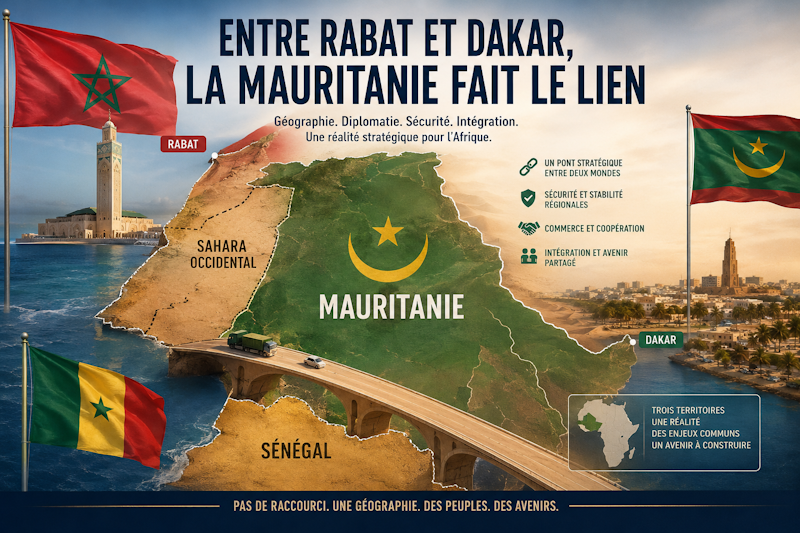

The vast stretch of land between Morocco and Senegal is often oversimplified in geopolitical discussions. Yet, tucked between these two nations lies a crucial link: Mauritania. Journalist Ahmed Ould Bettar emphasizes this overlooked reality, reminding us that geography is not just a matter of maps but of tangible realities.
The Saharawi territory, with its disputed international status, occupies a central place in regional debates. However, the true bridge connecting the Maghreb to West Africa is none other than Mauritania. Ignoring its existence or significance distorts the understanding of this complex geopolitical landscape.
Why Mauritania Matters in Regional Diplomacy
Mauritania is far more than a transit zone or a stretch of desert. It stands as a fully sovereign state, a key diplomatic actor, and a strategic linchpin between two distinct regions. Its role extends beyond mere geography, encompassing security, trade, and regional integration.
The country’s position is not just geographical—it is a product of history, culture, and shared interests. By dismissing or overlooking Mauritania, analysts risk oversimplifying a reality that is both intricate and deeply rooted in the region’s fabric.
Challenges of Geopolitical Simplification
Geopolitical shortcuts may offer quick explanations, but they often fail to capture the nuances of the situation. The relationship between Morocco, Mauritania, and Senegal is shaped by layers of history, economic ties, and security concerns. Each of these nations plays a distinct role in the broader North and West African context.
For instance, Mauritania’s neutrality in disputes, such as that over the Saharawi territory, underscores its ability to maintain balanced relations with all parties. Its diplomatic approach fosters stability and cooperation, making it an indispensable player in the region.
Lessons from Regional Dynamics
This case highlights the dangers of reducing complex geopolitical interactions to mere oversimplifications. The realities on the ground demand a deeper understanding of each country’s role, particularly that of Mauritania.
By acknowledging Mauritania’s central position, analysts and policymakers can better grasp the intricacies of North and West African relations. Geography, history, and sovereignty are not mere abstractions—they are the foundations of a stable and interconnected region.