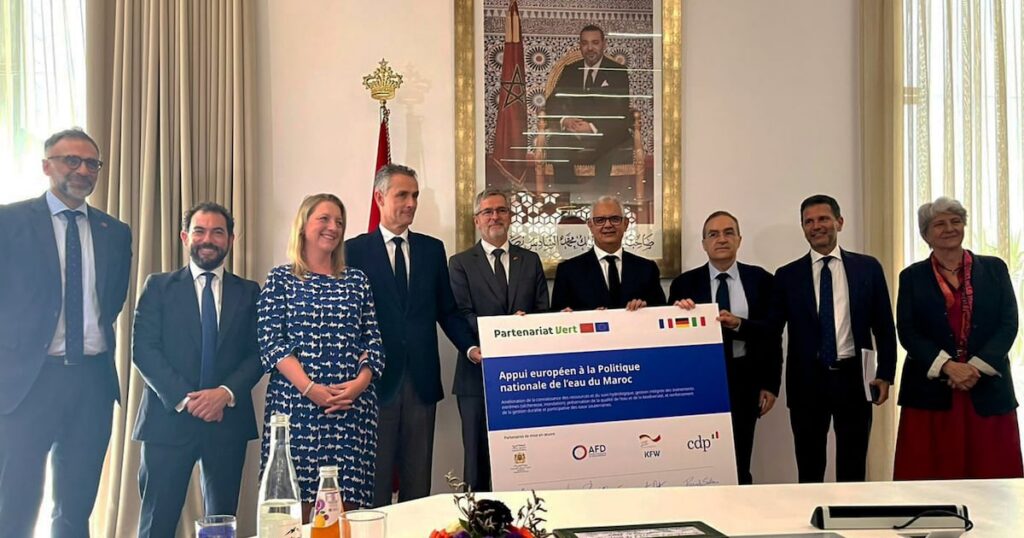
In a significant move to tackle water scarcity and climate challenges, the European Union (EU) and several European development agencies have inked a €348 million funding agreement with Morocco. The deal, worth nearly 3.7 billion Moroccan dirhams, aims to accelerate the country’s national water strategy over the next three years.
The agreement was formalized in Rabat during a ceremony at the Ministry of Equipment and Water, attended by Minister Nizar Baraka and the EU, French, German, and Italian ambassadors to Morocco.
Collaborative funding to address rural and agricultural water needs
This financing builds on the momentum generated by the November 2024 meeting in Rabat between Morocco’s King Mohammed VI and France’s President, which underscored the urgency of water security in the region. Key European agencies contributing to the initiative include the French Development Agency (AFD), Germany’s KfW development bank, and Italy’s Cassa Depositi e Prestiti (CDP). The AFD, leading the project, has played a pivotal role in advancing the program’s objectives, with France contributing a total of €1 billion to water-related initiatives in Morocco to date.
Prioritizing water resilience amid climate change
EU Ambassador to Morocco, Dimiter Tzantchev, emphasized the bloc’s commitment to water security, particularly in the face of climate change. The funding will prioritize rural communities, ensuring both drinking water access and agricultural irrigation. “Water is at the heart of our priorities, especially as climate shifts intensify the pressure on resources,” Tzantchev noted.
Morocco’s water strategy gains momentum
Minister Baraka outlined the country’s ambitious water strategy, which currently relies on 26 operational dams to irrigate approximately 1.5 million hectares. Looking ahead, Morocco aims to source 60% of its potable water from desalination plants in the near term. “A nation that does not control its water supply cannot shape its future,” Baraka asserted during the signing event.
The minister also highlighted the ministry’s commitment to implementing the program with efficient governance and measurable outcomes, expressing gratitude to the ambassadors for their support.
Strengthening strategic partnerships
Germany’s ambassador to Morocco underscored the strength of Moroccan-German cooperation in this critical sector. Through KfW, Germany has been actively involved in water infrastructure projects, a testament to the strategic importance of the partnership. The German diplomat, nearing the end of his tenure in Morocco, reflected on the progress achieved in this vital domain.
With this new funding, Morocco is poised to enhance its response to water stress while accelerating the execution of its national water strategy. From desalination and dam construction to rural water supply, the initiative addresses far more than infrastructure—it safeguards the nation’s hydrological, agricultural, and social stability.