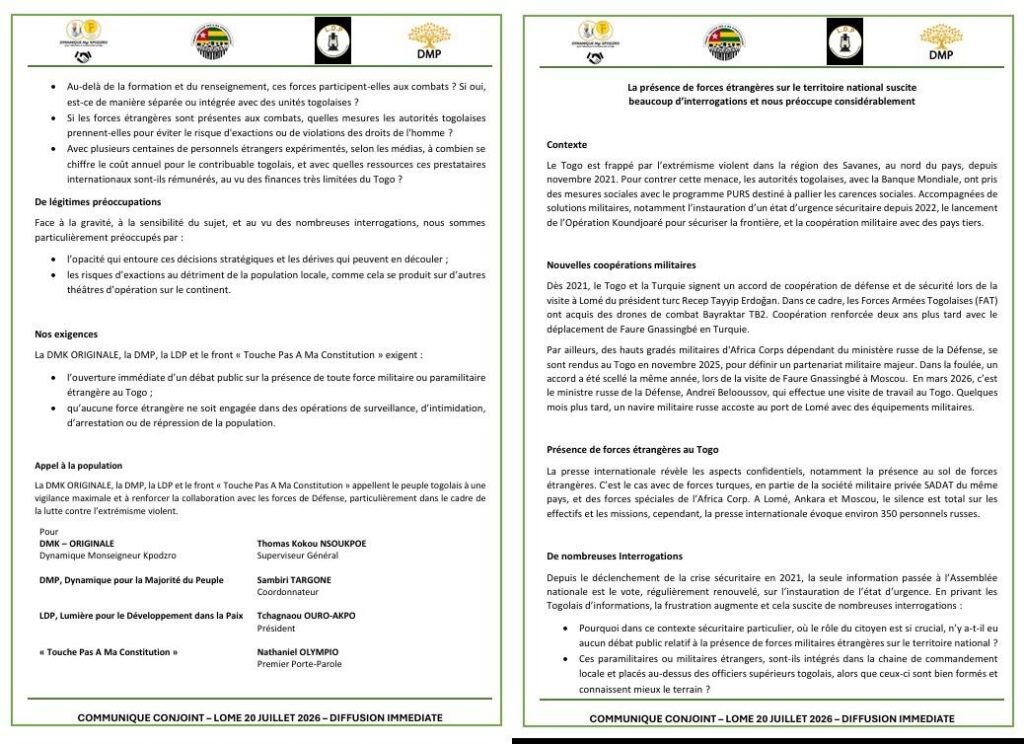
The presence of foreign military personnel in Togo has sparked a wave of questions, particularly regarding the motivations and legal framework governing their deployment. While defense matters often require confidentiality, persistent opacity risks undermining public trust rather than reinforcing it.
Unanswered questions about foreign military personnel
Reports indicate that military personnel from Russia and Turkey may be stationed in Togo, a claim that has yet to be officially confirmed or denied. This ambiguity has fueled speculation about the true intentions behind their presence. Critics argue that such partnerships could serve as a safeguard for the current regime, particularly as criticisms of governance grow louder amid socio-economic strains and institutional constraints.
Motives under scrutiny: security or regime survival?
The deployment of foreign military personnel is not inherently problematic, as many nations rely on international partnerships to bolster their defense capabilities. However, in Togo, the lack of transparency has led to suspicions that these forces are not merely supporting national security but could also be shielding the government from potential internal or popular upheaval. The absence of clear explanations has done little to dispel such concerns.
Operational and legal ambiguities persist
Fundamental questions remain unanswered. What are the exact roles of these foreign personnel? Are they involved in training, intelligence gathering, strategic advisory roles, or the maintenance of military equipment? Alternatively, could they be participating in security operations, including the protection of state officials? Without detailed official statements, these uncertainties persist, complicating the assessment of their true function.
The legal framework governing their activities is another critical issue. Typically, such partnerships are accompanied by agreements that define rights, responsibilities, and oversight mechanisms. What provisions have been established in Togo to regulate the conduct of these foreign personnel? Are there safeguards in place to prevent abuses and ensure compliance with national and international laws?
The financial burden of secrecy
Financial transparency is equally pressing. How many foreign military personnel are currently deployed in Togo? What is the duration of their missions, and what are the associated costs? Are these expenses covered by the Togolese state, the partner countries, or through specific cooperation agreements? Taxpayers, who ultimately fund these initiatives, have a right to clarity on these matters.
It is worth noting that Togo faces genuine security challenges, particularly the threat of terrorism in the northern regions. International military cooperation could be justified in this context. However, the lack of public information has overshadowed these potential benefits, leaving room for misinterpretation and doubt.
Transparency as a cornerstone of public trust
For any government, transparency is not a luxury but a necessity. Clear communication about the objectives, legal frameworks, and responsibilities of foreign military personnel can help dispel rumors and foster public confidence. In a region plagued by political instability and shifting security alliances, such clarity is indispensable.
The government must address these concerns by providing verifiable information without compromising national security. A democracy cannot sustain itself on silence alone; it thrives on accountability and openness. The unresolved questions surrounding foreign military personnel in Togo demand answers—not just for the sake of transparency, but for the preservation of democratic principles.