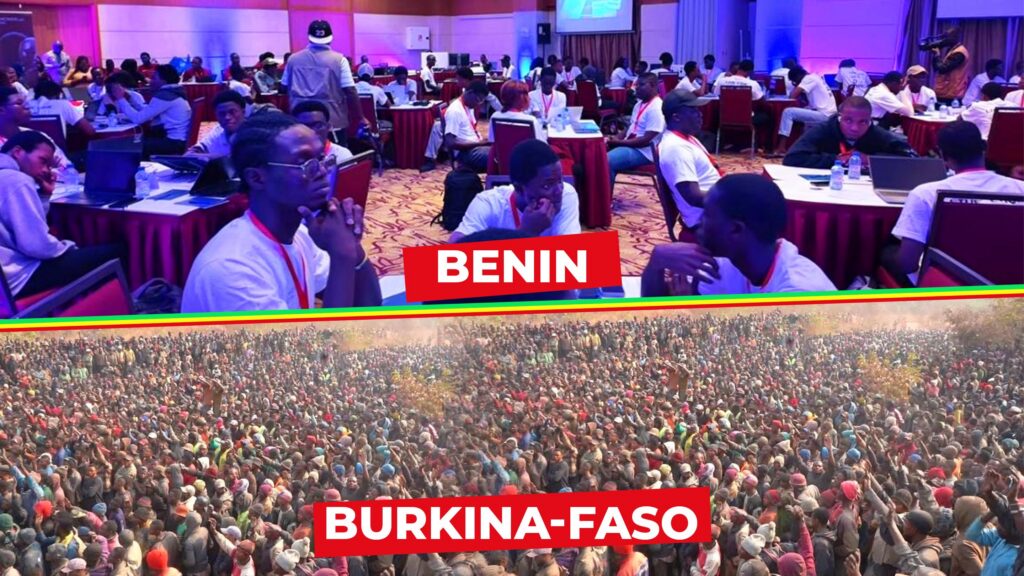
Two nations, two divergent approaches to nation-building
In West Africa, two neighboring countries are pursuing radically different strategies to secure their futures one through targeted investment in digital talent, the other through prolonged political turbulence. The divergent paths of Benin and Burkina Faso reveal a fundamental question facing the region: What does it take to build a sustainable future for citizens and economies?
The contrast could not be more stark. While Benin’s youth are being groomed for a digital economy through rigorous competitions and structured training programs, Burkina Faso’s displaced miners face an uncertain future as political controversies dominate national discourse. These contrasting realities highlight the real-world consequences of policy priorities and the urgent need for tangible action over rhetoric.
From competition to capacity: how Benin is shaping tomorrow’s workforce
The Cyber Africa Forum (CAF), held on November 16–17, serves as more than just a showcase for tech talent it is a deliberate investment in the country’s future workforce. Over two intensive days, young competitors demonstrated not only technical skills but adaptability, problem-solving, and the ability to innovate under pressure. Yet the true value of the event lies in what preceded it: a meticulously designed selection process that began months earlier.
The journey to the finals started with a two-month nationwide talent hunt. Participants were organized into teams and given daily challenges designed to push creative and technical boundaries. After a month of rigorous assessments, only the top 20 teams qualified to compete in the final event. This layered approach does more than identify winners it fosters collaboration, sharpens skills, and cultivates an ecosystem where digital competencies can thrive.
In an era where national competitiveness hinges on technological prowess, such initiatives are not mere spectacles they are strategic investments. The competencies nurtured today in Benin’s tech hubs, universities, and innovation labs will define the country’s economic resilience tomorrow. From software development to AI integration, these are not abstract advantages but essential foundations for a digital economy.
The human cost of political instability in Burkina Faso
While Benin builds for the future, Burkina Faso grapples with an immediate crisis: the forced repatriation of thousands of gold miners from neighboring Guinea. These workers, once a vital part of the informal economy, now face unemployment, loss of livelihood, and the collapse of entire family support systems. The social and economic toll is profound and immediate millions of dollars in lost income, disrupted communities, and a population left without clear pathways to recovery.
In the face of such challenges, political posturing and media narratives offer little solace. Citizens aren’t concerned with arrest warrants or ideological battles they need jobs, safety, and the chance to rebuild. Yet without a structured response, the void left by lost employment risks deepening social fractures and fueling further instability.
How many families are affected? What measures are in place to support their return and reintegration? Are there vocational training or economic reconversion programs for displaced workers? These are not rhetorical questions they demand concrete, transparent solutions from public leaders. Governance cannot be reduced to media appearances or political rallies. It must deliver measurable outcomes: jobs created, skills developed, and livelihoods restored.
The leadership imperative: turning vision into reality
It would be misleading to suggest that Benin has solved all its challenges or that Burkina Faso’s difficulties stem solely from poor leadership. Security threats, regional tensions, and historical legacies complicate both nations’ journeys. Yet the comparison remains valid and urgent. The choices made today will determine whether these countries rise with resilience or fall under the weight of unmet needs.
Benin’s model rooted in education, competition, and innovation offers a blueprint for investing in human capital. It signals a commitment to preparing the next generation not just for existing jobs, but for careers that do not yet exist. Burkina Faso’s crisis, by contrast, underscores a painful truth: no amount of political grandstanding can replace economic opportunity. When citizens lose their means to support themselves, stability erodes and so does public trust.
The Africa of tomorrow will not be shaped by soundbites or social media trends. It will be forged in classrooms, coding labs, vocational centers, and government offices where leaders prioritize action over spectacle. The question is not whether these nations can afford to invest in their people it is whether they can afford not to.
Toward a model of responsible development
Benin and Burkina Faso do not need to adopt identical policies, but they do need to align their priorities with the lived realities of their citizens. One nation’s youth are being prepared for the digital frontier; the other’s workforce is being displaced with no safety net. One is building capacity through merit and innovation; the other risks eroding its foundations through neglect and distraction.
The lesson is clear: Sustainable progress requires more than ambition it demands discipline. It means choosing training over theatrics, results over rhetoric, and people over politics. The future of West Africa will be written not in headlines, but in the hands of its youth and the policies that empower them.
By Rose Njoya — Journalist





