The credibility of a public broadcaster is built on its commitment to impartiality, factual reporting, and the fundamental right of citizens to access balanced information. Yet when a state-funded institution appears to prioritize political allegiance over journalistic integrity, the consequences extend far beyond its own reputation undermining public trust in media institutions across the region.
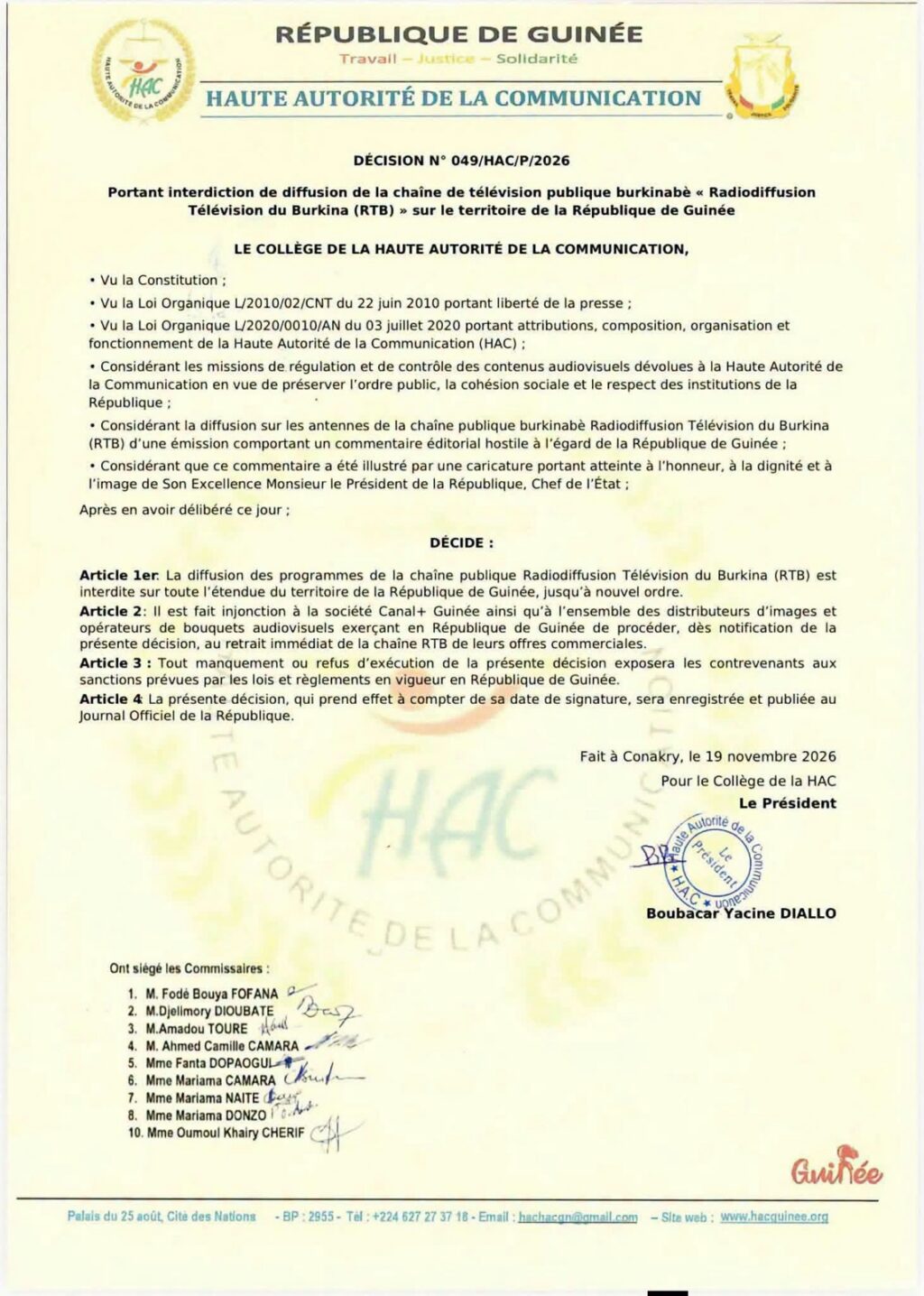
Guinea’s decision to prohibit the Burkina Faso state broadcaster, Radiodiffusion Télévision du Burkina (RTB), from airing content nationwide marks a critical juncture. The move by the High Authority of Communication (HAC) reflects growing concerns over how state media can be weaponized to serve political narratives rather than public interest.
Publicly funded media under scrutiny: when information becomes a political tool
Under the leadership of Burkina Faso’s transitional authorities, the RTB was expected to uphold the highest standards of public service broadcasting: delivering accurate news, fostering diverse perspectives, and ensuring citizens could form opinions based on verified facts. Instead, the channel’s programming has increasingly blurred the line between journalism and government propaganda, with systematic attacks on dissenting voices and a clear bias toward the ruling power’s agenda.
This erosion of editorial independence raises a fundamental question: if a broadcaster fails to separate reporting from political advocacy, what remains of its role as a guardian of democracy and a pillar of the public sphere?
An administrative ban with far-reaching implications
The Guinean HAC’s decision to suspend RTB transmissions is not merely a bilateral dispute between two nations. It signals a broader crisis in how state media across West Africa are being instrumentalized often under the guise of national sovereignty to silence opposition, distort narratives, and consolidate power.
For media organizations to serve their purpose, they must adhere to ethical standards that prioritize the public good over partisan interests. When this balance is lost, the repercussions are felt by citizens, who are deprived of reliable sources of information, and by the broader media landscape, which risks being perceived as an extension of state authority rather than an independent watchdog.
Beyond borders: the domino effect of politically captured media
The conflation of state broadcasting with political messaging is not unique to Burkina Faso. Across the Sahel, similar patterns have emerged, where public funds are used to fund outlets that function less as informational resources and more as megaphones for government positions. Such practices erode the very foundation of democratic societies, where freedom of expression and access to diverse viewpoints are essential.
For Guinea, the decision to block RTB reflects a growing intolerance for media perceived as tools of manipulation. Yet it also underscores a pressing challenge for African nations: how to restore faith in public broadcasting when its institutions are repeatedly repurposed for political agendas rather than public service.
What citizens lose when state media becomes propaganda
Access to neutral information: When state outlets prioritize political narratives, citizens are denied the opportunity to critically assess events based on multiple perspectives.
Erosion of trust in institutions: The credibility of public broadcasting is permanently damaged when it is seen as an arm of the state rather than an independent entity.
Threat to regional stability: The weaponization of state media can escalate tensions between nations, as each side accuses the other of biased coverage.
Restoring balance: the way forward for public broadcasting
To reclaim their role as trusted sources of information, public broadcasters must recommit to editorial independence, transparency, and accountability. This includes:
Separating newsrooms from direct government influence.
Ensuring diverse voices and viewpoints are represented in programming.
Upholding rigorous fact-checking and verification standards.
The ban on RTB in Guinea is a stark reminder that the integrity of state media cannot be taken for granted. As African nations grapple with political transitions and security challenges, the need for reliable, unbiased public broadcasting has never been more urgent.
By Rose Njoya — Journalist





