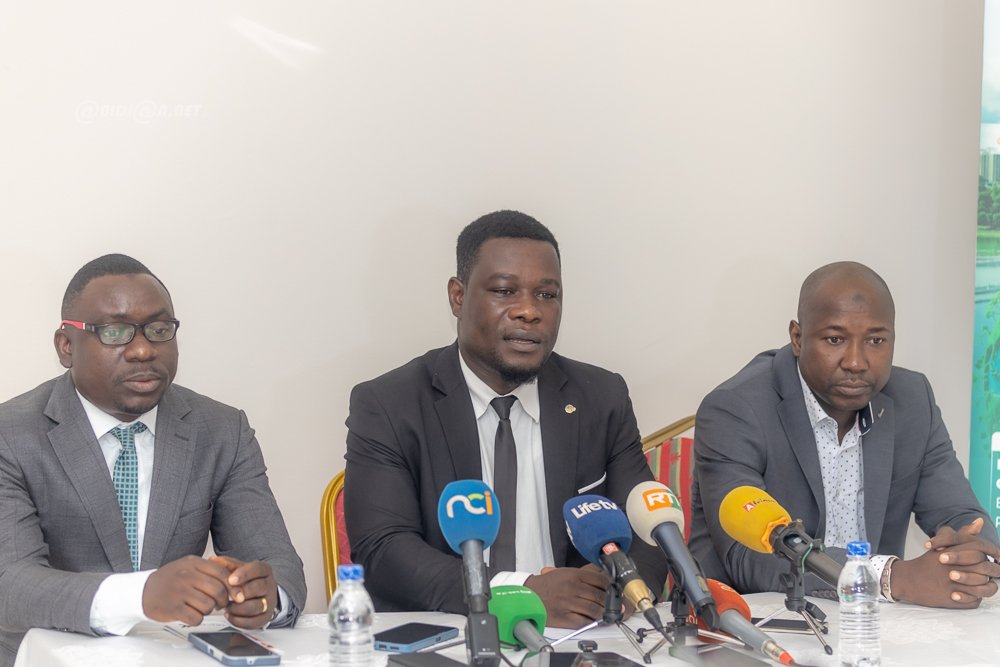
Green financing, carbon credits, innovation, and business opportunities will take center stage at the 2026 International Forum on Sustainable Development (FIDD). The announcement came during the event’s launch press conference, held on Tuesday, September 8, 2026, in Cocody, and led by Tra Bi Michael, the Forum’s General Commissioner.
Scheduled for October 13 and 14, 2026, at the CGECI headquarters in Plateau, the FIDD is expected to attract over 3,000 participants, around twenty experts, and representatives from several countries. The central theme is “Sustainable Development, Innovation, and Competitiveness: Transforming Economic Models for Responsible Growth.”
This gathering aims to position sustainable development as a driver of competitiveness and value creation. Organizers particularly want to boost the mobilization of green funds, enhance access to climate finance, and foster the growth of the carbon market, all while facilitating connections between investors and local economic players.
During the press conference, Tra Bi Michael outlined the Forum’s main directions, describing it as a platform for dialogue and networking among public authorities, businesses, investors, experts, civil society organizations, and project developers.
Discussions will focus on several high-potential sectors, including the green and circular economy, green finance and corporate social responsibility (CSR), carbon footprint and the carbon market, human capital and green skills, innovation, digitalization and artificial intelligence, as well as sustainable agribusiness.
The program features panels, workshops, masterclasses, exhibitions, an innovation challenge, B2B meetings, and a job dating session designed to connect young talent with companies operating in the ecological transition fields.
The stated ambition is also to create a favorable environment for business development. The B2B meetings are expected to allow companies and innovative entrepreneurs to engage with investors and explore new financing and partnership opportunities.
Speakers also emphasized the need to evolve economic models without pitting development against environmental protection. The Director of Green Economy and CSR at the Ministry of Environment and Ecological Transition pointed out that the challenge is not to halt economic activities but to transform how they are conducted.
The issue of illegal gold panning was notably raised, with estimated economic losses reaching 46 billion FCFA per year, alongside significant environmental and social consequences.
Training and employment are also key pillars of the Forum. Organizers believe the ecological transition holds potential for creating new professions and opportunities for Africa’s youth.
With participants expected from Mali, Guinea, Senegal, Burkina Faso, Mauritania, and the Central African Republic, FIDD 2026 aims to strengthen regional exchanges on sustainable investments and business models.
In summary, the organizers aim to make sustainable development a true lever for financing, innovation, job creation, and growth for African economies.