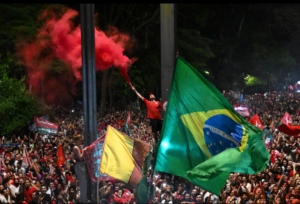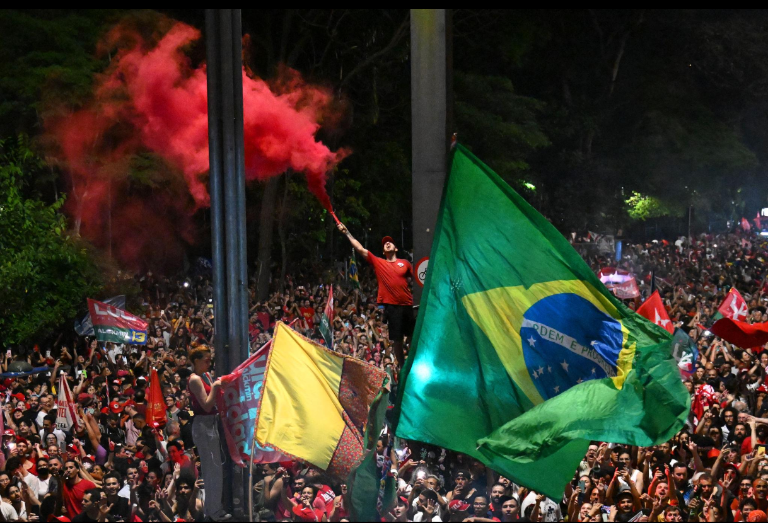
Brazil finds itself at a critical crossroads after Luiz Inácio Lula da Silva secured a fourth term as president, winning 51.79 percent of the vote—just over four million votes ahead of his opponent Flávio Bolsonaro. The announcement of Lula’s victory has been met with fierce legal resistance, with the right-wing senator immediately filing a challenge to overturn the election results, citing alleged irregularities in the voting process.
BRASÍLIA — The political climate in Brazil remains tense following one of the most closely watched presidential elections in decades. While Lula’s historic re-election marks a significant milestone, his mandate has been immediately undermined by Bolsonaro’s refusal to concede, escalating what is now both a legal and democratic crisis.
Lula’s victory overshadowed by electoral dispute
Official results from Brazil’s Superior Electoral Court (TSE) confirmed Lula’s win, with 64,256,232 votes (51.79 percent) to Bolsonaro’s 59,826,041 votes (48.21 percent). The margin, though decisive, has done little to quell the controversy sparked by Bolsonaro’s insistence on contesting the outcome.
Bolsonaro’s campaign has seized upon a last-minute decision by Supreme Court Justice Cristiano Zanin to extend voting hours in certain polling stations from the original 5 p.m. to 7 p.m. local time on election day. The move, intended to accommodate voters facing logistical challenges in Bahia and São Paulo due to transportation issues, was authorized after several polling places had already closed.
Speaking to reporters, Bolsonaro labeled the election as fundamentally flawed. “The circumstances of this vote make it impossible to accept the result,” he declared, vowing to pursue legal avenues to challenge the legitimacy of the election. His team has argued that the late rule change violated electoral fairness and disrupted the integrity of the process.
Contradictions cloud the legal challenge
Yet the complaint is fraught with contradictions. Notably, Bolsonaro’s own campaign had previously requested extended voting hours in southern regions due to severe weather conditions, raising questions about the consistency of the argument. Legal experts suggest that while procedural concerns may exist, there is no concrete evidence of systemic fraud.
Bolsonaro’s broader contention—that the Supreme Court and electoral authorities altered the rules mid-vote—has intensified concerns about institutional trust. As the son of former President Jair Bolsonaro, who is currently serving a 27-year prison sentence for his role in a failed coup attempt, Flávio Bolsonaro’s stance further polarizes an already divided electorate. His refusal to accept defeat underscores deeper anxieties about Brazil’s democratic resilience.
The urgent task: governing a fractured nation
Lula now faces the daunting challenge of uniting a country where nearly half of voters rejected his leadership. His victory, the result of a late surge fueled by appeals to social welfare and anti-poverty policies, comes at a time when Brazil’s political divisions run deeper than ever.
The election’s outcome has exposed stark ideological divides: Lula’s legacy of social programs and inequality reduction versus the bolsonarista movement’s emphasis on tradition, security, and conservative values. The incoming administration must navigate a Congress dominated by conservative forces, which threatens to constrain progressive reforms and further entrench political gridlock.
In his first remarks following the vote, Lula struck a conciliatory tone, acknowledging the country’s deep divisions while reaffirming his commitment to governance for all Brazilians—even those who did not support him. “The majority has spoken, but democracy demands respect for the minority,” he stated.
What’s next for Brazil’s democracy?
The legal battle initiated by Bolsonaro’s team could drag on for weeks or months, testing the limits of Brazil’s electoral institutions. While the TSE has officially declared Lula the winner, the pending challenge raises unsettling questions: Can the country trust its electoral system? Will institutional credibility be irreparably damaged?
For now, Lula’s presidency is assured by the rules of the game, but the shadow of contestation looms large. Whether this legal challenge becomes a footnote in Brazil’s political history or exacerbates existing tensions will depend on how both camps—and the country’s judiciary—respond in the coming weeks. One thing is clear: Brazil’s democratic experiment faces a moment of reckoning.